Tasnim reports mine strike on tanker in the Strait of Hormuz
A Tasnim wire reported on 26 July 2026 that an oil tanker struck a naval mine and exploded in the Strait of Hormuz after deviating from an Iran-designated shipping route; the Western wire that picked up the line attributed the claim to IRGC-linked media.
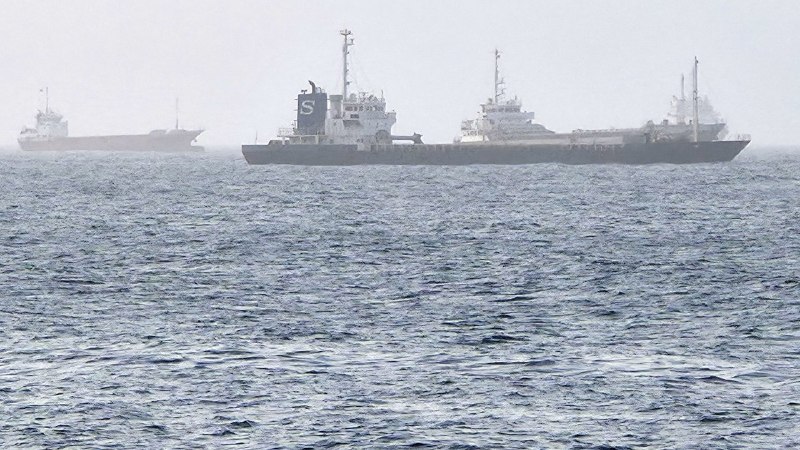
A Tasnim news agency wire circulated across Telegram channels on 26 July 2026 reporting that an oil tanker struck a naval mine and exploded in the Strait of Hormuz after deviating from an Iran-designated shipping route. War Frontier Witness posted the Tasnim line at 12:15 UTC; Middle East Spectator relayed it at 12:29 UTC. War Frontier Witness posted again at 12:41 UTC, this time carrying the Tasnim wire alongside a Mehr item in which Tehran said it had repeatedly warned that vessels straying from the corridor faced the risk. Fotros Resistance ran the line at 12:52 UTC with the added characterisation that the tanker had taken an "illegal route outside of Iran's designated shipping route." The Cradle and a second The Cradle post republished the framing at 12:50 UTC. Two Majors carried it at 12:56 UTC. The Jerusalem Post's Telegram channel posted at 12:57 UTC, the first Western-aggregator appearance in the cited posts, noting that there was no immediate official statement from Iranian authorities.
What is in circulation at this hour is therefore a single originating wire, attributed by the relaying channels to Tasnim, with additional Mehr material appended by one channel, and an unsourced characterisation of the tanker's route as "illegal" added by an Iran-aligned channel. The Western-aggregator item that picked the line up characterised the underlying claim as originating with "IRGC-linked media," per The Jerusalem Post's own framing as captured in its Telegram post. The cited posts do not name the vessel, its flag, its tonnage, its owner, or its cargo, and the available source items do not specify whether the tanker sank, was disabled, or continued under power.
The sourcing chain
The information path matters because the framing travels with it. Tasnim is identified as the originating wire by Middle East Spectator, War Frontier Witness, and Fotros Resistance. Mehr, the Iranian news agency, is cited only in the 12:41 UTC War Frontier Witness post alongside Tasnim. Fotros Resistance, an Iran-aligned channel, is the source of the "illegal route" language; that characterisation does not appear in the Tasnim wire as relayed by the other channels. The Cradle, a Beirut-based outlet, carried the same Tasnim-derived line and added the context that Iranian authorities had "repeatedly warned" vessels deviating from the corridor. Two Majors, a Russian milblogger channel, reposted the line. The Jerusalem Post Telegram post brought the story to a Western audience, attributing it to "Iranian media" in its headline and noting the absence of an official Iranian statement.
The framing travels with the source. Tasnim is a news agency close to the Islamic Revolutionary Guard Corps, not a state broadcaster in the conventional sense, and The Jerusalem Post's characterisation of the claim as "IRGC-linked media" is consistent with how independent Western reporting has previously described Tasnim sourcing on security incidents. Monexus assessment: when the originating wire is Tasnim and the only Western pickup labels it "IRGC-linked media," readers should treat the framing as a Tehran-aligned security claim rather than as a neutral incident report, and weight any official Iranian statement, when it comes, against this baseline.
What the framing is doing
Monexus analysis: the language circulating in the cited posts does political work that goes beyond reporting a casualty. Tasnim's framing names the route as "Iran-designated" and treats deviation as the cause of the incident; Fotros Resistance escalates that into "illegal route"; The Cradle layers in the "repeatedly warned" context, which positions Tehran as having discharged a notice obligation before the strike. Read together, the framing positions Iran as the legitimate traffic manager of the strait and the vessel as having exposed itself to risk by ignoring that management.
The available reporting does not support, and the desk does not assert, that the mines in question are Iranian-laid. The framing circulating treats the existence of the corridor and the danger of mines outside it as a fact requiring only warning, not as a question of responsibility for having mined the water. That framing is the one Iran-aligned channels want readers to absorb; it is also the framing that international maritime law, in Monexus's reading, would not accept without independent evidence of who laid the mines and under what authority.
What to watch next
Three signals will clarify whether this becomes a contained incident or the opening of a new Gulf security cycle, and the cited posts do not yet contain any of them. First, identification of the vessel, including its flag, owner, insurer, and cargo. Without that, the desk cannot say whether this is a routine commercial tanker or a vessel caught in a sanctions-or-seizure dispute. Second, an official Iranian statement on the incident. The Jerusalem Post post notes the absence of one as of 12:57 UTC; whether Tehran's foreign ministry, the IRGC, or the port authority issues an on-record line will determine whether the framing in circulation hardens or shifts. Third, the war-risk insurance market. A confirmed mine hit in a commercial transit corridor would, in Monexus's expectation, raise war-risk premia across the basin and push some operators to route around Hormuz, but the desk is not asserting that this has happened yet, because the cited posts do not specify any advisory.
For now, the cited posts contain a single originating wire attributed to Tasnim, a Mehr line attached by one channel, and an IRGC-linked characterisation in the first Western pickup. The available source items do not specify the tanker's identity, its flag, or the extent of the damage. The dominant framing is Iran-aligned; the alternative framing, that a mined international waterway is a violation of safe-passage obligations regardless of which lane a vessel used, has not been voiced in the reporting under review. Until those gaps are filled, the incident reads as a probe, with both sides able to claim it confirms their priors.
Desk note: Monexus framed this story around the sourcing chain (Tasnim wire, Mehr add-on, Fotros Resistance characterisation, Western pickup as IRGC-linked) rather than around the incident's underlying facts, because the cited posts underdetermine the underlying facts. Wire coverage so far has carried the Iran-aligned framing; this article reads the same sources and flags which voice is, and is not, in the room.
Wire provenance
This editorial synthesis draws on the following public wire/social posts:
- https://t.me/The_Jerusalem_Post/16785
- https://t.me/two_majors/80138
- https://t.me/FotrosResistancee/23334
- https://t.me/TheCradleMedia/65034
- https://t.me/wfwitness/104974
- https://t.me/Middle_East_Spectator/35479
- https://t.me/wfwitness/104971