China's Kimi K3 resets the AI cost curve, and crypto feels it
Moonshot AI's 2.8-trillion-parameter Kimi K3 has overtaken frontier US models on key benchmarks at Sonnet pricing. Bitcoin and chip stocks fell on the news. The story is bigger than a leaderboard shuffle.
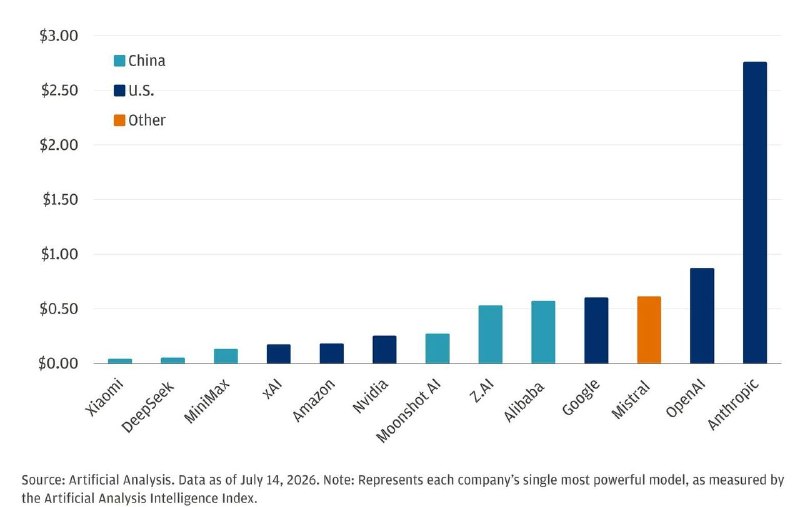
Moonshot AI, a Beijing-based artificial-intelligence lab, released Kimi K3 on 17 July 2026 and within hours the model had knocked Anthropic's Claude and OpenAI's GPT 5.6 Sol off the top of a pair of widely watched leaderboards. Decrypt reported the same day that Kimi K3, a 2.8-trillion-parameter mixture-of-experts model, took first place on Arena AI's frontend coding leaderboard, displacing Claude Sonnet, and topped the Fable 5 creative-writing benchmark at the same list price as Claude Sonnet. The release is free at the API tier Moonshot markets to developers. Within the session, semiconductor stocks sold off and Bitcoin dropped with them, a reminder that the AI cycle and the crypto cycle now trade on the same macro tape.
The release matters less for any single benchmark than for what it does to the price-performance frontier. A Chinese lab has matched or beaten the best Western frontier models on two tasks that companies actually pay for, and has done so at price points that compress the margin of every US competitor that priced on scarcity. The implications run through cloud compute, through the semiconductor supply chain, and through the risk-asset complex that has treated US AI dominance as a one-way trade.
What Moonshot actually shipped
Kimi K3 is Moonshot's third-generation flagship. The two benchmarks Decrypt highlighted are the ones developers and enterprise buyers cite most often. Arena AI's frontend coding leaderboard ranks models on real, human-graded web-frontend tasks; Kimi K3 took the top spot from Claude, according to Decrypt's 17 July 2026 write-up. Fable 5 measures long-form creative writing; Kimi K3 leads there as well. Pricing is set at the Claude Sonnet tier, which means Moonshot is choosing to compete on margin, not on sticker discount. A free API tier widens the funnel for smaller developers and for any team that wants to A/B test without a contract.
The structural question is whether the 2.8-trillion-parameter scale is real or is, as some Western analysts suggested after earlier Moonshot releases, an inflated marketing figure. Moonshot has not, to this publication's knowledge, published a full parameter breakdown or an independent evaluation harness. The benchmark wins are reproducible on Arena's public site, which is the part that matters to buyers; the parameter count is the part that matters to investors trying to gauge the underlying capex bill.
The chip angle the market read first
Crypto's reaction was the headline. CoinDesk reported on 17 July 2026 that Bitcoin faced fresh headwinds as the Kimi release rippled through semiconductor names. The mechanism is not mysterious. A Chinese model matching US frontier performance at frontier-tier pricing implies that the compute demand curve flattens: more capability per dollar means customers do not need to buy as many accelerators to get a given output. Nvidia and the broader semiconductor complex, the equity proxy for AI capex, sold off. Bitcoin, which has correlated with Nasdaq-style risk-on flows through 2025 and 2026, sold off with them.
There is a counter-narrative worth taking seriously. Cheaper inference is bullish for AI-native applications, including the on-chain agent and inference-token projects that have raised capital through 2026. If Kimi K3's pricing holds and the API stays reliable, the marginal cost of running an AI agent that posts to a blockchain, settles a prediction market, or routes a trade drops. The flow-through to crypto would be positive over a quarter or two. The market, on 17 July, traded the capex angle first and the application angle second, which is the usual order.
The Chinese position, stated fairly
Western coverage of Chinese AI advances tends to slide into one of two registers: alarm that a national-security threat has crossed a capability threshold, or dismissal that the benchmark wins are gamed. Both miss the substance. Moonshot is a private company, founded in Beijing in 2023, with a track record of releasing capable open-weights models. Its argument, voiced in domestic tech press and on Weibo by founder Yang Zhilin and other executives, is straightforward: scale, engineering discipline, and a deep domestic talent pool let a Chinese lab hit the frontier on tasks that matter, and Western buyers who treat Chinese AI as a category to avoid are leaving performance and price on the table. The argument is structural, not rhetorical; it is also consistent with what the benchmarks show.
The reciprocal mistake is to read every Chinese win as a sign that US export controls have failed. The US Commerce Department's October 2022 chip rules and the October 2023 update tightened access to leading-edge accelerators for Chinese labs. Moonshot's response has been to invest heavily in efficiency: a mixture-of-experts architecture that activates only part of the 2.8 trillion parameters per query, and aggressive work on inference-time compute. The result is a model that competes at the frontier on less cutting-edge silicon. That is a real engineering story, not just a benchmark story, and it is the part that should worry Nvidia's pricing power more than any single leaderboard result.
What to watch next
Three dates are worth marking. First, the next Arena AI leaderboard refresh, typically every two weeks, will show whether Kimi K3 holds the top spot or whether Anthropic or OpenAI ship a counter-release. Second, Moonshot's enterprise pricing page is the leading indicator for whether the Sonnet-equivalent list price holds or erodes; price cuts inside the first quarter would be the strongest signal that Moonshot is going for share. Third, US chip policy is due for a review cycle through late 2026; if the Kimi release is read in Washington as evidence that the compute gap has narrowed, expect tighter, not looser, rules on Chinese access to HBM and leading-edge fab capacity.
The honest uncertainty is around reliability. Benchmark wins on Arena AI and Fable do not yet tell a buyer whether the model will hold up under sustained production load, what its latency tail looks like, or how it handles adversarial prompts in safety-critical settings. Moonshot's free API tier invites the kind of stress-testing that enterprise procurement teams will want to see before committing. Until that data is public, the smart position is to treat Kimi K3 as a credible frontier option that has not yet been operationally validated at scale, and to watch the equity tape around it as the cleanest read on whether the market believes the gap has actually closed.