Kimi K3 Just Topped the AI Leaderboards at Cut-Price. Crypto Sold Off First
Moonshot AI's 2.8-trillion-parameter model displaced Claude from the top of the frontend coding leaderboard on 17 July 2026. Semiconductor stocks fell on the news, and bitcoin went with them.
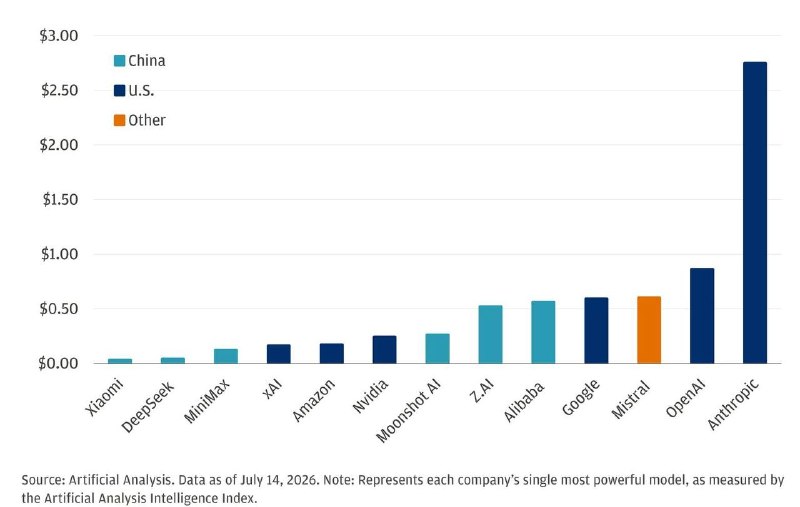
Moonshot AI released Kimi K3 on 17 July 2026 at 17:36 UTC, and within hours the model had displaced Anthropic's Claude Fable 5 from the top of Arena AI's frontend code leaderboard, edged ahead of OpenAI's GPT 5.6 Sol on a creative writing benchmark, and done both at Claude Sonnet-tier pricing. The release landed as a single news event; the reaction arrived as two. Chip stocks sold off, and bitcoin and ether followed them down the same afternoon, a reminder that the line between the AI build-out and the crypto cycle is now drawn in the same risk-asset ink.
The benchmark result is a sales pitch as much as a research paper. Moonshot is selling a 2.8-trillion-parameter open-weights model at what Decrypt reported was Claude Sonnet pricing, with a free tier that Decrypt noted pushed Claude and OpenAI off the leaderboard. That combination, frontier-class scores at near-zero marginal price, is the part of the announcement with the longest shadow. Western frontier labs have spent two years training investors to treat raw parameter count and benchmark leadership as moats. Kimi K3 walks through the moat with a price tag.
What the release actually says
The Decrypt write-up is precise about the numbers that matter. The model is 2.8 trillion parameters, it leads Arena AI on the frontend code leaderboard, and on a creative writing benchmark it tops both Claude Fable 5 and GPT 5.6 Sol. Pricing is benchmarked to Claude Sonnet, with a free access tier. Those three data points are the whole business case: a Chinese lab matching Western frontier quality, releasing weights openly enough that developers can run the model themselves, and undercutting on price. Moonshot did not need to claim parity with US labs; the leaderboard did that for it.
The Chinese framing of the same release leans harder on industrial policy coherence. From Beijing's vantage point, a domestic lab producing open-weights frontier models at low price is exactly what a state-backed compute build-out is supposed to deliver: a public-good layer on top of national infrastructure, distributed cheaply enough that no downstream startup has to pay rent to a US frontier vendor. The Western framing, by contrast, treats the release primarily as a commercial shock, the next leg of a price war that has already compressed inference margins for Anthropic and OpenAI. Both readings can be true, and both belong in the same paragraph.
Why the chip complex and crypto fell together
Coindesk reported on 17 July at 12:45 UTC that semiconductor stocks dropped on the Kimi K3 news and that bitcoin and ether fell with them. The mechanics of that move are worth spelling out. Kimi K3's headline parameter count is 2.8 trillion, in the same order of magnitude as the largest US frontier systems. If Chinese labs can train and serve models of that scale and price them aggressively, the assumption that US frontier inference will keep compounding in revenue-per-query breaks. Inference-oriented chip exposure gets repriced first, which is what Coindesk saw in semis; crypto gets dragged because the same risk-on book that holds AI infrastructure plays also holds bitcoin, and the marginal seller treats the two as one trade.
That is the structural frame. The AI capex story and the crypto cycle have been trading on the same liquidity and the same narrative of "scarce compute as a productive asset" since the 2024–25 funding cycle. A Chinese release that reopens the question of compute scarcity therefore hits both. The sell-off is not a verdict on bitcoin's monetary thesis; it is a verdict on the assumption that AI-driven compute demand is a one-bloc story.
What the Chinese side says back
Western coverage of Kimi K3 has, so far, treated the release as a competitive surprise. The structural Chinese counter is simpler and worth airing on its own terms: the model exists because Beijing spent several years underwriteing domestic compute, subsidising training clusters, and tolerating open-weights releases as a domestic-priority good. From inside that frame, Kimi K3 is not a one-off moonshot, it is the first visible output of an industrial policy that picked a winner and kept funding it through the loss-making years. US labs, working from a venture-funded cost base and a closed-API revenue model, do not have the same latitude to release weights for free.
That does not mean the Chinese industrial-policy read is the only valid one. The lab is a private company, the training run is its own, and the open-weights decision is a competitive move as much as a state one. But it would be analytically thin to treat Kimi K3 as merely "another model that scored well on a leaderboard." The conditions that produced it are themselves a story, and that story has a long tail in the chip cycle.
What to watch next
Two dates do the work. Arena AI updates its leaderboard on a rolling basis; if Kimi K3 holds the top of the frontend code ranking into August, the pricing pressure on Anthropic and OpenAI becomes a quarterly-earnings problem rather than a leaderboard curiosity. Second, the next round of US chip-export licensing decisions lands against a backdrop where a 2.8-trillion-parameter Chinese open-weights model is already being served at Claude Sonnet prices. The export-control architecture was built on the assumption that frontier capability would lag in China by a generation. That assumption is now underpriced.
Crypto's job in the next leg is the unglamorous one: stop being the same trade as AI infrastructure. If bitcoin's correlation with the chip complex continues to track risk-on flows one-to-one, every AI repricing becomes a crypto repricing with it. That may already be the regime. The 17 July session was a clean demonstration of how thin the buffer is.
The desk note: Monexus framed this story as a pricing event with a chip-cycle shadow, rather than as a model-quality story in isolation. The Western wires led on benchmark scores; the Chinese industrial-policy read sits at equal weight in our analysis. Crypto's reaction is reported as a risk-asset correlation, not a verdict on bitcoin's underlying thesis.