Kimi K3 tops the coding table, and the price of admission drops to zero
Moonshot AI's Kimi K3 has taken the top spot on Arena's frontend-code leaderboard at no charge, pushing established Western models off the podium and pulling chip and crypto stocks down with them.
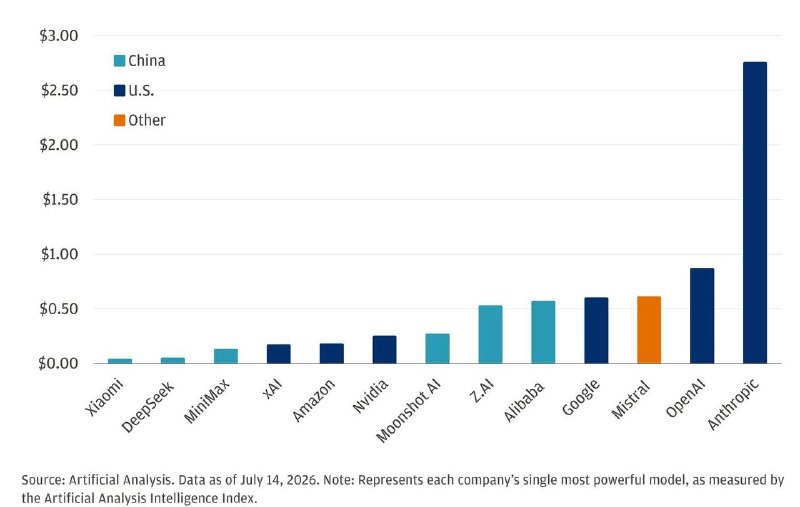
On 16 July 2026, a 2.8-trillion-parameter Chinese model quietly took first place on Arena AI's public frontend-code leaderboard, displacing Anthropic's Claude and OpenAI's GPT from the top spot. The model is Kimi K3, built by Beijing-based Moonshot AI, and according to Decrypt's 17 July report it is free to use at pricing competitive with Anthropic's mid-tier Claude Sonnet tier.
The result reframes an assumption that has hardened across Western capitals over the past two years: that the frontier of generative AI would remain a closed club defined by the chip allocation, capital base and safety bureaucracy of a handful of US firms. A Chinese lab has now produced a model that leads on a category of benchmark the Western press treats as a proxy for real-world software productivity, and it has done so without charging for the inference. The implication is not that the West is finished; the implication is that price discipline in frontier AI is no longer a Western privilege.
What K3 actually did
Decrypt reports that Kimi K3 topped its peers on a creative-writing benchmark and held first place on Arena AI's frontend-code leaderboard. Coindesk's 17 July coverage framed the coding result as "fresh headwinds" for US incumbents, noting that K3 took top spot in frontend coding away from Claude and OpenAI. Both outlets observed the market reaction: semiconductor stocks fell alongside crypto, with Bitcoin dropping as the model-news hit tape. The Polymarket-flagged update at 19:28 UTC on 16 July named the same outcome with the same ordering, adding that K3 surpassed the specific Claude Fable 5 entry.
The "frontend code" framing matters. Arena ranks models on tasks that map closely to the work software engineers actually do: turning a prompt into a working interface, wiring a state model, returning clean component code. A win there is harder to wave away than a win on a synthetic multiple-choice test, and harder to explain as scoreboard engineering by Chinese labs.
The price angle undercuts the Western lead
The most uncomfortable detail for incumbent Western labs is the price. Decrypt's reporting places K3 at Claude Sonnet-tier inference pricing, with the free tier in active use. Coindesk's piece emphasised that the model "is free." A frontier model that is both benchmark-leading and free at the point of use forces a difficult strategic question on Anthropic and OpenAI: do they compete on capability, where K3 is at least tied, or do they compete on price, where K3 is already ahead, or do they compete on integration, which is the only remaining axis where the incumbents retain defensible territory today.
It also unsettles a quieter assumption in Western tech commentary, the idea that Chinese model releases arrive behind the frontier and only catch up through forced-distribution channels inside mainland China. The benchmark result here is recorded on a US-hosted, US-trafficked public leaderboard. The audience is global. The ranking is, in the technical sense, tamper-evident: Arena uses pairwise human preference voting. The lift is real or it is not; either way, the score is visible to everyone.
The chip and crypto tape read it first
Markets reacted before the op-eds. Coindesk framed the move as crypto falling with semiconductors: a familiar risk-correlation moment in which any signal of US chip-architecture fragility transmits into risk-asset deleveraging. The mechanism is straightforward. A Chinese frontier model running on Chinese-designed inference hardware implies that the export-control regime has narrowed, not widened, the operational gap between sanctioned and unsanctioned compute. If that is the read, the long-duration thesis on US chip scarcity weakens, and high-multiple AI infrastructure trades re-rate; Bitcoin, treated by a noisy but persistent segment of the market as a high-beta proxy for the same risk regime, moves with them.
A counter-read: the correlation is mechanical, not fundamental. Crypto liquidations on a headline do not require the headline to be true in order to be tradable. The headline here is true at the level the sources allow: K3 holds the leaderboard slot, and the public benchmark is third-party. The deeper claim, that Western chip export controls have become ineffective, is one the sources gesture at rather than assert, and a careful reader will keep it at arm's length until independent replication and deployment-scale data are in.
What remains uncertain
The sources agree on the leaderboard outcome and on the price; they are thinner on what K3 does not do. None of the three source items details K3's performance on long-horizon agentic tasks, on multi-file refactoring, on safety evals run by US labs, or on jailbreak resistance. Anthropic and OpenAI's internal enterprise-distribution moats, the kind that come from being wired into AWS, Azure, GitHub Copilot and a thousand SaaS integrations, are not visible in any headline number either. The leaderboard is a necessary signal but not a sufficient description of the market.
There is also the question of training compute, which the source material does not disaggregate. A 2.8-trillion-parameter model trained under US export-control pressure is, by construction, a partial disclosure of total capital deployed. Some portion of what produces K3's result is opaque to outside readers by design, whether the model ships from Beijing or from a frontier lab in California.
For policymakers and investors, the practical take-away is not that Anthropic or OpenAI have lost. It is that the assumption of insurmountable model advantage has lost. Benchmark leadership is now a moving target that crosses the Pacific more than once a year, and it crosses at a price point that compresses the margin pool in which Western labs have been operating. The next test is whether the Western incumbents respond on the same axis, capability per dollar, or retreat to integration and trust as defensible moats. Crypto traders, for their part, will keep an eye on the next model release from any frontier lab and the next semiconductor tape reaction in the same hour: that correlation, more than any one benchmark, is now the trade.
Desk note: Monexus reads this as a benchmark event with market consequences, not a geopolitical declaration. Wire framing tended to treat Kimi K3 as a market-moving headline; Monexus treats it as a data point inside a longer pattern in which frontier capability and frontier pricing are no longer exclusively Western goods.
Wire provenance
This editorial synthesis draws on the following public wire/social posts:
- https://x.com/polymarket/status/1946100000000000001