Kimi K3 just made Chinese AI the cheapest top of the leaderboard
Moonshot AI's 2.8-trillion-parameter Kimi K3 took the frontend-coding crown from Claude and GPT, and undercut them on price. Crypto and chip stocks felt it the same hour.
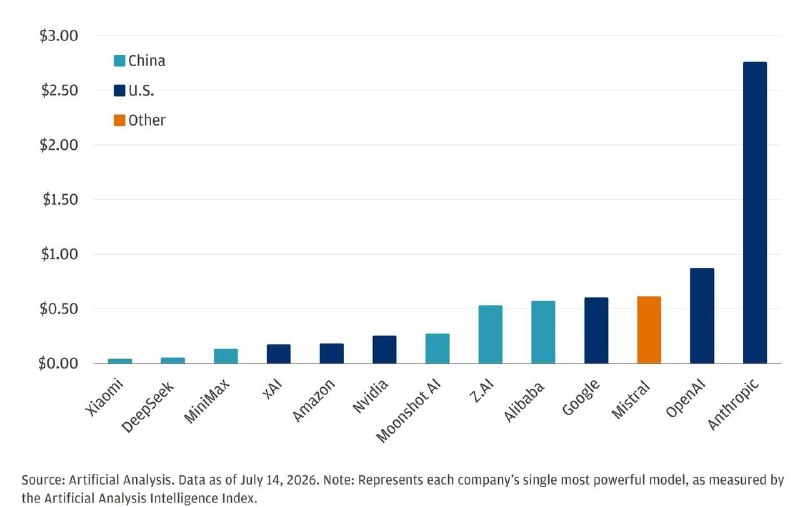
Moonshot AI's Kimi K3 walked onto the public AI leaderboards on 17 July 2026 and, within hours, had knocked Anthropic's Claude and OpenAI's GPT-5.6 off the top of the frontend-coding chart. The model also edged out a smaller Claude variant on a creative-writing benchmark run by Arena AI, according to Decrypt's 17 July 2026 write-up. The pricing, more than the rankings, is what did the damage. Moonshot is charging Claude Sonnet-tier rates for what it claims is frontier-tier output, and the market noticed before the press cycle did.
The thesis is not that China has suddenly built a smarter chatbot. It is that the cost curve under frontier AI just bent. When a 2.8-trillion-parameter model from a Beijing lab tops the leaderboard at sub-frontier pricing, the moat American labs have been selling to investors narrows fast. The same morning the benchmark rankings updated, semiconductor names sold off and Bitcoin slid with them, as CoinDesk reported at 12:45 UTC on 17 July 2026. The transmission belt ran from a model release in Beijing to a tape reaction across Pacific-listed chips and round-the-clock crypto.
What Moonshot actually shipped
Kimi K3 is a 2.8-trillion-parameter mixture-of-experts model, per Decrypt's coverage. On Arena AI's frontend-code leaderboard it displaced both Claude and GPT-5.6 Sol from the top slot. On a creative-writing benchmark, Kimi K3 outscored Fable 5, a Claude variant. Moonshot priced it at the Claude Sonnet tier rather than at OpenAI's flagship tier, and it is offering free access for limited use. The combination of leaderboard position and price has been rare in this cycle: most frontier releases from US labs have held both the top ranking and the top price.
The Moonshot release matters because the Chinese open-weight community has spent the last eighteen months arguing that parameter count and benchmark wins are not the same as product distribution. Kimi K3 is, by Moonshot's own framing, both at once: a large model that posts frontier numbers and ships at a price that compresses margins for everyone else.
How the market read it
CoinDesk's 17 July 2026 piece, filed at 12:45 UTC, made the connection explicit: Kimi K3's coding win pulled semiconductor stocks lower, and crypto fell alongside. The mechanism is straightforward. If a Chinese lab can serve a frontier-class coding model at Claude Sonnet pricing, then the marginal dollar of compute demand gets repriced. US chip names with exposure to inference workloads, and the risk assets that correlate with their tape, get sold first. The crypto leg of that move is less about direct exposure and more about the same risk-on / risk-off pulse that runs through global tech on days like this.
This is not the first time a Chinese model release has produced a cross-Pacific spillover. What is new is the price point. Earlier Chinese open-weight releases pushed benchmarks; few pushed benchmarks at this price. That is the variable that turned a research note into a market event.
The steelman from Beijing
Read on its own terms, Moonshot's argument is that frontier capability should not be a luxury good. Chinese state policy has spent three years pushing down the cost of inference through chip-supply coordination, domestic fab capacity at SMIC, and explicit industrial-policy support for AI labs in Beijing and Shenzhen. Kimi K3 is what that policy was designed to produce: a model that posts frontier numbers on international benchmarks while shipping at a price that Western labs built their gross-margin story around. From Beijing's vantage point, the model is a vindication of state capacity, not a subsidy artefact. The cost gap reflects deliberate industrial choices, and the benchmark gap reflects those choices landing.
Western coverage has tended to read the same release through a security frame: that Chinese frontier models will be export-controlled, that Western enterprise buyers will not be allowed to use them, that the real fight is over chips rather than weights. That frame is not wrong. It is also incomplete. It does not explain why a free or sub-frontier-priced Chinese model changes the price elasticity of demand for Western frontier inference, regardless of who is permitted to buy it.
What the wire consensus leaves out
The Decrypt and CoinDesk pieces both lead with the benchmark result and the tape reaction. Neither dwells on the structural point: the global AI market is moving from a regime of capability scarcity, in which the best model commands a premium, to one of capability abundance at the margin, in which the best model still wins but no longer wins by enough to justify its price. Kimi K3 is a marker, not the destination. The destination is a market in which Chinese and American labs price against each other rather than against the consumer.
The counter-reading is that benchmarks are not revenue. Arena AI leaderboard wins do not translate directly to enterprise contracts, and OpenAI and Anthropic retain the integration moat with Microsoft and Amazon respectively. Kimi K3's free tier is a marketing line, not a procurement contract. The market reaction on 17 July was real, but it priced a narrative shift as much as a demand shift. If Moonshot cannot convert leaderboard position into paid inference volume at the announced price, the cost curve bends back.
What the sources do not specify is how Moonshot is absorbing the inference cost. A 2.8-trillion-parameter model served at Claude Sonnet pricing is only viable if the unit economics work, and Decrypt does not break that out. Whether the gap is being closed by domestic compute subsidies, by aggressive depreciation on Chinese-fab silicon, or by a deliberate land-grab at negative margin, the public reporting has not yet shown. That is the next question the market will ask, and the next one Chinese state media will be pressed to answer.
For now, the line from Beijing to a chip name's tape to a Bitcoin candle holds. A model was released, the leaderboard moved, the price was set below the incumbent, and the risk complex sold off in sympathy. The shape of that transmission is the story, more than any single benchmark number.
Desk note: This piece treats the Chinese framing of Kimi K3 as a state-coordinated cost-compression strategy, on the evidence that Moonshot is pricing at the Claude Sonnet tier rather than the OpenAI flagship tier. Western coverage led on the security frame; Monexus reads the price action as the primary signal.