Ukraine just put a 60-year-old bomber on the front page
A single Tu-95 destroyed at Engels by an SBU drone does not end the war. It does rewrite what each side can credibly threaten from deep inside its own territory.
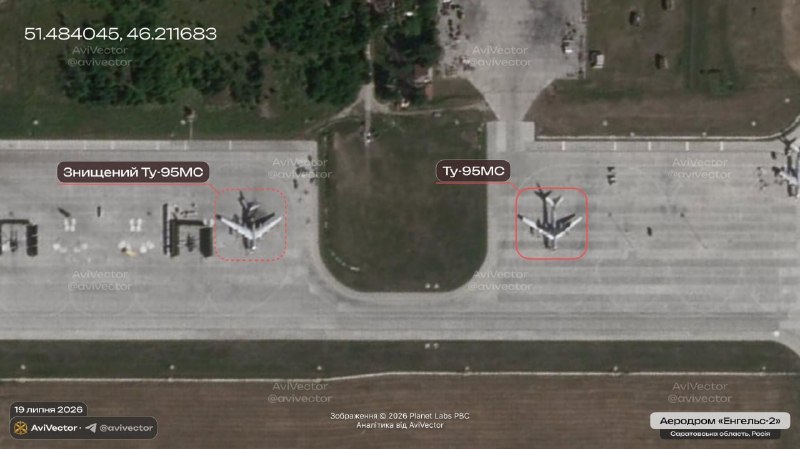
On the morning of 16 July 2026, a Tu-95MS strategic bomber sat on the apron at Engels-2 Airbase in Saratov Oblast, deep inside Russia, roughly 700 kilometres from the nearest Ukrainian border crossing. By midday, Ukraine's Security Service said the aircraft was on fire. President Volodymyr Zelensky confirmed the strike; independent geolocated footage from the Russian channel AMK_Mapping shows the wreck. One Cold War-era missile carrier, designed to hound NATO navies in the 1970s, gone from the Russian order of battle in a single drone sortie.
It is tempting to read the moment as a turning point. It is not. It is something more useful: a public, dated, photographable demonstration that the geography of sanctuary has collapsed for the Russian air force. Every Tu-95 and Tu-22M that flies against Ukrainian cities from now on flies from a base Kyiv can reach. That is a strategic fact, not a tactical headline.
What an SBU drone at Engels actually proves
Engels-2 is not a mystery target. It has been on Ukraine's published strike list for years. The base hosted the 121st Guards Heavy Bomber Regiment, the backbone of Russia's cruise-missile salvoes against Ukrainian energy infrastructure. A single bomber costs more to replace, in real money and industrial lead time, than any plausible cost estimate of the drones that destroyed it. The Tu-95 line is not in serial production. It was restarted at a trickle pace more than a decade ago, in part because the original design depends on a small pool of engineers who once built the airframes in Kuibyshev and Samara.
The strike also reads as a quiet answer to a quieter question. Western capitals have spent two years debating whether Ukraine should be permitted to hit Russian airfields with Western-supplied weapons. Kyiv has, again, decided to ask forgiveness rather than permission, using domestic drone technology to convert a political constraint into a fait accompli. The lesson travels: long-range strike capacity is now a sovereign Ukrainian asset, not a donated capability that can be revoked at a coalition meeting in Brussels or Washington.
The Russian counter-read, and why it still matters
Moscow's framing of the event, carried through Russian-aligned Telegram channels and milblogger feeds, treats Engels as a nuisance attack rather than a doctrinal reversal: an embarrassing incident inside a base the West has known about for decades, carried out by cheap drones against high-value fixed-wing hardware, with the rest of the regiment still on the ramp. There is a version of that argument worth taking seriously. One aircraft, even a strategic one, does not break the cruise-missile pipeline by itself. Saratov's runways are long. The replacement parts economy for Soviet-era bombers is thin but persistent. Russia can rotate, disperse, and decoy. The honest reading is that Engels exposes the problem; it does not solve it.
What the Russian framing cannot do, however, is restore the air-defence umbrella that made Engels comfortable in 2022. The base sits far enough behind the front line that NATO-supplied long-range missiles were, until recently, not formally cleared to reach it. Ukrainian domestic drones evidently can. The political problem for Moscow is not the loss of one bomber; it is that the protected-zone doctrine, the implicit promise that bombers can strike Ukrainian cities with relative impunity, is visibly fraying at the seams.
What changes for Kyiv, and what does not
For Ukraine, the Engels strike lowers the bargaining cost of future attacks by establishing a working pattern. Drone corridors to Volgograd, to Ryazan, to the bomber heartland around Engels and Ukhta, are no longer hypothetical. Each successful sortie widens the range at which Russian pilots must operate, forces dispersal to secondary strips, and burns Russian air-defence interceptors that would otherwise be held against more threatening platforms. None of that ends the war. All of it raises the per-sortie cost of every Russian cruise-missile attack launched against Kharkiv, Kyiv, or Odesa.
What does not change is the underlying arithmetic of the missile campaign. Russia has more cruise-missile launchers than Ukraine has destroyed bombers, and the production lines, while strained, have not stopped. The strategic-bomber fleet was always an instrument of psychological pressure as much as military effect; the missiles it carries, including the Kh-101 and the Kh-55 family, will still fly. The honest measure of Engels is not whether Russia's missile salvos slow. It is whether the launch cadence and the political confidence required to sustain them become visibly harder to maintain.
The standoff Kyiv is actually building
Read alongside the broader pattern of Ukrainian strikes against refining capacity, radar nodes, and command posts, the Engels operation is part of a deliberate campaign to invert the deep-strike problem. For two years, only Russia has been able to threaten Ukrainian infrastructure at depth. A serious long-range strike capability flips that. It also, inevitably, raises the question of what a settlement now looks like from Moscow's side. An adversary that can credibly degrade the bomber fleet at will is an adversary that can credibly degrade the tanker fleet, the reconnaissance drone fleet, and, eventually, the command-and-control nodes that coordinate them. The strategic-bomber threat was a permanent fixture of Cold War signalling. Ukraine has just demonstrated that it is now a targetable line item.
None of this should be mistaken for optimism. The conflict is grinding, the casualties are real on both sides, and the diplomatic track remains frozen. What Engels shows is narrower, and more durable. The map has changed. Air bases inside Russia are operational targets, and the war's centre of gravity on the Russian side is no longer safe behind the Urals.
Desk note: Monexus framed this as a structural shift in sanctuary geography, not as a tactical success story. Russian-aligned Telegram reporting was treated as counter-claim material, with the underlying event corroborated against the SBU statement and the AMK_Mapping geolocation footage.
Wire provenance
This editorial synthesis draws on the following public wire/social posts:
- https://t.me/wartranslated/81492
- https://t.me/AMK_Mapping/20746