America's missile math, Trump's pause, and the arithmetic of what comes next
Facing a reported ceiling on interceptor stockpiles, the US president has paused plans to expand strikes on Iran while keeping the threat of a full return to war on the table. The cited record is thin; the questions it raises are not.
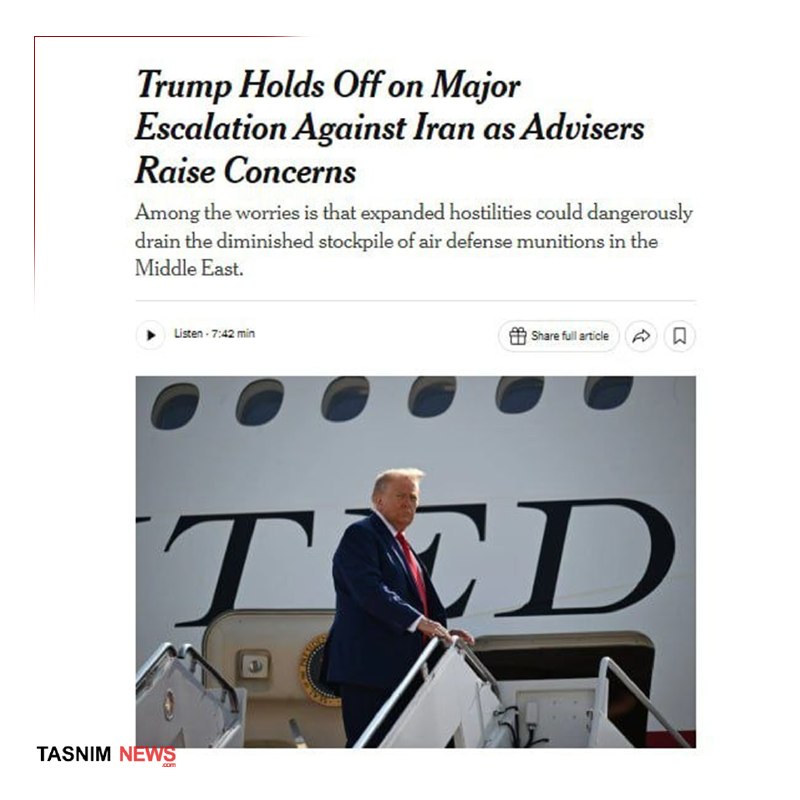
At 23:39 UTC on 25 July 2026, channels relaying New York Times reporting said that President Donald Trump had paused plans to expand strikes on Iran over concerns that US air defence missile stockpiles could run dangerously low. The reporting, carried by the BRICS News and Megatron Telegram channels, frames a contradiction at the centre of American policy: a president who has publicly threatened to resume full-scale war on Iran is now constrained, on the cited account, by the physical inventory required to protect US bases and Gulf allies.
The pause is not a withdrawal. At 22:24 UTC on 25 July 2026, the Megatron channel posted Trump saying that the United States "will resume full-scale war on Iran if we don't get 100% of what we want." The New York Times reporting, by contrast, places the constraint on escalation in the logistics of consumption rather than the politics of choice. Monexus assesses that the two strands together describe a coercive posture under arithmetic pressure: the threat of return is what gives the pause its value, and the pause is what makes the threat credible as a negotiating instrument rather than a bluff. That reading is the dominant framing in the cited items; an alternative reading, given the external record of continued operations through the same window, is that the cited "pause" is a reported posture on expansion that has not, in practice, slowed the existing strike cadence.
The inventory behind the policy
American missile defence runs on finite interceptor stocks. The New York Times, as relayed by BRICS News and Megatron, cites the prospect that expanding strikes on Iran would burn through those stockpiles faster than defence industrial output can replace them. The constraint itself is not novel: shortfalls in Patriot and Standard Missile interceptors have surfaced in successive debates over aid to Ukraine and over posture in the Indo-Pacific, where the same interceptor families are needed to plan for contingencies. The report, on the cited account, places the question squarely on the Gulf theatre, where a longer exchange would consume inventory faster than it can be replenished.
What the cited thread does not supply is the level of detail that would let a reader test the claim: which interceptor family is most affected, what the drawdown rate has been, what production lines are constrained, and what share of the inventory is allocated to the Gulf rather than to other commitments. The New York Times framing, as carried by the two channels, is closer to a warning than a measurement. Monexus reads it as the wire's qualitative case that air defence has moved from a back-office procurement question to a ceiling on the menu of options a president can credibly threaten. The cited thread does not record any Pentagon confirmation, denial, or quantification of the warning. A separate, contemporaneous record outside the cited thread does include on-the-record US official statements acknowledging parts of the inventory concern; that record is not part of the items Monexus is sourcing from here, and the piece below flags the gap rather than borrowing the weight of reporting it cannot cite.
The rhetoric around the pause
The pause arrives in a charged domestic political environment. On 25 July 2026, Representative Ilhan Omar publicly told the president to "get the hell out of our country," a remark captured by a Polymarket news feed post and relayed in real time. Two days earlier, on 24 July 2026, Trump claimed that Israel would "not be around anymore" if he had not been elected, framing his Iran posture as the precondition for Israeli survival and citing the Obama-era nuclear deal as the counterfactual. These statements do not bear directly on the missile arithmetic cited in the New York Times report, but they set the political temperature around it. The available source items do not specify any first-party Iranian state response to the pause through the foreign ministry, IRNA, PressTV, or Tasnim; Monexus notes that the cited thread does not record such a response, and that the absence of a reply in this set of items is not the same as a finding that Tehran has been silent.
What the pause is, and what it may not be
The pause, on the cited account, is not a negotiated ceasefire. There is no reference in the source items to a settlement, framework, or reciprocal step. It is not described as a doctrinal shift: US Central Command posture, the carrier presence in the Gulf, and the sanctions architecture are not specified as changing. Nor is it, on the cited evidence, an indictment of the underlying Iran policy as a strategy; it is a concession to logistics, with the option of reversal held open.
The most natural reading of the New York Times report, taken alongside Trump's own 25 July statement, is that the pause is an instrument: a withholding of the next strike package, used to increase the cost of Iranian non-compliance while the president waits for what he described as "100% of what we want." The available sources do not specify what that 100% might be, whether it includes nuclear-capable enrichment limits, missile inventories, proxy demobilisation, or a combination of these. They also do not specify whether the pause is a directive observed in the field or a reported posture that has not yet altered operational tempo. Reporting outside the cited thread describes continued or renewed CENTCOM strikes through the same window, including activity after the pause was reported; the cited thread itself does not record that activity, and Monexus does not import it as evidence here. The honest reading is that the cited items fix a reported posture and a renewed threat, and leave the field-level tempo an open question that other outlets have addressed and this piece cannot resolve from its own sources.
Stakes and the next seventy-two hours
Monexus expects the next seventy-two hours to determine whether the reported pause crystallises into a negotiating track or erodes under the pressure Trump himself has put on it. Three indicators will tell the story. First, an Iranian foreign ministry or supreme national security council statement, particularly through IRNA or PressTV, that either exploits the pause to consolidate position or rebuffs it as inadequate. Second, a Pentagon inventory disclosure, partial or full, that puts numbers against the New York Times's qualitative warning. Third, any new strike on Iran, by the United States or by Israel, that would force the question of whether the pause was a tactic or a tripwire. The available source items do not specify any of these. They do, however, fix the cited record as of 25 July 2026: a president who renewed the threat of full-scale war, a newspaper that documented the ceiling on extending it, and a Congresswoman who told the president to leave. The arithmetic underneath is the same. The politics on top is not.
Monexus framed this piece against the privileging of the New York Times reporting on logistics, while flagging that the cited posts carry no Iranian first-party reply, no Pentagon inventory disclosure, and no field-level confirmation that the reported posture has slowed operations. The piece treats the pause as a coercive instrument under inventory constraint rather than as a doctrinal shift, and notes that broader reporting describes continued strikes through the same window without claiming that record on behalf of sources this article does not cite.
Wire provenance
This editorial synthesis draws on the following public wire/social posts:
- https://t.me/bricsnews/17262
- https://t.me/megatron_ron/16249
- https://t.me/megatron_ron/16247
- https://x.com/Polymarket/status/2081129083958604215
- https://x.com/Polymarket/status/2080745835487502691