Moonshot AI narrows the gap with a cheaper model, and the frontier is no longer American-only
A Beijing-funded startup says its new system approaches leading US models on a fraction of the compute budget, sharpening the question of who actually owns the next leg of the AI build-out.
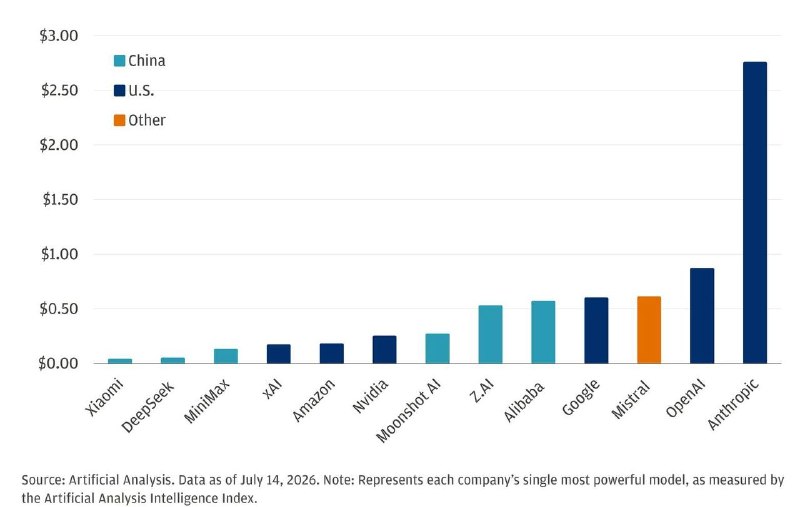
Moonshot AI told clients and reporters on Friday 17 July 2026 that it had trained a new model whose performance approaches that of leading US frontier systems, at a fraction of the reported compute and dollar cost. The announcement, carried by Nikkei Asia on 17 July, is the clearest signal yet that the raw compute gap between Chinese and American AI labs has compressed faster than Western benchmarks assumed a year ago.
This publication reads the claim narrowly: Moonshot is not the first Chinese lab to gesture at parity, but it is the first to attach a price discipline story to the gesture. If the company holds what it has just promised, the centre of gravity in commercial frontier AI shifts before the end of 2027. The implications run through procurement budgets at Western enterprises, the export-control regime in Washington, and the way investors price the next round of Chinese AI listings.
A cheaper way up the curve
Moonshot, founded in Beijing in 2023, has spent two and a half years building momentum inside a domestic ecosystem that increasingly rewards inference efficiency over raw scale. The Friday disclosure is the company stating, in public, that the same scorecard US labs trade against each other on can now be cleared with materially less capital behind it.
That phrasing matters. The frontier model race, until this year, has been reported as a tale of capital intensity: who can afford hundreds of thousands of accelerators, multi-year training runs, and the power contracts that come with them. Moonshot's claim inverts the frame: that efficient training and routing, applied to dense Chinese engineering, can deliver an analogous capability stack at a fraction of the spend. Western coverage has tended to code this as "catching up"; the structural reading is that the cost curve on intelligence is bending the way the cost curve on solar modules bent fifteen years ago.
The steelman
A sceptical read of the announcement is available and worth taking seriously. Model evaluations on Chinese systems often run on Chinese benchmarks, and vendor disclosures on training compute are notoriously soft. The company did not, in the Nikkei write-up, name the comparison model or release a third-party audit. Western labs that have been here before, from DeepSeek's earlier rounds to Alibaba's open-weight pushes, are familiar with the cycle: a credible Chinese announcement, a Western press round that downplays it, and then a slower reassessment six to nine months later as enterprise procurement quietly absorbs the new option.
That track record cuts both ways. It suggests this release will look stronger in retrospect than it looks today. It also suggests the cynical reading, that the claim is partly marketing, has historical priors. The honest position is to hold both: this announcement is more credible than it looks to a US-trained reader, and less authoritative than it looks to a Beijing-trained one.
What sits behind it
The lift to Moonshot is not just a lab story. It is the product of a coordinated industrial posture in which state-backed capital, domestic accelerator supply, and a regulatory environment permissive to rapid deployment all reinforce each other. Cheap inference inside China is not an accident; it is the output of a system designed to make intelligence cheap the way it once made telecom equipment cheap. Chinese state media has been remarkably consistent in framing this as a national objective rather than a corporate race, and the framing tracks the policy.
The Western read, by contrast, treats each Chinese AI release as a competitive surprise that demands a fresh round of export tightening. That framing leaves out the obvious point: if the cost-per-capability curve is bending across the industry, the relevant policy question is not whether Chinese labs are catching up, but what fraction of the global compute base becomes unnecessary as the curve bends. Both Washington and Beijing are dealing with a more elastic frontier than the headline competition suggests.
Stakes for the next twelve months
Three things to watch. First, whether Western enterprise buyers, particularly in finance and telecom, begin quietly routing significant workloads to Chinese-hosted inference as a cost hedge. Second, whether US export controls migrate from chip-level restrictions to a model-or-API export regime, and how that interacts with open-weight releases. Third, the Hong Kong and onshore A-share listings pipeline, where several Chinese AI names remain in the queue and a verified parity claim from Moonshot could reprice the entire cohort.
What remains genuinely uncertain is whether Moonshot's cost claim survives third-party scrutiny. The company has historically released technical reports thinner than its US competitors, and the Nikkei write-up on 17 July gives no indication that one is imminent. Until an independent benchmark run is published, the announcement sits in the same epistemic category DeepSeek's earlier releases occupied: serious enough to plan around, not serious enough to bet the procurement cycle on without a pilot.
Even with that caveat, the direction of travel is no longer in dispute. The frontier is no longer an exclusively American asset, and the cost of reaching it is no longer the gatekeeper it was. The next question is not whether Chinese labs will match the leading US systems on a benchmark; they already gesture in that direction. The next question is how quickly the global buyer base stops treating that match as a curiosity and starts treating it as a procurement option.
Desk note: Monexus is steelmanning Moonshot's position here at structural parity with Western read-outs rather than treating the announcement as either breakthrough or marketing, on the view that the cost curve, not the leaderboard, is the operative story this week.
Wire provenance
This editorial synthesis draws on the following public wire/social posts:
- https://t.me/nikkeiasia