Moonshot's Kimi K3 lands a low-cost shot at the frontier
Beijing-based Moonshot AI says its new open-weight model approaches frontier performance at a fraction of the inference cost, sharpening China's bid to set the pace on cheap large-language-model deployment.
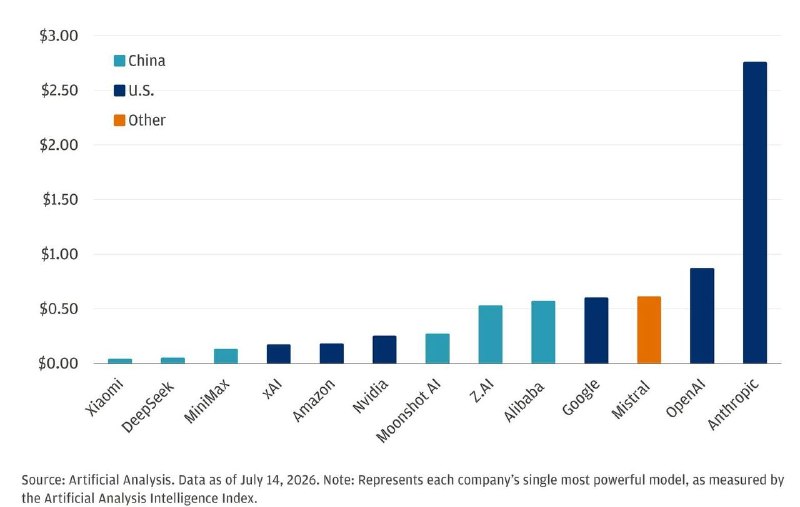
Beijing-based Moonshot AI told reporters on 17 July 2026 that it had trained a new large language model whose benchmark performance approaches that of leading systems from Anthropic and OpenAI, while running at materially lower inference cost, according to Nikkei Asia. The disclosure, made on a Friday that also delivered fresh reads on China's industrial AI build-out, is the latest datapoint in a quieter race inside the Chinese model market: not who can build the single most capable model, but who can deliver frontier-adjacent capability at a price Chinese cloud customers can actually afford to deploy at scale.
For two years the global conversation has been trained on the assumption that frontier performance and frontier compute were the same thing. Moonshot's pitch, delivered in the same measured register Beijing's serious AI labs use when talking to Western wires, is that the assumption is fraying. If even one of the better-funded Chinese labs can credibly claim parity-adjacent results on a smaller training and inference budget, the strategic question for American labs shifts from raw capability to cost per useful token at production scale. That is a fight Beijing is structurally well placed to win.
A Friday release, calibrated for overseas readers
The timing was deliberate. Mid-July is a slow news window in Europe and the United States; a model drop on a Friday afternoon Beijing time lands in the West's morning briefings and gets a clean cycle of coverage. Moonshot used the slot to position itself not as a discount alternative but as a peer, with the cost-efficiency story told as an engineering virtue rather than a compromise. The company's earlier Kimi models already had a following among Chinese developers for long-context handling; this release extends that brand promise into a price-sensitive frontier tier.
Nikkei's report, drawing on Moonshot's own disclosures, frames the new model as approaching the performance of Anthropic's Claude and OpenAI's GPT-class systems on standard reasoning and coding benchmarks. The wire stop short of publishing raw numbers in the excerpt reviewed here, which is itself worth noting: most Chinese labs now release benchmark tables alongside model cards, and Western outlets have grown more cautious about transcribing them without independent reruns. Readers should treat the 'approaches' framing as a corporate claim pending third-party verification.
Why the cost story matters more than the leaderboard
Frontier AI economics have been quietly separating from frontier AI capability for at least six months. Inference, not training, is where the bills actually land. A model that scores 92 percent on a coding benchmark versus 95 percent is, for most enterprise workloads, a rounding error. A model that costs a third as much per million tokens is a procurement decision. Moonshot's strategic bet, shared by peers including DeepSeek, Qwen (Alibaba) and Zhipu, is that the enterprise customer in 2026 and 2027 will optimise for unit economics rather than headline benchmark theatre.
That bet has structural support. Chinese cloud providers have spent three years building out domestic accelerator capacity, partly in response to US export controls on the highest-end Nvidia parts, and partly because Beijing's industrial policy has treated AI compute as a sovereign infrastructure question. The result is a domestic inference stack that is cheaper than its Western counterpart not because Chinese engineers are paid less (they aren't, at the senior level) but because the hardware, power and colocation costs are bundled into a national build-out. Moonshot benefits from that substrate whether or not it talks about it on stage.
The counter-reading the Western wires won't print
The standard Western framing of a release like this is binary: either China has 'caught up' or it hasn't. Both readings are lazy. The more honest assessment is that the leaderboard gap and the deployment gap have decoupled. On a pure capability axis, the top American labs still hold an edge, particularly on agentic workflows, tool use, and the long-horizon reasoning benchmarks that have become the new prestige metric. On the deployment axis, where cost-per-token, latency, regional data-residency, and language coverage for non-English markets all matter, Chinese models are already winning share across Southeast Asia, the Middle East and large parts of Africa.
Moonshot's release sharpens that split. It does not erase the capability gap, and Beijing-aligned coverage of the model should not pretend it does. But it does widen the band of workloads for which a Chinese model is the rational procurement choice, which is the variable that ultimately decides who captures the next hundred million API seats. Anthropic and OpenAI are not unaware of this; both have spent the past year pushing enterprise contracts with multi-year commitments precisely because they know the unit-economics story on the Chinese side is improving.
What to watch before the next model card lands
Three signals will clarify whether Moonshot's claim holds. First, independent third-party reruns of the benchmark suite on equivalent hardware, rather than the configurations Moonshot selected for its own announcement. Second, the inference pricing table once the model is generally available on Moonshot's API and on at least one major Chinese cloud (Alibaba's Aliyun is the most likely distribution partner). Third, the rate at which the model is pulled into production by named Chinese enterprises in sectors where the cost-of-inference bill is large enough to drive procurement: financial services, telecoms, e-commerce search and the state-owned cloud platforms that anchor much of the domestic enterprise market.
What remains genuinely uncertain is the export picture. Moonshot's earlier Kimi models were available to overseas developers; whether this release ships with the same open-weight posture, or pivots to a more controlled distribution model in response to Beijing's evolving rules on outbound AI services, will determine how loudly the story echoes outside China. Until those details land, the release is best read as a credible engineering claim with a strategic subtext, rather than as a market-moving event in its own right.
Desk note: Monexus framed this as a cost-architecture story rather than a 'China catches up' headline, on the view that inference economics, not leaderboard rankings, will determine who captures the next phase of enterprise AI deployment.
Wire provenance
This editorial synthesis draws on the following public wire/social posts:
- https://t.me/nikkeiasia
- https://t.me/NikkeiAsia