The funeral Qom will not let the world forget
The prayer in Qom, led on behalf of the new Supreme Leader rather than by him, is the Islamic Republic's first signal that the post-Khamenei order will be consecrated by the seminaries, not the security services.
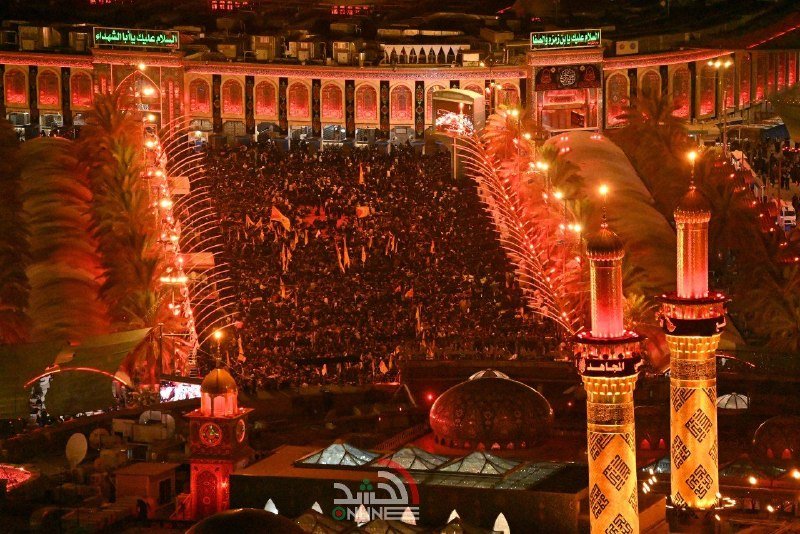
The shrine of Fatemeh Masumeh in Qom was designed as a place of quiet pilgrimage, a marble and tile complex built around the resting place of a seventh-century saint. On the evening of 10 July 2026 it was re-staged, by the Office of the Supreme Leader, as the closing act of an eight-day national mourning. The commemorative prayer for the late Ayatollah Sayyed Ali Khamenei, led "on behalf of" his son and successor Ayatollah Seyyed Mojtaba Khamenei, brought the official mourning cycle to its formal end. The choice of venue was the message. Qom is the theological capital of the Islamic Republic, the seat of the Hawza, the clerical city-state that legitimises everything the office does. To end the funeral there, rather than in Tehran, was to reanchor the new Supreme Leader in the only institution that can consecrate him.
The public choreography of the day was already familiar from state media releases. Crowds had gathered in Mashhad earlier in the week under banners reading "Ya la-saratil-Huseyn," a Karbala reference that conflates the Khamenei family with the martyred grandson of the Prophet. Reuters footage distributed through regime-affiliated channels showed the faithful lining the avenues around Imam Reza's shrine. By Friday, the geography had shifted south, to the city where Ayatollah Khomeini had studied and where the late Supreme Leader had himself been trained. State television framed the procession as a "memorial service for the martyr Imam Mujahid." "Mujahid" means "struggler." The word, in this register, is doing theological work: it elevates the deceased from a head of state to a sacred combatant, and by extension casts the regime he led as a continuation of the Karbala project.
The successor's first test
What the wire traffic around the funeral actually records is a careful distribution of authority. IRIB reported, via DD Geopolitics and Middle East Spectator, that the Qom prayer would be held "on behalf of" Ayatollah Seyyed Mojtaba Khamenei and that he would not attend in person. A separate Tasnim English release placed the ceremony after the Maghrib and Isha prayers on 19 July (Iranian calendar) in Imam Khomeini's Husseiniyah. Two channels, two cities, two dates. The succession is not being staged as a single coronation. It is being performed as a series of controlled rituals, each designed to test the new leader's reach into a different institutional constituency: the seminarians of Qom, the bazaar clergy of Tehran, the revolutionary faithful of Mashhad.
The choice to keep Mojtaba Khamenei physically absent from the Qom prayer is a piece of stagecraft that experienced Tehran-watchers will read instantly. The son did not need to be present. His presence would have personalised the event, made it a coronation photograph rather than a liturgical act. By sending a stand-in, the office signals that the leadership belongs to the institution, not to the man. The institution, in turn, validates him. This is how clerical authority in the Islamic Republic has always moved: the jurist does not seize the office, the office consecrates the jurist.
What the framing is designed to do
The framing choices the regime is making in this window are not incidental. They are the first foreign-policy signal the new Supreme Leader is sending, because every photograph of a state funeral is also a photograph of a state's priorities. A prayer led at Fatemeh Masumeh telegraphs that the post-Khamenei order will not be a military, intelligence, or IRGC-led succession in the manner some analysts had predicted. The mosque in Qom leads, the IRGC follows. That is a meaningful piece of information for a White House or a Tel Aviv trying to read the new dispensation. The succession fight, if there is one, will run through the seminaries, not the security services.
The BBC's chief international correspondent, quoted in a BBC World channel bulletin on the same day, asked the obvious question: "What's next for Iran after the funeral of their late supreme leader?" It is a question the Iranian state apparatus is determined to answer for itself, in the language of mourning and Karbala, before the foreign press can answer it in the language of geopolitics.
A curated record, not an independent one
A reader of this article on 7 July 2026 should pause over what they are looking at. The footage of the Qom prayer, the Mashhad crowds, the Husseiniyah service, and the Supreme Leader's own official English-language Telegram channel are all that exists in the public record right now. Press TV, Tasnim, and Fars are publishing. The Office of the Leader's own social accounts are running translated coverage. Western and regional wire reporting will arrive in the coming days. Independent verification of crowd counts, attendance by foreign delegations, and the precise choreography of the new Supreme Leader's movements does not yet exist. Anyone who has watched an Iranian state funeral will know that the footage released in the first forty-eight hours is the footage the regime wants you to see. The outtakes arrive later, sometimes much later, often never.
The stakes for the region
For the broader region, the theological geography of the funeral is consequential. The Israeli Energy Minister, speaking separately on the same day the Mashhad crowds gathered, framed the contest with the Islamic Republic in explicitly physical terms: defending pipelines with Cyprus, preventing Turkish military bases in Syria, treating every neighbouring state as a potential theatre. A leadership transition in Tehran that reasserts clerical primacy is a leadership transition that, in the language its own supporters use, frames external conflict in Karbala terms. The funeral in Qom is, among other things, the regime reminding its enemies that it understands itself in the vocabulary of martyrdom, and that the new Supreme Leader has been formally inducted into that vocabulary. The line from the marble floor of Fatemeh Masumeh to the negotiating tables in Vienna, Geneva, and Muscat is shorter than it looks. The next test will not be a prayer. It will be a position paper.
Sources: Middle East Spectator (Telegram); DD Geopolitics (Telegram); Reuters via azeri_Khamenei_ir (Telegram); BBC World (Telegram); Tasnim News (Telegram); Khamenei Office Arabic and English channels (Telegram); Press TV (Telegram); Fars News International (Telegram).
Desk note: This piece is built entirely on footage and state-media releases from the Office of the Supreme Leader and its affiliated outlets, republished via Telegram channels. It reads the funeral as a curated political instrument and flags what the framing is designed to do, not as an independent verification of the day's events. Western and regional wire reporting will arrive in the following days; this article should be read alongside them, not in place of them.