Khamenei frames Hezbollah's survival as the price of Iran's regional doctrine
Tehran's Supreme Leader tells Hezbollah Secretary-General Naim Qassem that ending Israel's campaign in Lebanon is a precondition for any war-ending memorandum with Washington, codifying a long-held strategic posture as active diplomacy.
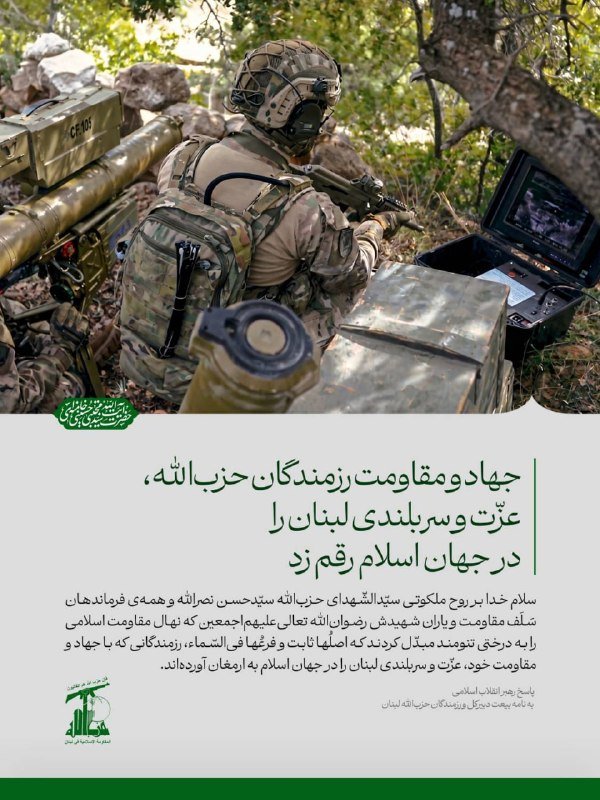
Ayatollah Mojtaba Khamenei, Iran's Supreme Leader, published a written response on 26 July 2026 to a letter of allegiance from Hezbollah Secretary-General Naim Qassem and the group's fighters, declaring that the defence of "the Lebanese Mujahideen" has been elevated to a strategic policy of the Islamic Republic and that the "complete" end of Israeli operations against Lebanon is a basic condition of any memorandum of understanding to end the war with the United States. The text, released by Iranian state outlets in parallel at 17:01–17:09 UTC and relayed by Hezbollah-aligned channels within minutes, is the most explicit public linkage Tehran has made this year between its bilateral diplomacy with Washington and the fate of its Lebanese ally.
The exchange is, on its face, a solidarity gesture. It is also, on the same page, a negotiating position. By tying a US-Iran deal to the file in Lebanon, Khamenei has folded a regional front into a bilateral track, and signalled to both Washington and Tel Aviv that the price of any closure extends beyond the nuclear file and the Strait of Hormuz. The framing matters less for what it reveals about Iran's intentions, which were never in serious doubt, than for the moment at which it is published: at a time when the Lebanese state, Hezbollah's main patron and host, is simultaneously negotiating its own ceasefire terms, and when Israeli strikes on Lebanese territory have continued through 2026.
What Khamenei actually wrote
The published excerpts, carried by Press TV, Tasnim and Al-Alam Arabic, frame Hezbollah's "steadfastness" as an "inspiring message" to "free nations" and characterise "the criminal Zionists" and the US government as a single oppressor. Khamenei writes that "persistence in the path of resistance leads to divine victory" and that the Islamic Republic has "determined the defence of the Lebanese Mujahideen as its strategic policy." Hezbollah's letter of allegiance, signed by Qassem on behalf of the group's fighters, is reciprocated in kind: Tehran answers fealty with a doctrinal commitment that, in Iranian strategic vocabulary, sits above ordinary bilateral relations.
The operative line, however, is the conditional. Al-Alam Arabic's bulletin, timestamped 17:09 UTC, summarises the message as: ending "the complete Israeli aggression against Lebanon" is a "basic condition in the memorandum of understanding to end the war with the United States." That formulation puts a Lebanon ceasefire inside the architecture of a US-Iran settlement, rather than treating the two as adjacent but separate files. It is a stronger statement than the standard Iranian line that regional de-escalation is "desirable," and it falls short of a declared red line in the technical sense: Khamenei has not, in the published excerpts, threatened to walk away from negotiations if Lebanon is excluded. He has, though, told his domestic audience and Hezbollah's leadership that Lebanon is non-negotiable.
Why the timing is not accidental
Three clocks are running at once. The first is the US-Iran track itself, which has produced intermittent movement across 2026 without a public framework. The second is the Lebanese track, where Beirut and international intermediaries have spent months attempting to consolidate a halt to Israeli operations, a process complicated by Hezbollah's continued capacity to fire into northern Israel and by Israeli insistence on a buffer zone. The third is Hezbollah's internal recovery, after the war of late 2024 and the Israeli campaign that followed: the letter of allegiance is itself a signal that Qassem's leadership believes it has held the organisation together, and wants that fact ratified publicly by Tehran.
Monexus analysis: the convergence of those three clocks is the news. A pure solidarity letter would have been issued days earlier or later; issuing it now, with the Lebanon ceasefire embedded as a US-Iran condition, is a way for Tehran to either extract a written guarantee from Washington or to have a clean public reason to harden its position later. Either outcome serves Iran's interest in being seen, at home and across the regional alliance, as the actor that did not trade Lebanon for sanctions relief.
Counterpoint: why read it as anything other than rhetoric
The cautious Western read is straightforward: this is theatre. Iranian strategic-policy statements about Hezbollah have been issued repeatedly since the early 1990s and have not, in any documented case, altered Israeli operational planning in southern Lebanon or the terms of a US-Iran understanding. A conditional embedded in a written reply to a letter of allegiance is a low-cost way to look firm without committing to walk away from a deal. On that reading, the line about Lebanon is a domestic-audience signal, not a negotiating chip.
That reading holds only up to a point. It cannot explain why Iranian state media released the same passages simultaneously across three outlets and three languages, with the Lebanon condition foregrounded in Al-Alam Arabic, the audience most likely to relay it to Arab and Lebanese intermediaries. If the purpose were purely internal, a single Persian-language statement would have sufficed. The multilingual release pattern is consistent with a message aimed at the negotiating table in Washington as much as at the studio audience in Tehran.
What it costs and what it gains
If Iran holds the line, the cost is concrete: a slower or colder US-Iran track, and the possibility that sanctions relief stays on the shelf. The benefit is reputational, both inside the Islamic Republic's coalition network and among Arab publics who have watched Iran's allies bleed in Gaza and Lebanon while Tehran negotiates. The structural pattern is familiar: a regional power that refuses to devalue its forward defence commitments in exchange for bilateral relief. The same pattern shaped the 2015 nuclear deal's aftermath, when Iran's regional footprint expanded even as the agreement was in force.
If Iran drops the condition, the cost is paid by Hezbollah: a public signal that the patron's strategic doctrine is negotiable after all, at exactly the moment when the Lebanese group needs the opposite signal to hold its deterrent posture against Israel. For Qassem, who rebuilt Hezbollah's command after the 2024 decapitation of senior figures, the letter-and-reply exchange is part of his own political survival inside the party's institutions.
What to watch next
Three signals in the next 72 hours would tell us which way this is moving. First, an official US State Department or White House response: silence is information, a denial of linkage is information, an acknowledgement of the Lebanon file in any framing is information. Second, any Hezbollah statement that operationalises the language, in the form of a rocket launch, a drone sortie, or a public readiness drill along the border. Third, a Lebanese-government statement from Beirut clarifying whether it endorses, tolerates, or rejects being folded into a US-Iran memorandum as a condition.
What the cited posts do not specify is whether a memorandum of understanding is currently in draft, in negotiation, or merely in Tehran's framing of the conversation. They also do not specify the contents of Qassem's original letter beyond the fact of its delivery and the response. Readers should treat the specific conditional as reported Iranian framing, verified by multiple Iranian outlets, until a US or Israeli source either confirms or denies the linkage in those terms.
Desk note: Monexus framed this as a negotiating-position story, not a solidarity story. The wire coverage from Iranian state outlets treats the exchange as primarily symbolic; the operational language about a Lebanon condition embedded in a US-Iran memorandum is more consequential than the framing suggests, and we leaned into that.
Wire provenance
This editorial synthesis draws on the following public wire/social posts:
- https://t.me/presstv/200447
- https://t.me/presstv/200445
- https://t.me/presstv/200444
- https://t.me/alalamarabic/490079
- https://t.me/presstv/200439
- https://t.me/tasnimplus/115956
- https://t.me/tasnimnews_en/28095
- https://t.me/tasnimnews_en/28094