A cloud workload could talk to the grid. The grid might answer
Researchers warn a malicious cloud tenant could synchronise GPU power draws to stress the grid, a finding The Hacker News says only works under tight co-location conditions.
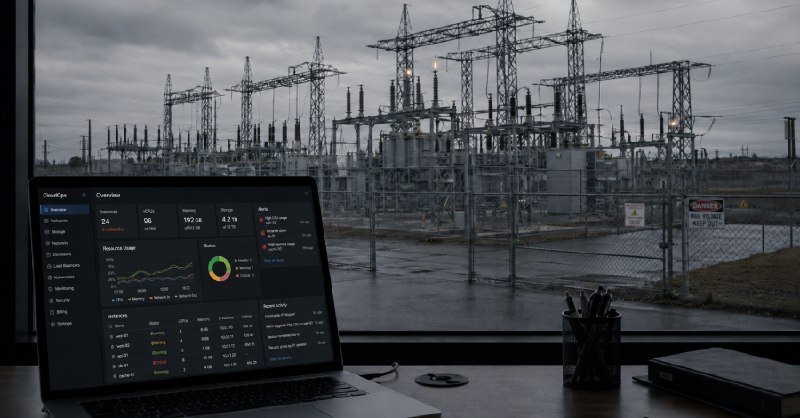
On 26 July 2026, The Hacker News published an interview with the Bit2Watt researchers in which the team described an attack class that turns rented compute into an actuator on the wider power system. The headline finding, as relayed by the outlet, is that a malicious cloud tenant could, in principle, force thousands of GPUs inside one region to spike their power draw together and feed a demand surge back into the grid.
The Hacker News summarises the scenario's reach narrowly. The outlet reports that the scariest result only works if the GPUs spike at the same instant and the surrounding grid is already running with thin margins. In other words, the result is conditional, not deterministic. That single caveat is what separates a research paper from an exploit, and it is also what the reporting leads with rather than buries.
What the thread evidence supports
The available reporting is thin. The Hacker News's Telegram summary confirms the mechanism: coordinated GPU power draw inside a cloud region can propagate back to the wider grid. The Nikkei Asia thread, dated the same day, frames AI agents as having "drastically altered" the security balance by making offensive actions faster to compose than defenders can review. The two pieces share a date and a structural premise: that the offensive side of cybersecurity is now moving on a clock the defensive side cannot match.
The thread evidence does not specify which cloud providers were contacted, whether any issued a statement, whether a coordinated disclosure was conducted, or whether any vendor has shipped a patch. The available source items do not specify the researchers' institutional affiliation, the paper's venue, or the specific electrical interconnection conditions the team tested. Any framing beyond what those sources contain is inference rather than reporting, and is labelled as such below.
What The Hacker News actually flags
The Telegram excerpt highlights two conditions for the headline scenario: the GPUs must ramp together, and the grid behind them must already be tight. Without the synchronisation, the surge dissipates across the region. Without tight margins, the surge does not propagate. The Hacker News does not report that either condition has been demonstrated end-to-end; the framing is feasibility-class, not exploit-class.
Monexus analysis: read against the available reporting, the result is best described as a boundary condition on what is possible. It places a workload-driven grid disturbance inside the set of threats a hyperscale operator should think about, without placing it inside the set of threats that should keep a regulator up at night. The reporting The Hacker News has chosen to lead on is precisely the conditional one, which is also the only one that survives contact with how grids are run in practice.
The agent-economy context, with restraint
The Nikkei Asia thread introduces a second variable: AI agents capable of autonomous action. The framing, again as relayed, is that offensive actions can now be composed and adapted faster than defenders can review alerts. The thread does not specify the agents in question, the platforms they operate on, or the specific incidents that motivate the framing.
Monexus assessment: the natural reading is that the agent economy sharpens the Bit2Watt finding rather than replacing it. A workforce of autonomous agents can search for the synchronisation window, schedule the burst, and adapt to throttling faster than a human operator can review logs. That reading is consistent with both thread items and is the most economical bridge between them. The thread evidence does not establish that any agent system has actually been used to mount this kind of attack; the assessment is therefore about trajectory, not event.
What this article has not established
The thread items do not specify any provider response, any vendor advisory, any regulator notice, or any replication of the Bit2Watt result by an independent team. The sources do not specify the power draw of a typical hyperscale region, the structure of utility interconnection queues, or the cost of spinning reserves. Claims about gigawatt-scale regional loads, substation-level propagation, brownout mechanics, or historical warnings in the infrastructure literature are not entailed by the available evidence and are therefore left out of this piece rather than asserted.
Monexus analysis: the right reading, given what the thread evidence actually contains, is that a feasibility result has been published and that an agent-economy context has been invoked the same week. Whether the result replicates on commodity cloud accounts, whether any provider acknowledges the scenario, and whether any regulator treats it as actionable are open questions. Until those questions resolve, the speculative price of the finding is bounded.
Desk note: the wire trade press ran Bit2Watt as a cyber story. This publication ran it as a conditional-feasibility story, with the agent-economy angle treated as a separate thread item rather than as a confirmed bridge between the two pieces. The thread evidence covers only The Hacker News's reporting on Bit2Watt and Nikkei Asia's reporting on AI-driven attack tempo; the supplied items on Japan's trading-card market regulation, Google's reported SpaceX stake and US credit-card grocery debt sit outside the article's frame and were not used. A 26 July Telegram item from TSN_ua noting an earthquake near a regional centre in western Ukraine is unrelated to the cyber-grid subject and is not used in this piece.
Wire provenance
This editorial synthesis draws on the following public wire/social posts:
- https://thehackernews.com/2026/07/new-bit2watt-attack-could-let-cloud.html
- https://t.me/thehackernews/9616
- https://t.me/NikkeiAsia/21069
- https://t.me/nikkeiasia/21069
- https://unusualwhales.com/news/japan-considers-regulating-pokemon-card-market
- https://unusualwhales.com/news/google-94-billion-spacex-stake-after-ipo
- https://unusualwhales.com/news/americans-credit-card-grocery-debt-repayment
- https://t.me/TSN_ua/581601
- https://thehackernews.com/2026/07/new-bit2watt-attack-could-let-cloud.html
- https://t.me/thehackernews/9616
- https://t.me/NikkeiAsia/21069
- https://t.me/nikkeiasia/21069
- https://unusualwhales.com/news/japan-considers-regulating-pokemon-card-market
- https://unusualwhales.com/news/google-94-billion-spacex-stake-after-ipo
- https://unusualwhales.com/news/americans-credit-card-grocery-debt-repayment
- https://t.me/TSN_ua/581601