Araghchi logs three SCO-side bilaterals in Kyrgyzstan on 24-25 July, carrying the same Hormuz message to Moscow, Beijing and Bishkek
On the sidelines of the SCO foreign ministers' council in Cholpon-Ata, Iranian Foreign Minister Araghchi met Lavrov, Wang Yi and his Kyrgyz counterpart between 24 and 25 July 2026, telling each that insecurity in the Strait of Hormuz is the product of US bad faith and broken agreements.
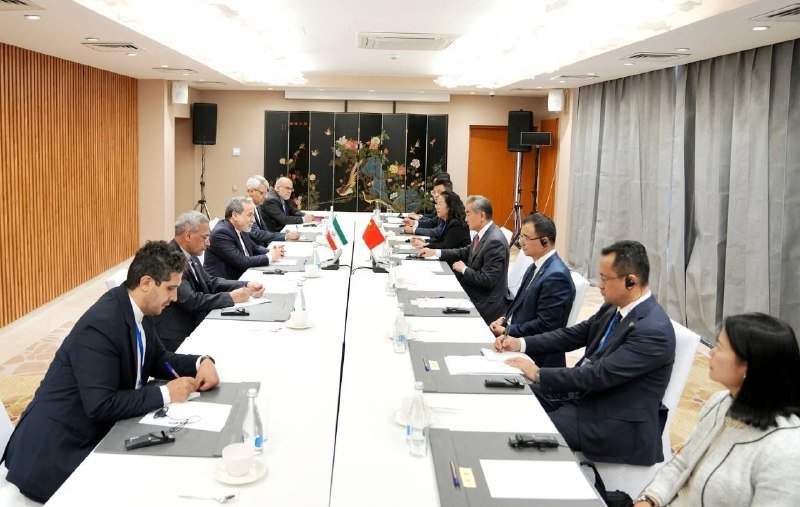
Iranian Foreign Minister Seyed Abbas Araghchi turned an SCO working visit into a three-bilateral push across 24 and 25 July 2026, carrying one message to Moscow, Beijing and Bishkek and reserving the same hostile framing for Washington each time. According to readouts published by Iranian state-aligned outlets between 00:07 UTC and 00:59 UTC on 25 July, Araghchi met Russian Foreign Minister Sergey Lavrov, Chinese Foreign Minister Wang Yi, and Kyrgyz Foreign Minister Kulubayev Zheenbek Moldokanovich on the sidelines of the Shanghai Cooperation Organization's Council of Foreign Ministers, which the available readouts place on a Friday-evening session in Kyrgyzstan, and used each encounter to register the same grievance: that insecurity in the Strait of Hormuz is the product of US bad faith, broken agreements and what Tehran characterises as crimes requiring accountability.
The readouts matter more than the meetings. Three separate bilateral channels, three separate state-aligned outlets, one near-identical substantive line. The pattern is consistent with a deliberate Tehran strategy at moments when the diplomatic cost of talking to Washington is rising: convert a multilateral hosting slot into a rolling set of bilateral venues where the same complaint is registered, in slightly different idioms, with each of the principal powers whose support Iran is trying to lock in. The structural question is whether the SCO legitimises that framing collectively, or whether Iran is doing the legitimising work bilaterally and hoping the umbrella organisation ratifies it later. Note on dating: the Telegram readouts from Tasnim News English refer to "Friday evening" for the bilateral sessions, which on the calendar places them on the evening of 24 July 2026 local Kyrgyzstan time; the readout publication timestamps fall on 25 July 2026 UTC. This article treats the meetings as spanning the late-evening-of-24 / early-hours-of-25 July window per the evidence in hand, and flags the SCO official dating as a separate matter the cited source items do not resolve.
The Hormuz line, repeated three times
The substantive content was narrower than the schedule suggested. According to a Jahan Tasnim readout published at 00:16 UTC on 25 July 2026, Araghchi told Lavrov that insecurity in the Strait of Hormuz is "a direct result of America's bad faith and crimes." A separate Jahan Tasnim item, timestamped 00:07 UTC, summarised Araghchi's message to Wang Yi in identical structural terms: insecurity in the Strait "is caused by the violation of the US agreement and the disruption in the implementation of Iran's obligations." Al-Alam's parallel account of the same Wang Yi encounter, posted at 00:59 UTC, repeated the formulation almost verbatim. The Mehr News readout of the Iran-China meeting, posted at 00:54 UTC, framed the Wang Yi session as a Persian-language counterpart to the Iranian-language runs without adding new policy specifics. The English-language Tasnim account of the Lavrov meeting, posted at 00:45 UTC, carried the same bilateral in a different register: it described the two ministers discussing cooperation across political, economic, transport and energy fields, SCO and BRICS coordination, and Russia's stated readiness to assist on a regional security mechanism, with the Hormuz attribution folded into the broader framing of US conduct.
The Kyrgyz meeting, on the available evidence, was the sharpest of the three. According to the Tasnim English readout at 00:41 UTC, Araghchi's meeting with Kulubayev Zheenbek Moldokanovich covered the SCO foreign ministers' session, regional cooperation, and condemnation of US and Israeli military aggression, with Araghchi invoking UN Charter violations and calling for accountability. The parallel Jahan Tasnim supplementary item at 00:11 UTC, which summarises Iran's appreciation of "the Shanghai Cooperation Organization's decisive position in condemning military aggression against Iran," carried the same aggressive framing and explicitly linked it to the Kyrgyz venue. Monexus analysis: the Kyrgyz readout therefore carried more political-edge language than the Lavrov or Wang Yi meetings and aligned most directly with the SCO statement on military aggression that Araghchi publicly welcomed in the same window, but this assessment is strictly based on the tone of the cited readouts and may reflect Iranian editorial choices about how to summarise each venue rather than substantive differences in what was said.
What the readouts do not specify is which "US agreement" Tehran believes has been violated. The source items refer to "the US agreement" and to "America's bad faith" as settled facts, but they do not name a particular accord, a particular breach, or a particular date of breach. This publication has not independently established whether Tehran is referring to the original 2015 Joint Comprehensive Plan of Action, to a more recent understanding, or to an informal arrangement negotiated earlier in 2026. The wording is consistent with the Iranian negotiating posture that has held publicly since at least mid-2025: when US-Iran tensions re-escalate, Tehran publicly attributes the deterioration to Washington and reserves the right to suspend elements of its own compliance, including cooperation that touches Strait security.
The SCO council, and why the venue matters
The diplomatic venue is not incidental. The Kyrgyz bilateral readout names a specific Kyrgyz location: the Tasnim English account and the Jahan Tasnim parallel item place the Kulubayev meeting in "the city of Starat Atai, Kyrgyzstan," which the SCO's own English-language framing of the venue identifies as Cholpon-Ata, the lakeside resort town on the northern shore of Lake Issyk-Kul that has hosted previous SCO gatherings. The available source items do not specify whether the Lavrov and Wang Yi bilaterals took place at the same venue or at a separate sideline location, and frame all three as occurring on the SCO Council of Foreign Ministers' sidelines in Kyrgyzstan. By hosting the council, Bishkek positions itself, in the readouts Iran is happy to amplify, as the convener of an expanded Eurasian security conversation in which Iran holds a seat at the table as a full member-state. Araghchi's public appreciation of "the Shanghai Cooperation Organization's decisive position in condemning military aggression against Iran," reported by Jahan Tasnim at 00:11 UTC, is the diplomatic counterpart of that framing: Iran reads the SCO statement as multilateral validation of its grievances against the United States, and uses the council as the venue where that validation is banked.
There is, however, an alternative read. The SCO council is also a venue at which Iran is the smallest and most sanctions-exposed member of an otherwise Eurasian grouping that includes India, Pakistan and several Central Asian states with their own reasons to keep the Strait of Hormuz open to international shipping on terms that favour non-belligerent transit. If the SCO collective position on Hormuz drifts toward language that emphasises "freedom of navigation" in neutral terms, that outcome would dilute Iran's preferred framing of Hormuz insecurity as Washington's fault. The available source items show Iran securing the condemnation language it wanted from the SCO on "military aggression," but do not specify whether the council adopted neutral language on Hormuz transit itself.
Russia and China, in their own lanes
The bilateral division of labour is worth noting. The Lavrov meeting, on the available evidence, is being staged as a security-and-sanctions consultation: the English-language Tasnim readout describes the two ministers reviewing political, economic, transport and energy cooperation, SCO and BRICS coordination, and Russia's stated readiness to assist on a regional security mechanism. The Wang Yi meeting, by contrast, leans toward energy and infrastructure: according to the Jahan Tasnim and Al-Alam readouts, the substantive focus was the Hormuz attribution and the implementation of Iran's obligations under the unnamed US agreement, framed in the diplomatic register Beijing uses when it wants to acknowledge an Iranian grievance without endorsing the operational steps Tehran might be considering. The two readouts do not contradict each other; they simply do not overlap. Monexus analysis: that non-overlap is itself a signal of how the Sino-Russian relationship with Iran has matured into a layered arrangement in which Moscow handles the security file and Beijing handles the diplomatic-and-commercial file, and Tehran gets to talk to both in a single working visit. The pattern is structurally similar to the read-out asymmetry Beijing and Moscow have used in earlier Iran-side statements since 2024.
The Kyrgyz session sits awkwardly in that frame. Bishkek is neither a nuclear-armed backer of Iran nor a large buyer of Iranian crude, but it is a host whose public endorsement of the SCO's "condemnation of military aggression" language carries weight because Kyrgyzstan is the convening state. The available readouts treat the Kyrgyz meeting as a courtesy plus a political-endorsement opportunity rather than a substantive policy session, but the absence of policy specifics may be a function of what the source items disclose rather than what the meeting actually covered. The available source items do not specify whether Bishkek offered any operational commitments on transit, sanctions evasion or security coordination.
What the day does not settle
The Kyrgyzstan visit establishes a Tehran record; it does not establish a settlement. None of the three bilateral readouts references a forthcoming negotiation, a confidence-building step, or a date for resumed US-Iran contact. The Chinese and Russian sides, on the evidence available, have offered Iran a diplomatic venue rather than a mediation track. The Kyrgyz meeting was a political-consultation session at which the host's standing was the asset Iran was drawing down. The next concrete date to watch is the next SCO summit communiqué; that text, when it appears, will reveal whether the organisation as a whole has accepted Tehran's framing of Hormuz insecurity as the product of US bad faith, or held itself to a more neutral line on freedom of navigation in the Strait.
The narrow uncertainty is the identity of the "US agreement" Tehran cites. The wider uncertainty is whether the diplomatic packaging of the Hormuz grievance in Kyrgyzstan changes anything at sea. The available source items do not specify any change to Iran's posture on Strait transit, on IRINMC patrols, or on commercial shipping access, and this publication has not independently established whether any such operational change has been signalled outside the SCO venue. The dating is also not fully resolved inside the cited evidence: the Telegram readouts refer to "Friday evening" and publish in the 25 July UTC window, while an authoritative SCO readout dating the council to 24 July 2026 in Cholpon-Ata would push the bilateral cluster back into the previous calendar day in local time.
Desk note: Monexus framed this as a coordinated Iranian diplomatic offensive across three SCO-side bilaterals in Cholpon-Ata, rather than as a single China-Iran event, because the available readouts show the same Hormuz grievance registered separately with Moscow, Beijing and Bishkek. The wire coverage most likely to follow will lead with the Lavrov or Wang Yi meeting individually; the more analytically interesting story is the layered diplomatic record being assembled in a single working visit, and the question of whether the SCO umbrella eventually ratifies the framework Tehran is constructing bilaterally.
Wire provenance
This editorial synthesis draws on the following public wire/social posts:
- https://t.me/JahanTasnim/226675
- https://t.me/JahanTasnim/226673
- https://t.me/JahanTasnim/226674
- https://t.me/tasnimnews_en/27793
- https://t.me/tasnimnews_en/27791
- https://t.me/tasnimnews_en/27792
- https://t.me/mehrnews/399536
- https://t.me/alalamfa/347696