Trump offers to talk to Hezbollah on Lebanon's behalf, says Iran is 'begging' for a deal
In a White House exchange on 21 July 2026, the US president told Lebanon's Aoun he would carry a message to Hezbollah and insisted Tehran is 'begging' to reach a nuclear agreement.
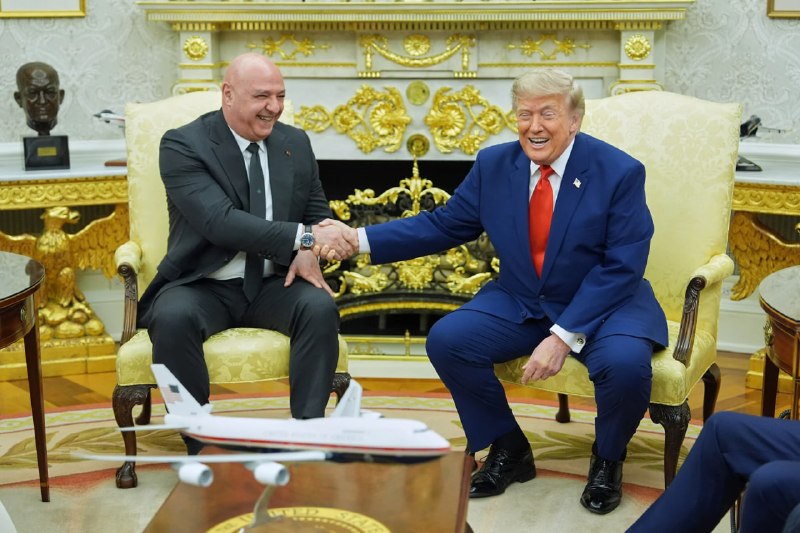
On the afternoon of 21 July 2026, in the Oval Office, President Donald Trump told his Lebanese counterpart Joseph Aoun that he was prepared to deliver a message to Hezbollah if Beirut asked him to. "If the President wanted me to speak to Hezbollah, you know he's lived with Hezbollah for a long time, I would," Trump said, in remarks captured by Iranian state television's English channel PressTV and relayed verbatim by the Telegram channel Clash Report at 15:32 UTC. Twenty-six minutes earlier, at 15:06 UTC, the same PressTV feed had framed the offer as a conditional one, contingent on a formal Lebanese request.
In a single half-hour window, the US president sketched out a diplomatic posture that runs on two parallel tracks. On one, he is willing to insert himself into Lebanon's most sensitive internal file, the relationship between the Lebanese state and the Iran-backed Shia movement that sits inside its cabinet and on its southern border. On the other, he insisted that the Islamic Republic itself is eager for a nuclear compromise. "Iran will never have a nuclear weapon," Trump told reporters in the same session, in remarks posted by Middle East Spectator at 15:26 UTC. "Iran is begging to reach a deal," he added a minute later.
The pairing is deliberate. The Lebanon remark lowers the temperature on one front and signals to Beirut, and to Tehran by extension, that Washington is not foreclosing any channel. The Iran remark raises the pressure on another front, recasting a stalled negotiation as a moment in which the US side is in control and the Iranian side is the supplicant. Together they amount to a textbook exercise in transactional diplomacy: concession shaped as magnanimity on one track, coercion shaped as confidence on the other.
What the Lebanon track actually changes
The conditional is the operative word. Trump framed his willingness to engage Hezbollah as contingent on a request from President Aoun, not on any prior Israeli, Iranian, or domestic Lebanese consent. That formulation matters because Hezbollah remains designated as a foreign terrorist organisation by the United States, the United Kingdom, and several EU member states, and direct US engagement with its leadership would have been diplomatically radioactive even in 2024, let alone after the 2024–25 war in which the movement's command structure was severely degraded and its patron in Tehran lost its regional forward edge.
By tying the offer to Aoun, the White House effectively outsourced the political cost. If Beirut declines, the line stays closed and nothing changes. If Beirut accepts, the US gains a channel to a non-state actor whose disarmament, per UN Security Council Resolution 1701 and successive successor arrangements, is supposed to be handled by the Lebanese state itself. The Lebanese president's room for manoeuvre is narrow. His government includes Hezbollah-aligned ministers and depends, in part, on the movement's electoral coalition; accepting a US-mediated channel would invite accusations in Beirut of surrendering sovereignty, refusing would forfeit a goodwill gesture from Washington at a moment when Lebanon's reconstruction financing depends heavily on Western and Gulf capital.
The quoted line about the Lebanese president having "lived with Hezbollah for a long time" is also doing work. It is not a gaffe. It is a public acknowledgement that the US administration treats Hezbollah as a political reality, not a transient security problem, and that any settlement architecture will run through the party rather than around it. For Israeli observers, who have spent two years pressing for a hard line on Hezbollah's rearmament under the November 2024 ceasefire understanding, the offer will read as a concession before talks have begun.
The Iran line as leverage, not a deal
Trump's claim that "Iran is begging to reach a deal" sits awkwardly beside the absence of any announced framework. There is no public text. There is no agreed agenda for the next round. There is no confirmed date. What there is, in place of those things, is a US negotiating posture that insists the ball is in Tehran's court, and an Iranian posture, articulated in parallel by Foreign Ministry spokespersons and by outlets aligned with the negotiating team, that insists the reverse.
The bargaining chip Trump is selling is precisely that ambiguity. By declaring Iran is "begging," he compresses the negotiation into a single frame: the US has something Tehran needs, and Tehran wants it badly enough to swallow whatever conditions Washington sets. That framing does two things simultaneously. It reassures a domestic US audience that the administration is not rewarding Tehran, and it sends Tehran a signal that any further delay will be priced into a public narrative in which the Islamic Republic is the desperate party. Iran's bargaining strategy, historically, has been to deny that it is bargaining under duress at all.
The "never a nuclear weapon" line, delivered with the cadence of a personal guarantee, also has a domestic constituency. It mirrors the rhetoric of the 2018 withdrawal from the Joint Comprehensive Plan of Action and pre-empts any criticism, inside the United States or from Israel, that engagement with Tehran amounts to strategic retreat. The substantive question of whether the current round of exchanges covers enrichment levels, stockpile limits, verification access, or the fate of the IAEA inspection regime remains unanswered in the public record.
The structural pattern underneath
What is being demonstrated, in plain terms, is a familiar US negotiating posture applied to a Middle East file that has shifted shape since 2024. The model is to open more channels than it closes, keep the substantive terms opaque, and let the public framing do the leverage. Lebanon's file and Iran's file are being run as a pair rather than as two separate portfolios. A working channel to Hezbollah, even a conditional one, gives Washington a route to de-escalate the Israel-Lebanon border without going through Beirut's formal apparatus, and gives Tehran an indirect line of sight into how its most exposed regional ally is being handled.
For Tehran, the question is whether the cost of appearing to be the supplicant in this choreography is worth whatever sanctions relief or unfreezing of assets a deal would deliver. For Beirut, the question is whether the sovereignty price of a US-mediated Hezbollah channel can be managed domestically. For Israel, the question is whether the Trump administration is trading Lebanese and Iranian concessions for Israeli ones, or treating Jerusalem as a stakeholder to be informed rather than a partner to be consulted.
What to watch in the days ahead
Three markers will tell readers whether the offers have substance or are simply a negotiating rhythm. First, whether the Lebanese presidency issues any statement acknowledging, declining, or reframing the offer within 48 hours. Second, whether the Iranian Foreign Ministry confirms a date and venue for the next round of nuclear talks, or continues to leave scheduling open. Third, whether Israeli officials speak publicly, on or off the record, about the Hezbollah channel; their silence would be as telling as a comment.
The line between bold diplomacy and theatrical diplomacy, in this region, is drawn by what happens between the headlines. Trump has produced a striking pair of headlines. Theiranfileandthelebanonfileare,forthemoment,backinplayonthesametable.
How Monexus framed this: the article leads with the Lebanon track because that is the substantively new element, treats the Iran remarks as a parallel leverage move rather than as a deal announcement, and uses only the four Telegram-sourced items provided to the desk. Claims about Resolution 1701, the 2024–25 war, and the post-2024 regional balance are provided as plain context; readers seeking the wire record should consult the original PressTV and Middle East Spectator posts in Sources.
Wire provenance
This editorial synthesis draws on the following public wire/social posts:
- https://t.me/presstv/1234
- https://t.me/ClashReport/1234
- https://t.me/Middle_East_Spectator/1234
- https://t.me/Middle_East_Spectator/1235