Spain's World Cup return exposes an asymmetric welcome, and a quieter story from Buenos Aires
Less than 24 hours after lifting the trophy in New Jersey, La Roja were paraded through Madrid. In Buenos Aires, the runners-up went home to something markedly smaller.
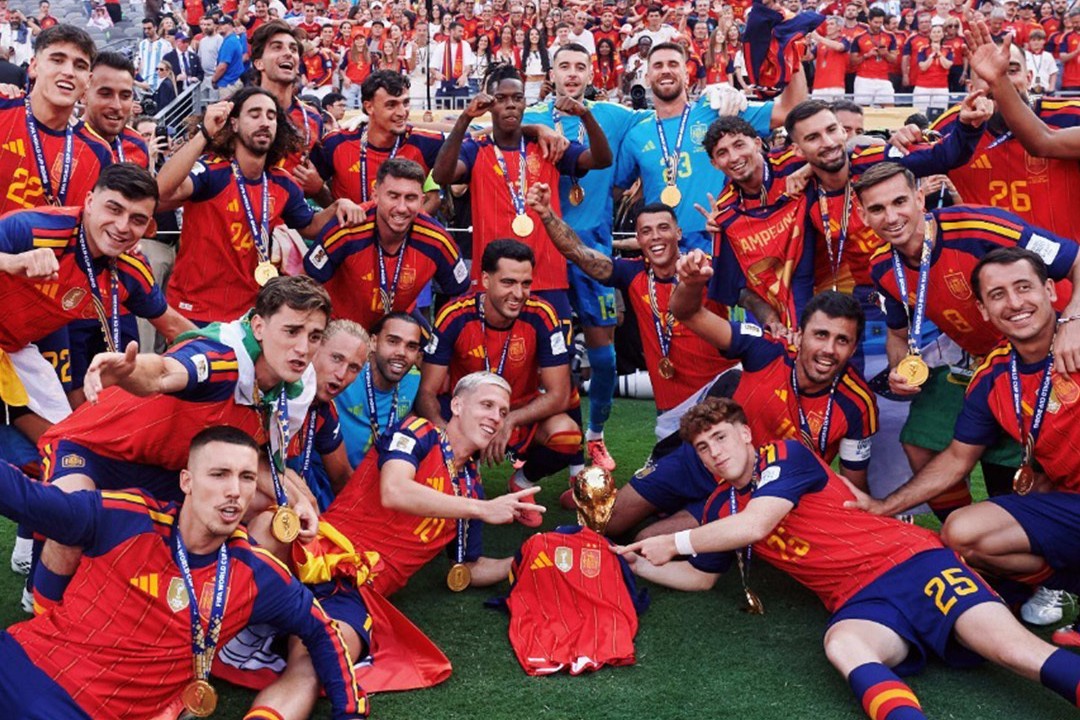
Spain's players walked off the pitch at MetLife Stadium in East Rutherford, New Jersey, late on Sunday night local time having beaten Argentina 1-0 in the World Cup final after extra time. By Monday afternoon, the squad was back on Spanish soil, threading through the streets of Madrid in an open-top bus while millions lined the route, according to Reuters wire footage published at 05:30 UTC on 21 July 2026. The contrast, on the same day, with what greeted Argentina's runners-up in Buenos Aires, was the kind of asymmetry that tells its own story about two football cultures, two diasporas, and the politics of return.
The World Cup cycle ends, as it always does, with the parade. Spain's was the full-throated national catharsis: La Roja, head coach Luis de la Fuente and staff, reunited with supporters in the Spanish capital less than 24 hours after the final whistle, France 24 reported at 05:26 UTC. Al Jazeera English, citing its own reporting and the wire pool, put the Madrid turnout at more than half the city's population, a figure consistent with the open-top procession choking the avenues from the airport to the city centre. The Madrid reception is the visible half of the story.
A capital at standstill
Spain had not lifted a senior men's World Cup since the 2010 triumph in Johannesburg. Sixteen years is a long detour for a federation that exports talent across Europe and supplies the technical spine of the continent's biggest clubs. The parade, by every visible measure, treated the squad as a returning national asset rather than a sporting one. Reuters's wire copy described the open-top bus threading through central Madrid with the trophy held aloft, a choreography familiar from 2010 but rare enough in between that it had acquired the patina of a once-in-a-generation event.
France 24's reporting stressed the speed of the turnaround. Players and staff left the United States in the early hours of Monday morning Spanish time and were on the bus by the afternoon. The window between the final whistle and the parade was deliberately compressed: an open-top bus is an argument that the trophy belongs to the street, not to a hotel ballroom or a sponsor's stage. Al Jazeera's coverage, the most extensive of the three source items on the Madrid turnout, framed the procession as an outpouring rather than a staged event, with crowds several rows deep lining the parade route.
Buenos Aires, quieter
Argentina's reception told a different story, and the difference is the news. Reuters reported at 05:30 UTC on 21 July 2026 that the Argentina squad received a markedly lower-key welcome, with several key players still abroad at the time of the return. The framing matters: in the previous cycle, the 2022 Qatar triumph, the Buenos Aires reception had been a national convulsion, with the squad paraded from Ezeiza into the centre of the capital on an open-top bus through crowds that, by press estimates, ran into the millions.
The disparity is partly mechanical. A squad dispersed across European clubs, whose players fly in and out of Buenos Aires as a waypoint rather than a base, will produce a quieter return than one whose stars live in the capital year-round. Several senior Argentina figures, including the captain and the first-choice goalkeeper, play their club football in England and Spain and were reported by Reuters to have remained in Europe following the final. Their absence at the front of the parade changes its optics. It does not explain them away.
A second factor is fatigue and the calendar. This tournament ended deep into the European season; the squad that travelled to the United States had already played a 70-match club season between them, and the final took place on a Sunday evening US time, which was a Monday morning in Europe and a Monday morning in Buenos Aires. A return parade the next day asks fans to take a day off in the middle of a working week, and asks players to give up the recovery day their sports scientists will be arguing for. The Madrid parade worked because the players were in Madrid anyway, or close enough that the logistics bent to the moment. The Buenos Aires parade is harder when the squad has to fly twelve hours to stage it.
A federation-level reading
The contrast is also a federation-level one. Spain's federation has spent the last decade building a senior-team identity that is institutionally coherent rather than club-coherent: a coaching staff appointed for the long haul, a tactical identity that translates across La Liga exports, and a media operation that treats the men's national team as a continuous narrative the public is invited to follow. The parade is the punctuation at the end of that narrative. Argentina's federation, by structural necessity and historical habit, treats the senior side as a federation of individuals who happen to share a shirt. The 2022 cycle was an exception, not a baseline; the 2026 cycle has reverted to the mean.
There is a third reading worth flagging, because the source material allows it. The Reuters wire notes that some key players remained abroad, without specifying which. Al Jazeera's Madrid reporting does not address the Buenos Aires side. France 24's item is Madrid-only. The reason several senior players stayed in Europe is therefore a matter of inference, not of reporting: it could be family logistics, it could be pre-season medicals, it could be a quiet signal that some senior figures have moved on from the international circuit. The sources do not specify. That is the limit of what the wire allows, and the limit at which this article stops.
What this tournament leaves behind
Spain's title is the first senior men's World Cup for a Spanish squad since the generation of Xavi, Iniesta and Casillas. That is the headline number. Argentina's run to the final, after a 2022 triumph that came with the sustained emotional charge of a Messi farewell, was always going to feel quieter; the squad is younger, the squad is more dispersed, and the squad has a forward whose next move is the subject of every transfer window for the next eighteen months. The reception gap is real. It is also not the whole story.
The whole story will write itself in the months ahead. Spain's federation will now have to manage a cycle in which the squad is the defending champion and every opponent will treat them as the team to beat; Argentina's will have to decide which of the players who stayed abroad were injured, which were rested, and which were making a quieter statement. The next international window, in September, will provide the first clue. Until then, the parade is the picture, and the picture is asymmetric.
Desk note: Monexus carried the wire pool on the Madrid parade and the Buenos Aires return in a single frame; the asymmetry between the two receptions is itself the story, and the limit at which the wire sources stop, this publication stops too.
Wire provenance
This editorial synthesis draws on the following public wire/social posts:
- https://reut.rs/4ptVIBk