A live-fire drill off Okinotori tests the line between protest and presence
Tokyo summoned Beijing's envoy after a Chinese destroyer, joined by a Russian warship, fired inside waters Japan claims as its exclusive economic zone near Okinotori Island.
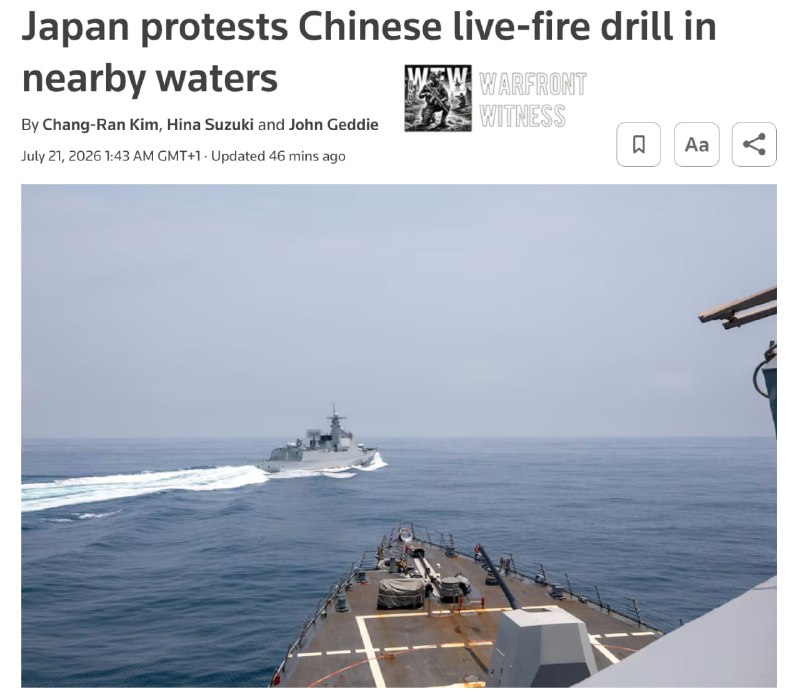
A Chinese destroyer, escorted by a Russian warship, fired live rounds inside waters Japan claims as its exclusive economic zone near Okinotori Island on 21 July 2026, prompting Tokyo to lodge a diplomatic protest with Beijing and summon China's ambassador. The drill, reported by Reuters at 09:41 UTC and amplified by Telegram's wfwitness and ClashReport channels, places a Sino-Russian formation directly on top of a tiny Japanese-administered feature that has been a contested marker in East China Sea sovereignty disputes for years. The Japanese protest frames the action as an incursion; Beijing's framing, when it lands, will almost certainly treat the drill as routine open-sea activity. Both readings have weight, and the gap between them is precisely the story.
The tactical significance is less the live fire itself, which lasted an as-yet-undisclosed duration, and more the pairing. A Chinese destroyer and a Russian vessel operating together inside a zone Tokyo considers sovereign-adjacent waters is a deliberate signal that the two militaries intend to keep showing up together in the spaces Japan patrols alone. Beijing and Moscow have deepened naval cooperation since 2022, with joint patrols through the Tsushima Strait and around the Sakhalin coast now an annual fixture. Sailing into the Okinotori EEZ with guns blazing reframes those routines as operations.
What Okinotori is, and why it matters
Okinotori is a coral atoll roughly 1,800 kilometres south of Tokyo. Its legal status is contested: Japan maintains it as an island under the UN Convention on the Law of the Sea, which would extend a full EEZ around it; China and South Korea both regard it as rocks, which would not. The distinction governs who controls fishing rights, seabed resources, and the airspace overhead. Chinese and Russian naval vessels passing through waters Japan maps as EEZ is not new. Live-fire exercises inside them are rarer, and a joint exercise rarer still.
For Tokyo, the protest is the procedural floor. A formal démarche through the foreign ministry signals that any further incident will be tracked and rebadged, not absorbed. Japan's Self-Defence Forces are already rotating surveillance assets through the area, and the response architecture is in place. The question the drill forces is whether Japan now treats each transit as an event to log, which raises the political cost of repetition.
The counter-narrative from Beijing
Beijing's framing of routine naval activity in the western Pacific has been consistent: Chinese warships operate in international waters and on seas that Chinese legal doctrine considers historic. The Chinese Foreign Ministry has previously dismissed Japanese EEZ claims around Okinotori as inconsistent with UNCLOS, arguing the feature does not meet the convention's definition of an island capable of generating one. From that vantage, a live-fire drill inside waters Japan maps as EEZ is a drill in open sea. Read this way, the Japanese protest is the problem, not the drill.
There is a parallel structural reading: the Russia-China naval axis is no longer aspirational. Joint drills through 2024 and 2025 have moved from photo-op to operational. Sailing near Okinotori with a Russian vessel is one data point in a slow accumulation, designed less to win any single encounter than to accustom regional observers to the presence.
Where this sits in the regional picture
The drill lands in a security environment that has hardened quickly. Japan's 2022 strategic documents formally named China as the principal strategic challenge; defence spending has climbed toward the NATO two-percent benchmark. South Korea and the Philippines have deepened their own maritime coordination with Tokyo. The United States has kept carrier strike groups transiting the Philippine Sea on a near-continuous schedule. A Sino-Russian live-fire exercise inside a Japanese-claimed EEZ reads, against that backdrop, as a calibration of how much presence Tokyo will protest and how Washington will respond.
The economic reading is quieter but no less real. The waters around Okinotori sit on fishing grounds Japan values and on seabed survey corridors where mineral-rights questions are not yet settled. Marking the area with live fire is a way of reminding every claimant that the legal status is unresolved and that Beijing intends to keep contesting it at sea, not at The Hague.
What to watch next
Three dates will matter in the next 30 days. First, whether Beijing's Foreign Ministry issues a counter-statement acknowledging the drill and dismissing the protest, which it has done in previous EEZ encounters; silence would itself be unusual and worth tracking. Second, whether Moscow confirms the Russian vessel's identity and role through its defence ministry, which would harden the bilateral reading of the exercise. Third, whether Japan's Maritime Self-Defence Force releases patrol data or shadowing details from the incident, which would indicate whether Tokyo intends to escalate the procedural response beyond a diplomatic note. Each is a small tell. Read together, they will tell you whether 21 July becomes a one-line item or the opening of a longer chapter.
This article was prepared by Monexus staff from wire and Telegram sourcing. Where a claim rests on a single Telegram post, that post has been cross-checked against Reuters reporting on the same event.
Wire provenance
This editorial synthesis draws on the following public wire/social posts:
- https://t.me/wfwitness
- https://t.me/ClashReport