Spain's second World Cup, by way of Delhi: how a Sunday final in the subcontinent's viewing economy ended at Lusail
A final watched through Delhi restaurant policy, a Spanish brand of football, and the realisation that the world's largest viewing public now sits firmly inside the subcontinent.
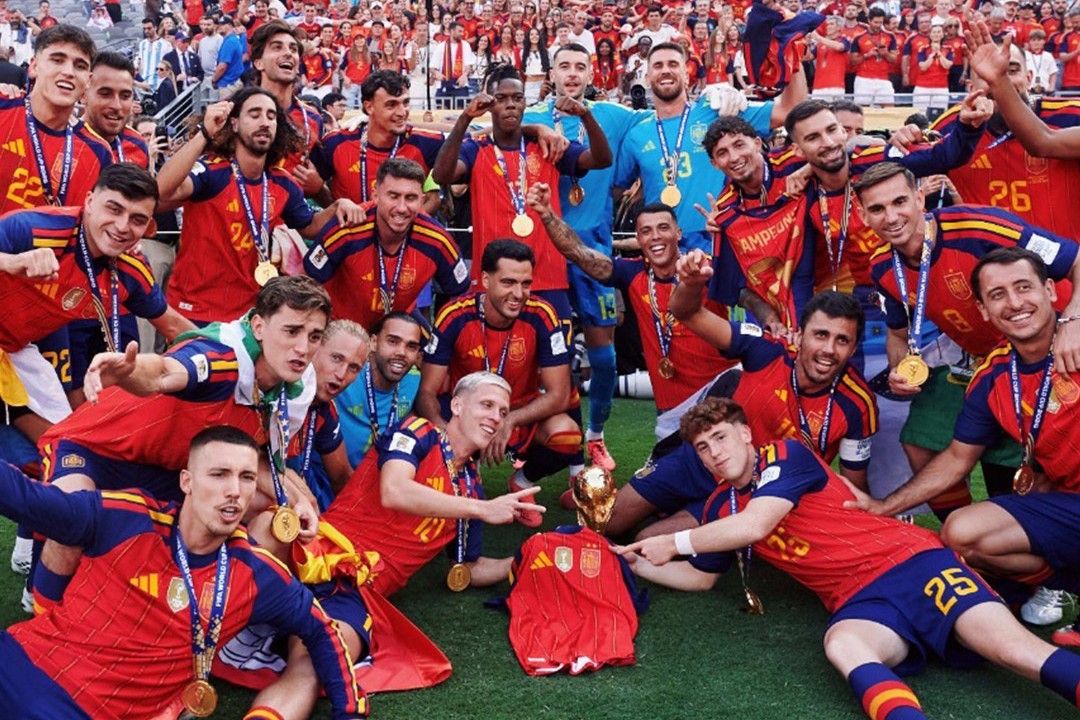
Lusail Stadium held a full house on the night of 19 July 2026 as Spain beat Argentina to win a second FIFA World Cup. Within hours, the story had already travelled further than the trophy: by Saturday's afternoon in New Delhi, the chief minister's office had cleared restaurants, cafés and other eligible establishments across the national capital to extend operating hours for the final, casting India's largest city as a viewing hub rather than a spectator.
The win itself, the second for a European nation to lift the tournament in this cycle, is the headline. The under-told story is the gravitational pull the event exerted on the subcontinent's consumer economy, broadcast rights grid, and political attention cycle, with the Delhi government's pre-final order to extend restaurant hours on the day of the match a small but telling instance of a state treating the tournament as civic infrastructure rather than mere entertainment.
What Spain built on the pitch
Spain's second world title arrived after a tournament in which the side's football, the patient possession game refined through La Masia and exported across Europe, was reportedly singled out by ThePrint editor-in-chief Shekhar Gupta as the defining identity of the win, with the country's politics and the institutional continuity of its academies framed as load-bearing components of the result. ThePrint's #CutTheClutter episode 1864 placed the sporting win alongside the country-of-origin analysis, treating the trophy as an artefact of state habit rather than a one-off upset.
That framing matters because it filters out the more familiar football narrative: a star striker turning the match, an individual moment of brilliance. Spain's second title reads, in the framing ThePrint highlighted, as a victory for system.
How Delhi chose to host the watch party
Days before the final, on Saturday 18 July 2026, Delhi Chief Minister Rekha Gupta announced that restaurants, cafés and other eligible establishments across the national capital could operate at extended hours on the day of the final, a permissive licensing signal from a city government treating a sports broadcast as a public accommodation. The exact restaurant and café hours were not published in the Telegram brief, and the Delhi government's notification portal would need to be checked for the operative numbers.
LiveMint's reporting on the announcement did not specify whether bars and clubs were pulled into the extension or whether the order applied only to food-led establishments. What is clear is the scale of the contemplated audience: a Sunday-evening match between Argentina and Spain does not normally warrant a chief-ministerial scheduling intervention, and the fact that this one did is itself a marker of how Indian state actors read football viewing in 2026.
The viewing economy that was already there
The subcontinent's football audience is no longer a rounding error in FIFA's broadcast ledger. India's rights-holders, broadcasters, and digital platforms have spent the last four years building scheduling logic around the subcontinent's prime-time appetite. A final scheduled to kick off in the European evening lands in Indian late-evening, an inconvenient hour for stadium-style watch parties and a permissive one for licensed food-and-drink venues.
The Delhi order, even in its permissive form, signals that urban Indian state governments are willing to adjust the licensing frame for major football events in ways they would not for, say, a domestic cricket fixture, where the broadcast already sits inside the working day. The asymmetry is small but real. Cricket in India has its own sovereign audience logic; football must compete for the evening slot, and any official assist to that competition is read by the industry.
What the headline leaves out
Three caveats worth flagging. First, Spain's second World Cup was decided in a final played at a Qatar venue originally built for the 2022 tournament, at a site whose place in the Gulf's sports-and-statecraft diplomacy has been thoroughly litigated elsewhere. Second, the Argentine side that lost the final is not the Argentine side Lionel Messi carried to the 2022 title in the same calendar generation; the gap between a defending champion and a contender is partly an artefact of squad turnover the wire headlines rarely pause on. Third, the Delhi government's permissive restaurant order is a state-level signal, not a national one; other metropolitan centres may choose differently, and broadcasts are visible across state borders in any case. These are the kinds of threads the dominant narrative flattens in its rush to the trophy moment.
A reasonable reader can hold two framings at once: Spain won because Spain plays Spain's way, a national-system conclusion that survives scrutiny; and a sports event of this magnitude is now, structurally, a subcontinental hosting problem, with Delhi's city government pre-clearing the watch party as part of the score.
This piece is part of Monexus's Asia desk coverage of how major sporting events reshape the urban-political geography of the subcontinent.
Wire provenance
This editorial synthesis draws on the following public wire/social posts:
- https://t.me/ThePrintIndia/
- https://t.me/LiveMint/
- https://t.me/thePrintIndia/
- https://en.wikipedia.org/wiki/2026_FIFA_World_Cup_final