U.S. ATACMS launches from Kuwait toward Iran reported in late-night exchange as drones hit Gulf state
A burst of Telegram traffic in the final hour of 19 July 2026 claims U.S. Army ATACMS fired from Kuwait toward Iran, while Kuwait's army says it is shooting down drones tied to an Iranian attack. The reporting is unconfirmed and the accounts partially contradict one another.
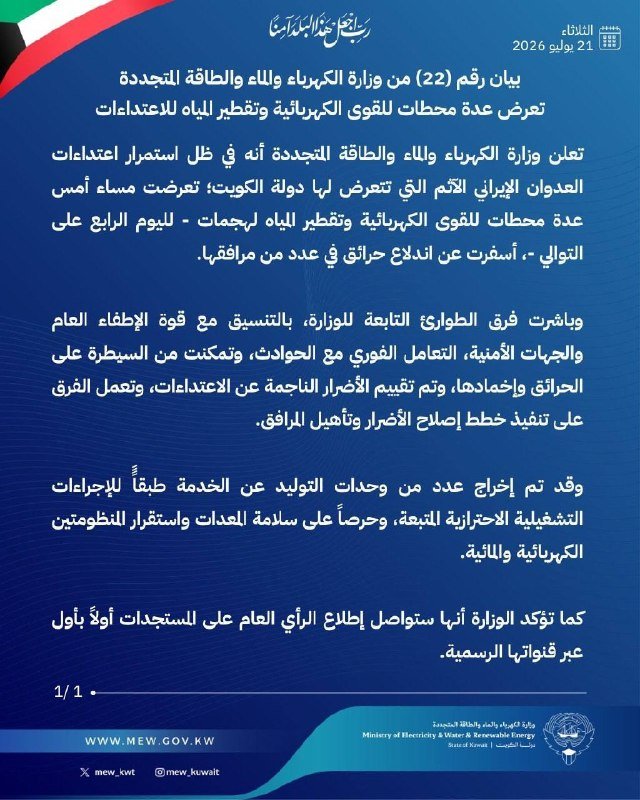
At 23:10 UTC on 19 July 2026, the Telegram channel wfwitness posted a brief, unverified flash: "Unconfirmed reports of U.S. launches from Kuwait towards Iran." Seven minutes earlier, the Russian-aligned channel IntelSlava had put a finer point on the same report, claiming that "the U.S. Army launched at least two ATACMS tactical ballistic missiles from Kuwait toward Iran." Roughly forty minutes before either post, at 22:32 UTC, Iran's Fars News International carried a statement attributed to the Kuwaiti army saying that Kuwaiti air defence was "currently intercepting hostile drone attacks following Iran's attack."
Read together, the three wire-service-style Telegram posts describe a reciprocal strike-and-counter-strike between U.S. forces based in Kuwait and Iranian targets, with Kuwait itself coming under drone fire attributed to Iran. The reporting is fragmentary, the sourcing mixed, and the accounts partially contradict one another. What can be said with confidence is narrow: at least three Telegram channels, one of them Iranian state-affiliated, reported cross-border fire involving Kuwait, the United States, and Iran inside a single late-night window.
What the channels actually said
The most concrete of the three is the IntelSlava post at 23:03 UTC, which claims a specific weapon system (ATACMS, the Army Tactical Missile System) and a specific launch origin (Kuwait). ATACMS is a real U.S. Army weapon family, surface-launched and conventionally armed in most variants, with a range of several hundred kilometres depending on the block. The channel is a well-known Russian-military-affiliated feed and has previously carried claim-and-counter-claim traffic about strikes in the Russia-Ukraine war and around the Middle East; its reporting should be treated as a single-source claim, not as confirmation.
wfwitness, at 23:10 UTC, reproduced the same report in more cautious language ("unconfirmed reports"), which is closer to how the wire services handle such flashes when only one or two sources are carrying them.
The Iranian state-affiliated Fars News International post, at 22:32 UTC, is the most institutionally specific: it attributes a statement to the "Kuwait Army" saying its air defence is "interception hostile drone attacks following Iran's attack." That phrasing acknowledges an Iranian strike against Kuwait and an active Kuwaiti air-defence engagement. Fars is the foreign-language outlet of Iran's state broadcasting apparatus and carries a clear editorial line; the underlying Kuwaiti statement, if genuine, would be the load-bearing primary source.
Where the accounts conflict
The three posts do not fully agree. IntelSlava places the United States as the initiator of missile fire from Kuwait toward Iran. Fars, drawing on what it says is a Kuwaiti army statement, places Iran as the initiator of drone fire at Kuwait, with Kuwaiti air defence responding. The two accounts are not strictly incompatible, a sequence in which Iran strikes Kuwait and U.S. forces in Kuwait then strike back at Iranian targets would satisfy both, but neither Telegram channel offers the timeline, the target coordinates, or the casualty picture that would let a reader verify the order of events.
The sourcing mix matters here. Two of the three channels (IntelSlava and wfwitness) carry traffic that has historically been sympathetic to narratives of Western overreach, while the third (Fars) carries the line of the Iranian state. None of the three is a Western wire service, an Israeli defence outlet, a UN agency, or a Gulf state news agency. Reuters, the Associated Press, Al Jazeera, the BBC and the Defense Department had not, in the material available to this publication at the time of writing, posted corresponding confirmations. The reporting is, in wire-service parlance, single-source at best and contested at worst.
What can be said structurally
Even before the picture firms up, the configuration of the three reports fits a pattern that has been visible across 2026: the Gulf has become a launch platform rather than a buffer. Kuwait hosts U.S. Army forward-deployed formations, including air-defence and rocket artillery units, as well as the operational headquarters of U.S. Army Central (ARCENT) at Camp Arifjan. Iranian and Iran-aligned forces have, in recent rounds of escalation, struck at the territory of states hosting U.S. forces rather than at U.S. bases alone. The reporting tonight, if it holds, places that pattern at its sharpest: a Gulf state simultaneously firing missiles at Iran and intercepting Iranian drones over its own airspace.
The political geometry that produces this is not new. Kuwaiti domestic politics do not permit the country to be a willing co-belligerent. Kuwait's parliament and its foreign-policy establishment have historically worked to keep the country from being drawn into open conflict between the United States and Iran, in part because Kuwait's Shia minority and its Iranian-aligned offshore gas field (the Dorra / Arash dispute with Tehran) make it structurally exposed. That Kuwaiti army air-defence crews are reportedly active tonight does not, by itself, indicate a Kuwaiti decision to enter the war; it indicates that Iranian munitions are arriving in Kuwaiti airspace and that Kuwaiti personnel are doing the job they are paid to do.
What remains unverified
The three Telegram posts do not establish: the number of ATACMS launched, if any; the targets inside Iran; the targets inside Kuwait of the Iranian drones; whether there are Iranian or U.S. casualties; whether Kuwait has formally attributed the drones to Iran in a public statement beyond what Fars reports; whether the U.S. Central Command has acknowledged or denied the launch; or whether any Gulf state other than Kuwait has been struck. The sources do not specify whether the drones Fars refers to are one-way attack drones, reconnaissance drones, or missiles that Fars is characterising as drones.
A reader working only from these three reports cannot tell whether the United States struck Iran first, Iran struck Kuwait first, or both strikes happened near-simultaneously against different targets. The most that can be said is that on 19 July 2026, between 22:32 UTC and 23:10 UTC, Telegram channels with Russian, Iranian, and independent alignment all reported cross-border fire involving Kuwait, the United States, and Iran. Confirmation from a Western wire service, from the U.S. Defense Department, from the Kuwaiti ministry of defence's own channels, or from Iranian state television's English service would materially change the picture. As of this publication, those confirmations are not in hand.
This publication is reporting the Telegram traffic as it stands and refusing to attribute the sequence of events until a wire confirmation or a primary-state statement lands. The framing here deliberately leaves open the question of who struck first, because the available sources do not settle it.
Wire provenance
This editorial synthesis draws on the following public wire/social posts:
- https://t.me/wfwitness
- https://t.me/intelslava
- https://t.me/FarsNewsInt
- https://en.wikipedia.org/wiki/MGM-140_ATACMS
- https://en.wikipedia.org/wiki/Camp_Arifjan