Spain's World Cup win and the small games the post-match commentary plays
A 2026 final settled on the pitch is being reframed off it as a referendum on the host nation. The framing deserves a closer look.
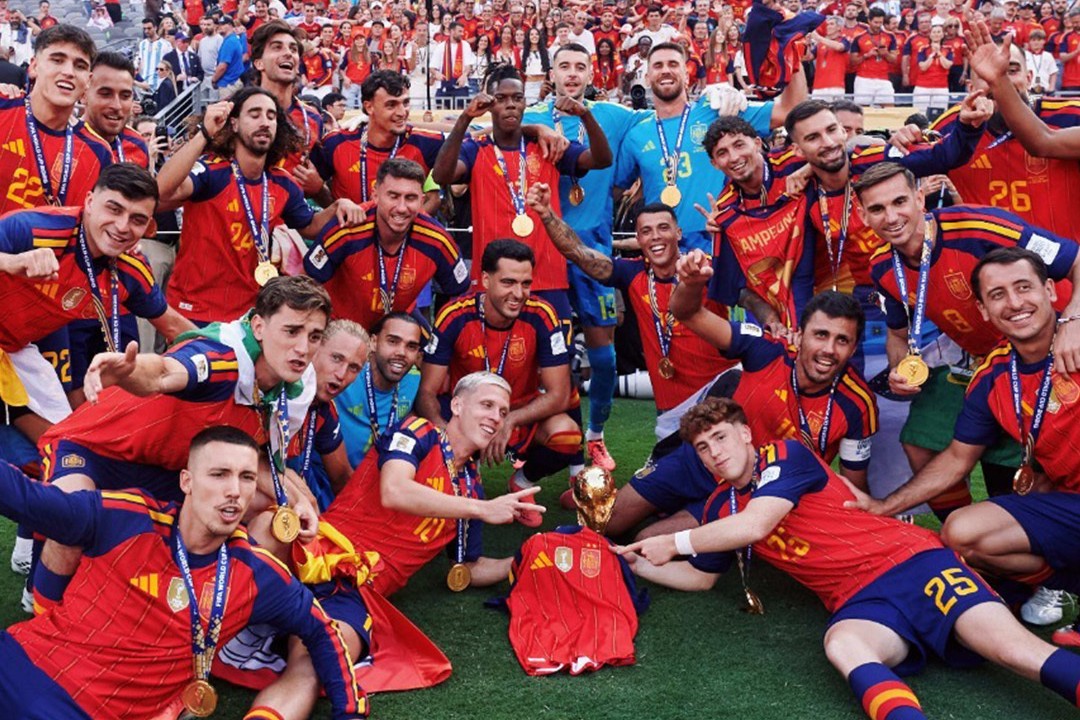
Ferran Torres scored. Spain, playing the 2026 final at a neutral venue, were proclaimed world champions at 22:09 UTC on 19 July 2026. Within thirteen minutes of the goal, the teleSUR English feed had the line, the GeoPWatch account on Telegram had the kicker ("To the world, you're welcome"), and the joke template had already calcified: Spain won; the United States hosted; therefore the United States hosted badly. The match result is settled. The interpretation of the tournament is not.
What makes the post-match framing worth examining is not the joy or the disappointment, both of which are legitimate. It is the speed with which a discrete sporting event is converted into a verdict on a host country, and the willingness of commentary channels from several political directions to repeat the same sentence. The reading deserves to be tested against what is actually verifiable.
The match itself
The final's decisive moment was straightforward: a Ferran Torres goal, reported live at 21:43 UTC on 19 July 2026 by teleSUR English, and confirmed within minutes by the CubaDebate Telegram channel and the GeoPWatch account. The tone on those feeds was congratulatory and brief. The football did what football does. Spain, a side that had entered the tournament without the burden of pre-tournament favouritism, took the one chance that mattered against an Argentina team that has spent a decade defining what elite international football looks like. There is no controversy in the result. The dispute is entirely about what the result is taken to mean.
The host verdict
The line "the US hosted the worst world cup in the history of football" circulated within minutes of full time, paired with the cheeky addendum that the United States is welcome. It is a sentence built for virality, and it is worth slowing down. A World Cup's quality is decided over a month of matches, transport arrangements, security logistics, ticketing, broadcast production, and the experience of travelling fans. None of those variables are settled by the identity of the finalists. A tournament in which the host nation fails to reach the latter stages is not, by that fact alone, a failed tournament. A tournament in which the host nation does reach the latter stages is not, by that fact alone, a successful one. The two questions are independent.
The framing also conflates two distinct audiences. For the travelling supporter, the question is operational: did the stadia work, were the trains running, could you get a beer. For the television audience, the question is editorial: was the broadcast coherent, were the replays quick, were the commentators informative. Neither audience has rendered a verdict in the sources available at the time of writing. The verdict was issued by channels that did not need the evidence to reach the conclusion.
What the joke is doing
There is a familiar pattern in global sports commentary where the host nation becomes a shorthand for the entire tournament, and where geopolitical priors are smuggled in through that shorthand. When a Western-aligned channel frames a Gulf-hosted World Cup, the commentary tends to emphasise labour conditions, climate, and soft-power projection. When a Latin American or Global South channel frames a US-hosted World Cup, the commentary tends to emphasise cost, militarisation, and the gap between American self-image and American delivery. The template is the same in both cases: the host becomes a screen onto which the commentator's wider view of that country is projected. The match result, in this case a Spain win, is then recruited as supporting evidence.
It does not have to be this way. Spain's victory on the pitch is a clean sporting fact. The goalscorer can be praised without irony. Argentina can be respected for reaching the final. The host can be assessed on its actual delivery, including the parts that went well and the parts that did not, by people who were actually there. None of this requires turning a 90-minute football match into a referendum on a country's standing in the world.
The stakes of the framing
The reason this matters beyond the sport is that the same commentary channels that delivered the verdict in thirteen minutes will be the ones shaping the reader's sense of what just happened for the rest of the week. If the dominant line becomes "the US hosted the worst World Cup in history," that line will travel further than any ground-level reporting from the host cities, and will eventually be cited as established fact in pieces written by people who never attended a match. A sporting tournament is too important to its participants, and too expensive to its host, to be reduced to a single tweet-cycle line.
The honest version is more boring, and more accurate: Spain won a final in 2026. Ferran Torres scored. Argentina pushed them. The host nation staged a tournament that, like every World Cup, had its successes and its failures, and a proper accounting will come from the fans and the federations, not from the group-chat layer of the internet. Until then, the kicker belongs to the pitch.
This publication notes that the sources cited here consist of post-match reporting from teleSUR English, CubaDebate, GeoPWatch, Middle East Spectator, DDGeopolitics, and Intelslava. Mainstream-wire confirmation of the result, and any official FIFA statement on the host's delivery, is awaited and will be appended when available.
Wire provenance
This editorial synthesis draws on the following public wire/social posts:
- https://t.me/CubaDebate
- https://t.me/GeoPWatch
- https://t.me/intelslava
- https://t.me/DDGeopolitics
- https://t.me/Middle_East_Spectator