The Kimi K3 moment, and what a 1,000-satellite sky tells us about the next AI cycle
Beijing's Kimi K3 release forced a $1.5 trillion Polymarket repricing of Anthropic in days. Days earlier, China switched on the first phase of a 1,000-satellite orbital computing network. The two stories are the same story.
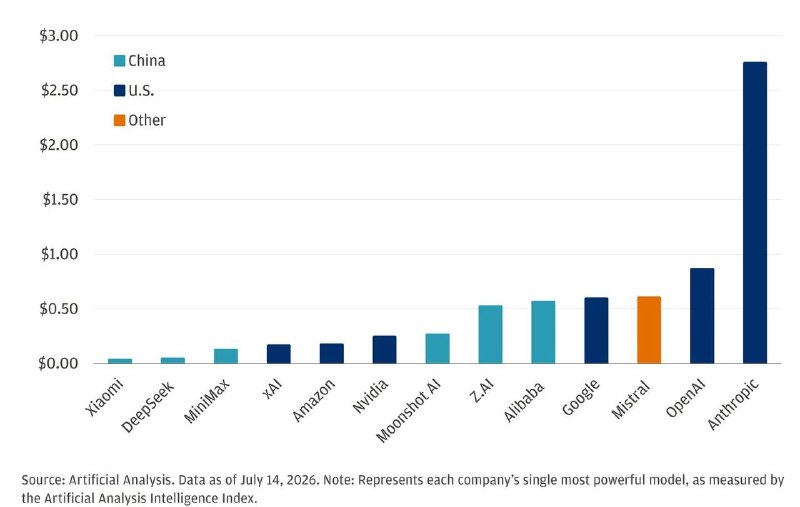
The Kimi K3 model landed on 17 July 2026 at 23:03 UTC, and within hours the prediction market for Anthropic's year-end valuation moved from a coin-flip to a 67% probability of reaching $1.5 trillion. That repricing did not happen because investors suddenly doubted frontier research in San Francisco. It happened because a Chinese lab produced a model competitive enough that the market could no longer treat American AI leadership as a closed variable.
That is the through-line connecting three otherwise unrelated dispatches from the past 72 hours: Kimi K3's release, Beijing's pushback against US allegations of illicit model distillation, and the launch of the first phase of a 1,000-satellite Chinese space-computing network. Read them together and a familiar pattern snaps into focus: compute, spectrum, and orbital infrastructure are now treated as integrated instruments of state power, and the gap that US frontier labs assumed was permanent is being renegotiated in months rather than years.
A 1,000-satellite first phase, not a 1,000-satellite finish line
The launch of the first phase of a 1,000-satellite space-computing constellation on 19 July 2026 at 04:18 UTC is best read as a hardware deposit on the AI race. Putting inference and training into low orbit does two things at once for a Chinese operator: it dodges domestic power and cooling bottlenecks at the data-centre layer, and it extends sovereign control over the radio spectrum and ground-station links that any orbital compute fabric requires. The strategic logic is straightforward. The capital intensity is not. State-backed constellations move at a pace that would terrify a Western private operator's board, and that pace is itself the moat.
The Western framing of the same launch tends to default to dual-use anxiety. That framing is not wrong, but it is incomplete. An orbital compute layer also serves a perfectly civilian commercial thesis: latency reduction for industrial customers in the Yangtze and Pearl River deltas, redundancy for disaster response, and a domestic answer to the GPU shortage that has throttled Chinese model training since 2024. The dual-use critique and the commercial thesis are not mutually exclusive, and the more honest read is that the same hardware serves both books.
"Misguided and counterproductive"
On 18 July 2026 at 15:29 UTC, China's official response to allegations that its AI firms illicitly distilled US frontier models was described, in the brief wire item this publication saw, as "misguided and counterproductive." That phrasing matters. Beijing has chosen to answer the distillation charge not with denial, but with a procedural objection: that the very concept of illicit distillation, applied across borders to neural weights, is a category mistake in a field where ideas are not patentable. It is the same diplomatic posture Beijing took to questions about EV subsidies, and it has a track record of partially working in third-country markets that are tired of being lectured by Washington.
The counter-narrative from Washington, articulated across recent congressional hearings and reported by wire services, is that distillation is theft dressed up as science. That framing has purchase inside the US AI lab community, where the training-cost gap to a successful distillation is real and visible. It has less purchase in Jakarta, Brasília, or Ankara, where the relevant question is which model ships in the local language at the lowest unit cost. On that question, Kimi K3 is a more disruptive product than any number of US indictments.
The Anthropic repricing, decoded
Anthropic's valuation was repriced not by a downgrade from a major analyst but by a market-implied probability. Polymarket traders put a 67% chance on Anthropic hitting $1.5 trillion by year-end 2026 after the Kimi K3 release on 17 July at 23:03 UTC. The mechanism is familiar in prediction markets and uncomfortable in boardrooms: a model release from a geopolitical competitor tightened the distribution around future AI returns because the prior assumption of uncontested US frontier pricing no longer held.
There is a less flattering read of the same move: that prediction-market liquidity is thin, that a single large position can swing a percentage point, and that the 67% figure is not a verdict on Anthropic's business so much as a sentiment pulse on the week. Both reads can be true. The fact that sophisticated money bothered to take the other side of a $1.5 trillion print tells you that the marginal investor is no longer treating Chinese AI releases as background noise.
The shape of the next cycle
The structural picture, stripped of theatre, is this. AI leadership is migrating from a single dimension (frontier model quality, judged on a US benchmark) to a multi-dimensional stack: model quality, energy footprint, orbital compute, domestic chip supply, sovereign data localisation, and price per token at the application layer. The US currently leads on the first; China is making the most aggressive moves on the second, third, and sixth. Anthropic's Polymarket print is, in effect, a market wager on whether the first dimension is enough to determine the outcome.
What remains genuinely uncertain is whether the 1,000-satellite first phase will stay on schedule. Chinese mega-constellations have slipped before, and orbital compute is a harder engineering problem than satellite broadband. It is also worth noting that the prediction market's 67% is a probability, not a number; traders are pricing an outcome, not endorsing it. The case for cautious optimism on both sides of the Pacific is that competition of this intensity almost always produces cheaper and better products for everyone outside it. The case for caution is that integrated industrial policy of this scale has historically produced both civilian marvels and strategic dependencies, and the two are rarely separable in real time.
Desk note: Monexus framed this as an integrated AI-industrial story, not a Kimi-versus-Anthropic horse race. The satellite and distillation wires were treated as part of the same stack, not as standalone items, because that is how Beijing is treating them.
Wire provenance
This editorial synthesis draws on the following public wire/social posts:
- https://x.com/polymarket/status/194784600000000
- https://x.com/polymarket/status/194790600000000
- https://x.com/polymarket/status/194792100000000