Detentions, school rules, and the load-bearing maths of India's internal geography
A 14-day fast ends in a police bus outside Bhopal, while Delhi quietly swaps a needs-based school gate for a self-certification form. Two unrelated stories that together expose who bears the cost of India's growth arithmetic.
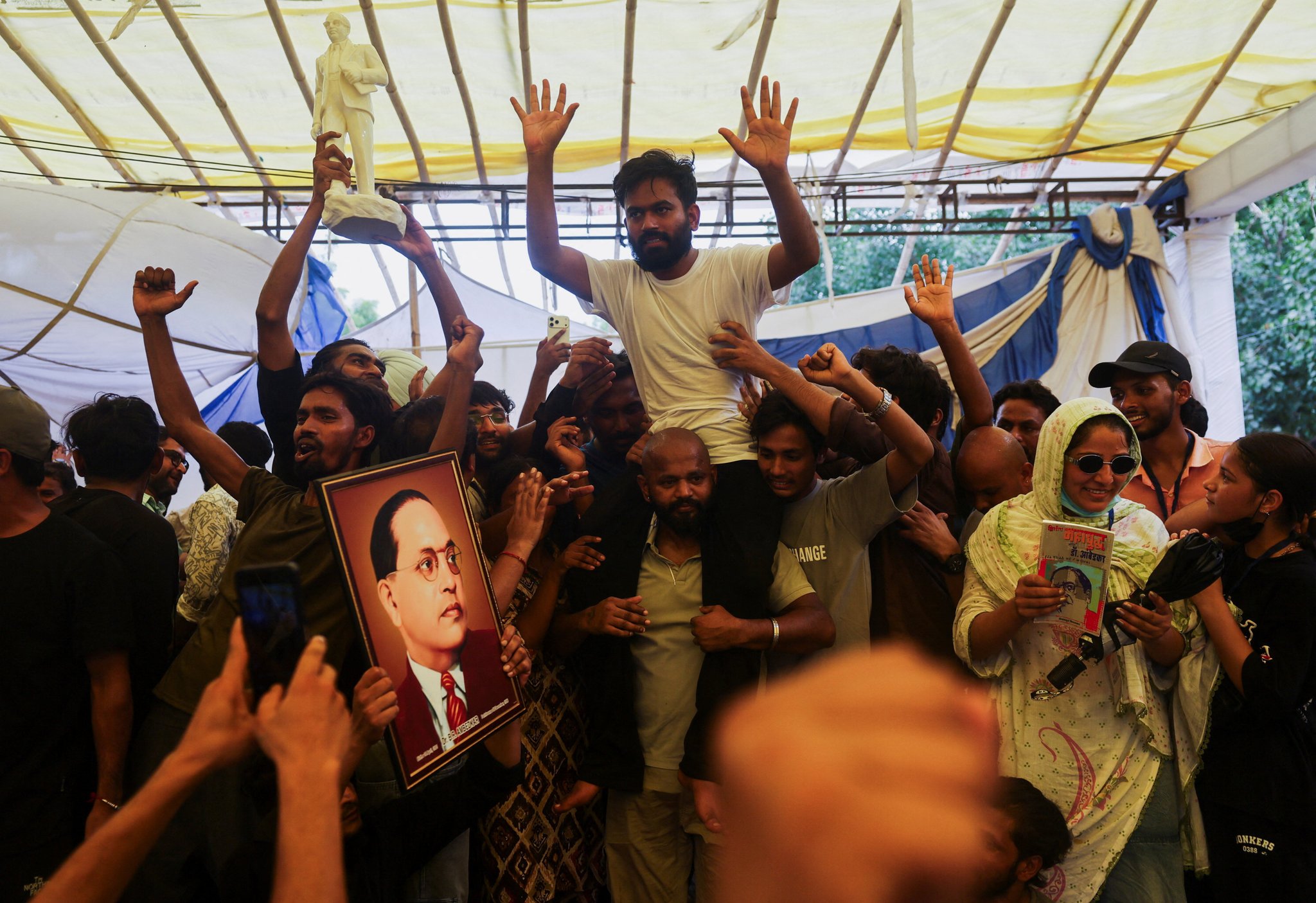
On the morning of 18 July 2026, police in Bhopal took activist Amit Bhatnagar off a protest pitch outside the Madhya Pradesh secretariat and put him on a bus. Bhatnagar had refused food for fourteen days as part of a campaign against the Ken-Betwa river-linking project, a scheme to dam and connect two tributaries of the Yamuna across Madhya Pradesh and Uttar Pradesh. According to The Indian Express, around 150 others were cleared from the site in the same operation and ferried away in buses. The fast was, by the protesters' own framing, an act of last resort against what they call the dispossession of forest-dwelling communities from the Panna tiger reserve catchment.
The state government has argued the project will irrigate roughly 10 lakh hectares and supply drinking water to over 6.2 million people, financed in part through a ₹44,605 crore package that includes a World Bank loan and central funding. Bhatnagar and his allies counter that the submergence zone, by the project's own environmental clearance, will drown thousands of hectares of forest and dozens of villages before any irrigation canal carries a drop of water. The protest, in other words, is not over the abstract idea of linking rivers; it is over the sequence, the compensation arithmetic, and who is counted as a stakeholder before the first pour of concrete.
Hours later, and 750 kilometres north, the Delhi government's directorate of education quietly issued a different sort of clearance. The Indian Express reported on 18 July 2026 that private schools in the capital will no longer be required to prove, through a "needs assessment," that an area genuinely lacks school seats before opening a new branch. Self-certification now substitutes for the assessment. For a city that has spent the better part of a decade fighting fee-cap litigation and land-use disputes in the private school sector, the change is technically minor. Its timing, beside a federal freeze on new construction permits in parts of the National Capital Region, is anything but.
Two decisions, one ledger
Taken separately, each story is a routine entry in the bureaucratic ledger of Indian federalism: a state government managing a tribal-rights protest, and a Union territory rewriting a private-school norm. Read together, they sketch a pattern. The first asks who has standing to resist a project whose benefits are national, quantified in crores and hectares, and whose costs are local, quantified in families and hectares. The second asks who gets to enter a market whose floor was previously set by a planner's map and is now set by an entrepreneur's affidavit.
Both pivot on the same threshold: where does the public assessment of need end and private attestation begin. In Bhopal, that threshold has effectively moved against the protester. In Delhi, it has moved in favour of the investor. The arithmetic in both cases is the same; the political colour is different.
What the Ken-Betwa fight is actually about
The Ken-Betwa Link Project (KBLP) is one of the oldest entries on India's river-interlinking wish list, first sketched in the 1980s and cleared by the Expert Appraisal Committee of the Ministry of Environment in stages through 2022 and 2023. The pitch is hydraulic realism: the Ken, a rain-fed tributary, surges during the monsoon and is dry by February; the Betwa runs in a parallel basin with the opposite rhythm. Joining the two would, in theory, smooth supply across the year and bank surplus in a reservoir at Daudhan.
The opposition is not a flat rejection of the idea. It is, in the main, a sequencing argument. Forest-dwelling communities in the Panna and Chhatarpur districts were notified for relocation under the Forest Rights Act, 2006, in 2023. The Indian Express's coverage of Bhatnagar's fast has emphasised the gap between that notification and the actual disbursal of rehabilitation packages, as well as the absence of gram sabha consents in some of the affected villages. The state government's position, as quoted in press briefings, is that consent processes have been completed in line with the Act and that the remaining objections are being addressed through a committee.
The relevant structural fact is this. India's river-linking programme is a classic case of an infrastructure whose returns are diffuse, delayed, and accrue mostly to users hundreds of kilometres downstream, while its costs are concentrated, immediate, and fall on a small population with weak bargaining leverage. When the cost-bearers are also the political minority in the affected assembly constituencies, the median voter has little incentive to slow the project. Bhatnagar's tactic, refusing food in a public square, is the older Indian remedy for that mismatch.
The Delhi school-rule shift, in plain terms
The needs assessment for private schools in Delhi was introduced under earlier Lieutenant-Governor directives and was used to deny permission to new branches in wards where the directorate believed existing capacity was adequate or where land-use plans disallowed additional commercial educational activity. The new rule, reported by The Indian Express on 18 July 2026, replaces the assessment with a self-certification: the school applies, affirms on paper that the locality needs a school, and proceeds.
The change does two things at once. It transfers the cost of getting the answer wrong from the regulator onto the applicant. And it removes one of the few public-interest checks on a sector that has grown faster than its regulator. The directorate will, presumably, retain the right to audit; whether it has the staffing to audit in a market that just opened is a different question. The federal layer matters too: the Delhi Development Authority's ongoing review of construction in the Ridge and the Yamuna floodplain has frozen some private projects in NCR districts, pushing more of the load onto the capital's own jurisdictions. The school rule, in that sense, is also a relief valve.
What stays contested
The sources do not specify the precise number of protesters removed from the Bhopal site beyond the figure of approximately 150 cited by The Indian Express, and they do not record a direct statement from Bhatnagar at the point of detention. The state government's position on consent processes is paraphrased from press briefings rather than reproduced verbatim; the rebuttal carries weight, but a reader who wants the procedural detail will need to look at the district-level Forest Rights Act filings, which are public but not in the record here. On the Delhi side, the directorate's order is summarised rather than quoted; the question of whether the self-certification route also loosens land-use conditions, or only the needs test, is not addressed in the available reporting.
The larger uncertainty is whether either move will hold up under the courts. India's tribunals have repeatedly intervened in river-linking projects on environmental grounds, and the Supreme Court's monitoring of the Forest Rights Act in forest-dwelling states has been quietly active. Delhi's education directorate, for its part, operates under a Lieutenant-Governor whose own authority over the territory has been litigated more than once. Neither decision is, in the language of Indian federalism, the last word.
What to watch next
Three dates will tell most of the story. The Forest Rights Act review committee's next hearing will determine whether Bhatnagar's demand for fresh gram sabha consultations is granted. The Delhi directorate's first audit cycle under the self-certification regime, expected within the next academic year, will show whether the regulator has the capacity to police a market it has stopped pre-screening. And the next monsoon, which arrived in central India with above-normal rainfall in early July 2026, will test the reservoir logic on which the Ken-Betwa project rests. If the dam fills on schedule and irrigation starts flowing before the next election cycle, the project's political ground will harden. If it slips, the protesters' argument that the cost was paid before the benefit was delivered will move from dissent to settled fact.
Until then, the arithmetic is the story. India is choosing, in two domains on the same Saturday morning, to widen the space in which growth calculations are written by the actor who stands to gain, and to narrow the space in which those calculations can be slowed by the actor who stands to lose. Whether that reweighting lasts depends on whether the next round of monsoons, and the next round of parent admissions, leaves either constituency with the leverage to reopen the question.
Desk note: Monexus treats these two Indian Express items as a single beat because they both turn on who gets to certify that a public need exists. The wire framing across English-language Indian outlets tends to separate environment and education into different sections; the editorial question here is what they have in common.
Wire provenance
This editorial synthesis draws on the following public wire/social posts:
- https://en.wikipedia.org/wiki/Ken-Betwa_River_Link_Project
- https://en.wikipedia.org/wiki/Forest_Rights_Act,_2006