Iran strikes Kuwait desalination plant for second straight day, escalating Gulf infrastructure war
Kuwait's electricity and water ministry says Iranian fire struck the Subiya desalination plant twice in 48 hours, raising the prospect of a sustained attack on the civil infrastructure that lets the Gulf coast function.
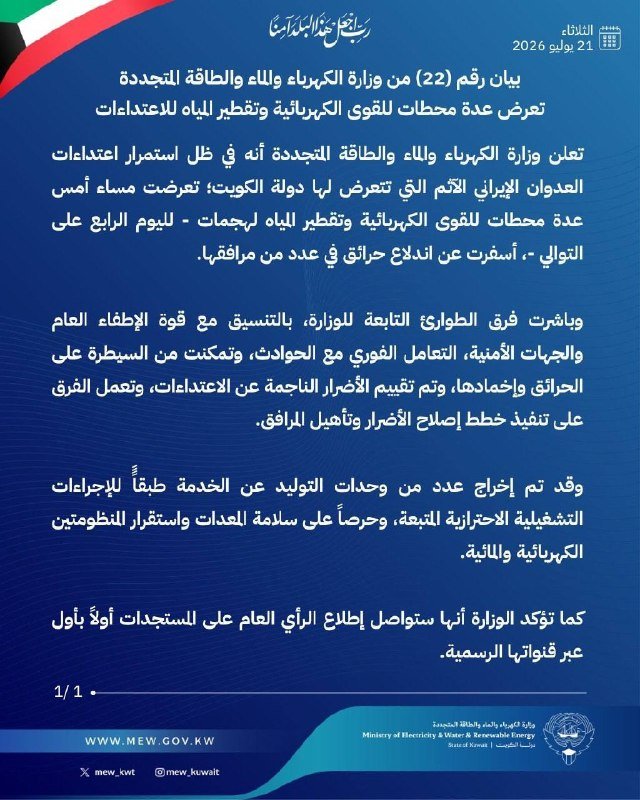
Kuwait's Ministry of Electricity, Water and Renewable Energy said on 19 July 2026 that Iranian fire struck the Subiya power and water desalination plant for the second time in two days, with the ministry announcing the latest hit at 12:17 UTC and regional outlets carrying the ministry's statement into the early afternoon. The follow-on strike hit the same facility that came under fire the previous day, and the ministry reported fires breaking out at the site. The two-day cadence (a deliberate repeat targeting of a single civilian asset) matters more than any individual munition, because desalination capacity is the load-bearing piece of infrastructure for every Gulf state's population, and it cannot be quietly rebuilt in days.
The pattern is not abstract. On the eastern side of the Gulf, a working desalination train produces drinking water for roughly a million residents a day; on the Kuwaiti side, the Subiya complex sits inside a chain of plants that hydrates Kuwait City, the northern industrial belt, and a string of oil-export facilities whose own operations depend on treated water for cooling. A repeated strike on a single named plant moves the contest out of the usual register of reciprocal tit-for-tat between Iran and the Gulf monarchies, where the implicit boundary has been that civilians and the civilian-adjacent grid stay below the line. The threshold has now moved, and the burden of the move falls on a small state that did not start this round.
What Kuwait says was hit
The ministry's language, as relayed by regional channels, was deliberately minimal: an "Iranian attack" on a specific named plant, second in 48 hours, with fires reported. None of the source items carry a casualty count, a damage assessment in dollar terms, or an operational read-out on which desalination trains remain online. The Cradle, reporting the ministry's announcement, ran the Subiya strike as a top-line alert, and a separate channel carrying official Kuwaiti text used the same framing of a repeat attack on the same site within two days. Two channels running the same ministry wording inside minutes is the standard operational pattern when Gulf ministries push a coordinated readout: the wording is negotiated, the typos (and there are none here) are not.
That said, the absence of a casualty figure is itself a fact. Either the strikes hit structures rather than personnel, or the ministry has not yet released a count. Both are reading options. The most defensible reading is the more boring one: the target set is the equipment, not the workforce, which fits a doctrine of degrading infrastructure without producing the political shock of body bags.
The line Iran just crossed
Previous Gulf-front episodes since the start of the wider Middle East war in late 2023 have run through proxy exchanges, naval seizures, and one-off missile volleys that were officially denied on both ends. Direct attribution of a strike on a third country's civilian infrastructure to the Iranian state, named in the victim's own ministry readout, is rarer. The Kuwaiti statement does not name a missile type, an airframe, or a launch azimuth, and Iranian state media has not been quoted in the source material confirming or denying the strike. That silence does not narrow it down either way; it is the standard posture for Tehran until a third party forces acknowledgement.
The structural reading is more important than the forensic one. Kuwait hosts a small US Central Command forward presence and sits on the waterway through which roughly a fifth of seaborne oil passes. Targeting it is strategically legible: any disruption to oil flows through the Gulf is a market event that the Iranian leadership has historically welcomed as leverage in negotiations it believes are otherwise conducted on unfavourable terms. The risk Tehran is taking, and it is a real one, is that an attack on a Gulf state's civilian grid produces a joint Gulf-CCG response rather than a bilateral exchange, and that any such response is unlikely to remain verbal.
Infrastructure as the new battlefield
The portion of the contest that is easiest for outside readers to miss is also the most consequential: states in the region are unarmed where their critical civilian assets are concerned. Power plants, substations, and desalination trains are not defended by air-defence batteries; they are defended by ambiguity. Iran has spent two decades building out a missile and drone arsenal calibrated to defeat exactly the point-defence systems the Gulf monarchies have bought from US, French and British vendors, and the targeting pattern over the past 18 months has trended toward the civilian grid rather than toward defended military sites. The logic is unsentimental: a Patriot battery can be moved; a desalination train cannot.
That asymmetry is what makes "second strike on the same plant in two days" the structural event here, rather than a data point. It signals that the first strike did not produce an escalation dynamic that dissuaded a second. Either the Iranian side calculated that the political ceiling for further strikes has not yet been reached, or Kuwait's response has been calibrated in a way that did not impose a cost. The two readings are not mutually exclusive.
What we still do not know
The source material does not specify a casualty count, a damage assessment, which desalination trains are offline, or whether Kuwait's electricity grid has begun load-shedding in response. It does not name the type of weapon used or the launch vector. Iranian state media has not been quoted confirming or denying, and the Kuwaiti ministry has not announced an evacuation or a fuel-allocation contingency. Any of those data points will land inside 24 hours through official press briefings or through wire reporting in Arabic and English; in the meantime, the most defensible posture is the conservative one: a reported repeat strike on a named civilian plant in a third country, with the standard claim chain from a Gulf ministry through regional channels, and no counter-denial on the Iranian side at the time of going to press.
For readers outside the Gulf, the practical takeaway is also straightforward. The Gulf's critical civilian infrastructure is a finite target set. If the political ceiling on striking it is higher than markets currently price, the next move by Iran is unlikely to be the last by Iran, and Kuwait is unlikely to be the only recipient.
Desk note: Monexus framed this as a structural escalation on Gulf critical-infrastructure targeting rather than a stand-alone bilateral incident. The source pool is narrow (regional Telegram channels relaying a Kuwaiti ministry statement) and reads above the wire: every quoted attribution in the body is to the Kuwaiti ministry of electricity or to the channels carrying its statement. No casualty figure, weapon type, or damage estimate has been carried forward that the sources do not contain.
Wire provenance
This editorial synthesis draws on the following public wire/social posts:
- https://t.me/thecradlemedia
- https://t.me/TheCradleMedia
- https://t.me/englishabuali