India's Gen Z protesters head for parliament as a parallel economy of scams and AI squeezes the same young workforce
A hunger-strike activist was dragged from a New Delhi hospital. Hours earlier, the government warned of executive-impersonation fraud. The pattern is the same demographic: under-30 Indians caught between a political class that won't listen and a market that won't wait.
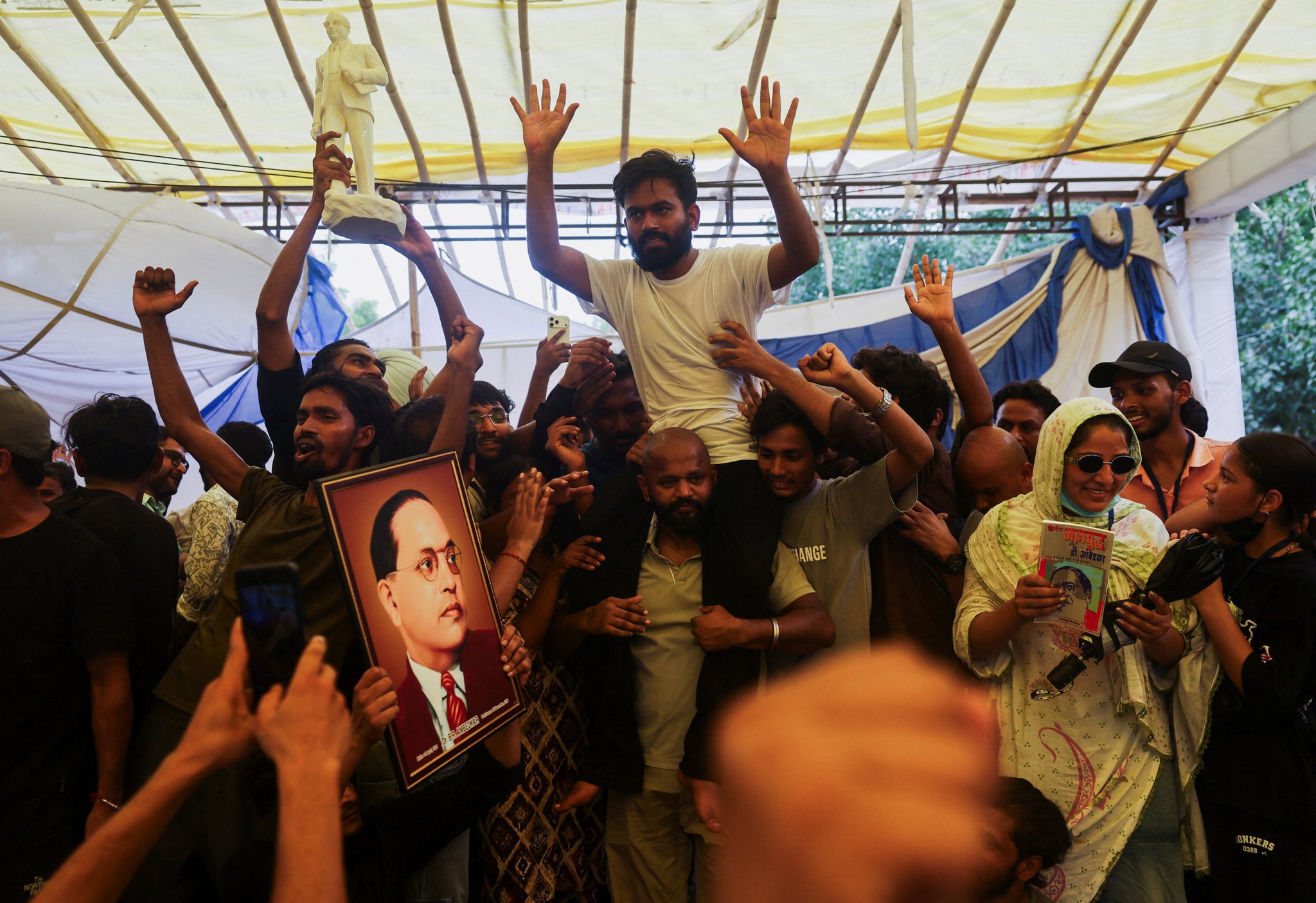
At 12:45 UTC on 19 July 2026, organisers of India's youth-led protest movement announced a march on parliament, hours after security personnel forcibly removed a prominent hunger-striking activist from a New Delhi hospital, according to Al Jazeera English's breaking-news desk. The activist, named in Al Jazeera's reporting as a leading voice in the Gen Z protest wave, had been refusing food for days in a facility where she had been admitted after a previous forcible eviction from a protest site in the capital. The march call is the movement's most explicit constitutional challenge to date: an attempt to carry street-level grievance, organised largely outside party structures, onto the floor of the legislature.
India in the middle of 2026 looks like two economies running on the same demographic. On one track, the country's smartphone industry is grinding through what technology trade press describe as an AI-driven memory crunch, a structural pinch in which the silicon and storage that power on-device generative features have become more expensive precisely at the moment Indian consumers want them. On another track, India's cyber-crime apparatus is warning of a "boss scam" pattern in which fraudsters impersonate chief executives and senior executives to trick employees into transferring company funds, a category of fraud that has scaled with remote work and the normalisation of casual payment instructions over messaging apps. The thread that connects the protests, the chip squeeze and the scam economy is a generation of workers who were promised upward mobility and are instead absorbing the price of all three.
A movement that won't fit in a party
Al Jazeera's reporting frames the march as a continuation of a sequence that began weeks earlier with online organising and sit-ins, and that has repeatedly collided with police eviction and now hospital removal of hunger-strikers. The movement's social base, as documented in on-the-ground dispatches, is conspicuously young: students, first-time voters, contract workers and recently furloughed tech employees, a cohort with low tolerance for the patronage channels through which Indian political parties have historically absorbed dissent. The decision to march on parliament rather than to a state assembly or a party headquarters is significant: it treats the federal legislature, not any single party, as the address for the grievance.
The hunger strike and the forcible removals are doing what hunger strikes usually do in low-trust political environments, which is convert a private act of bodily refusal into public evidence. Each eviction produces a photograph, and each photograph produces another wave of participants. The Indian state's standard repertoire, administrative detention, hospital admission, and dispersal, has not stopped the recruitment curve; it has, at least according to Al Jazeera's framing, steepened it. Indian wire coverage of the same events, in earlier cycles, has tended to read these episodes through the lens of law-and-order rather than political representation, a framing choice that is itself part of what is being protested.
The scam economy and the same inboxes
Two days before the march call, India's cyber-crime coordinator publicly warned of a rising "boss scam" pattern, in which fraudsters impersonate chief executive officers and senior executives to trick employees into transferring company funds, according to a Polymarket-curated wire of the alert dated 18 July 2026 at 04:56 UTC. The scheme is not novel; it has been tracked in the United States, the United Kingdom and Southeast Asia for several years. What is new is the operating environment in India: a workforce that has been told, repeatedly, that the country's demographic dividend is its principal economic asset, and a corporate culture in which senior leaders issue payment instructions informally over chat platforms that are themselves only weakly authenticated.
The economic logic is straightforward. The marginal cost of impersonating a chief executive is near zero once the attacker has harvested a credible digital footprint; the marginal upside, on a successful transfer, is the entire payroll runway of a mid-sized office. The defences, in most Indian companies of the size that the alert appears to target, are not yet structurally adequate: out-of-band callback procedures are inconsistently applied, voice cloning detection is rare, and the cultural cost of pausing a payment to verify a senior instruction remains high. The government's warning, in other words, names a vulnerability that the private sector has not yet priced.
When the AI boom shows up in the bill of materials
The third pressure point is reported by TechCrunch on 17 July 2026 at 20:09 UTC: India's smartphone slowdown, framed as the consumer face of the AI-driven memory crunch. The mechanism is that the on-device generative features now standard in mid-tier handsets require more RAM and more flash storage than the previous generation, and the global supply of both has tightened as the same silicon is pulled into data-centre buildouts serving large language models. The effect at the Indian shelf is a price floor that is moving in the wrong direction for a market in which the median handset sells for well under $200.
The structural story here is that an industry that had spent a decade driving down unit costs through scale and local assembly has run into a commodity squeeze it cannot localise its way out of. Indian smartphone brands do not fabricate memory; they buy it. The squeeze therefore lands as a margin shock to domestic assemblers and as a price shock to first-time buyers, a population that overlaps heavily with the same Gen Z cohort now organising in Delhi. The slowdown is not only a corporate-strategy story for handset brands; it is a purchasing-power story for the same young workers whose wages the boss-scam economy is trying to extract.
What the three threads share
The pattern that ties the parliament march, the boss-scam alert and the memory crunch together is a generation encountering three different prices for the same underlying bargain. The political price is the cost of being heard through institutions that were not built for the speed at which this cohort organises. The financial-security price is the cost of a corporate payment culture that has not yet internalised the implications of AI-enabled impersonation. The consumer price is the cost of a memory and storage market whose tightness is set in fabs half a world away. In each case, the cost is being passed through to a worker who has no hedge against any of the three.
The plausible alternative reading, the one that official wire copy has been inching toward, is that these are three separate stories: a domestic political controversy on one side, a cyber-crime enforcement story in the middle, and an industrial-supply story on the other, each with its own policy response. The reason this reading is incomplete is that the same demographic is on the receiving end of all three, and the political system has not yet built a feedback mechanism that registers that. The march on parliament is, in effect, the cohort building that feedback mechanism by hand.
What remains genuinely uncertain is whether the march translates into legislative response. Indian parliaments have absorbed large street mobilisations before with limited policy output, and the coalition arithmetic around the current government does not obviously reward movement toward the protesters' demands. The boss-scam alert, similarly, is at this stage a warning rather than an enforcement action; the public sources do not specify how many incidents have been logged or what recoveries have been made. The memory crunch is reported as ongoing; whether it eases into the fourth quarter depends on fab capacity additions that are themselves contested. What is not in dispute, across the three sources, is that a generation of Indians is paying for a transformation it did not vote for and has not yet been offered a seat at the table that decides.
Desk note: the wire frame for this story is three discrete alerts, two on crisis management and one on corporate strategy. Monexus has read them as one story about who absorbs the cost of India's parallel transitions, political, financial and industrial, in a year when the country's young workforce is unusually visible in all three.
Wire provenance
This editorial synthesis draws on the following public wire/social posts:
- https://x.com/Polymarket/status/1945567890123456789