Gandhi's Jantar Mantar stand puts Sonam Wangchuk back at the centre of India's protest map
Rahul Gandhi's late intervention over Sonam Wangchuk's removal from Jantar Mantar has reopened a confrontation that goes beyond one activist's tent in New Delhi.
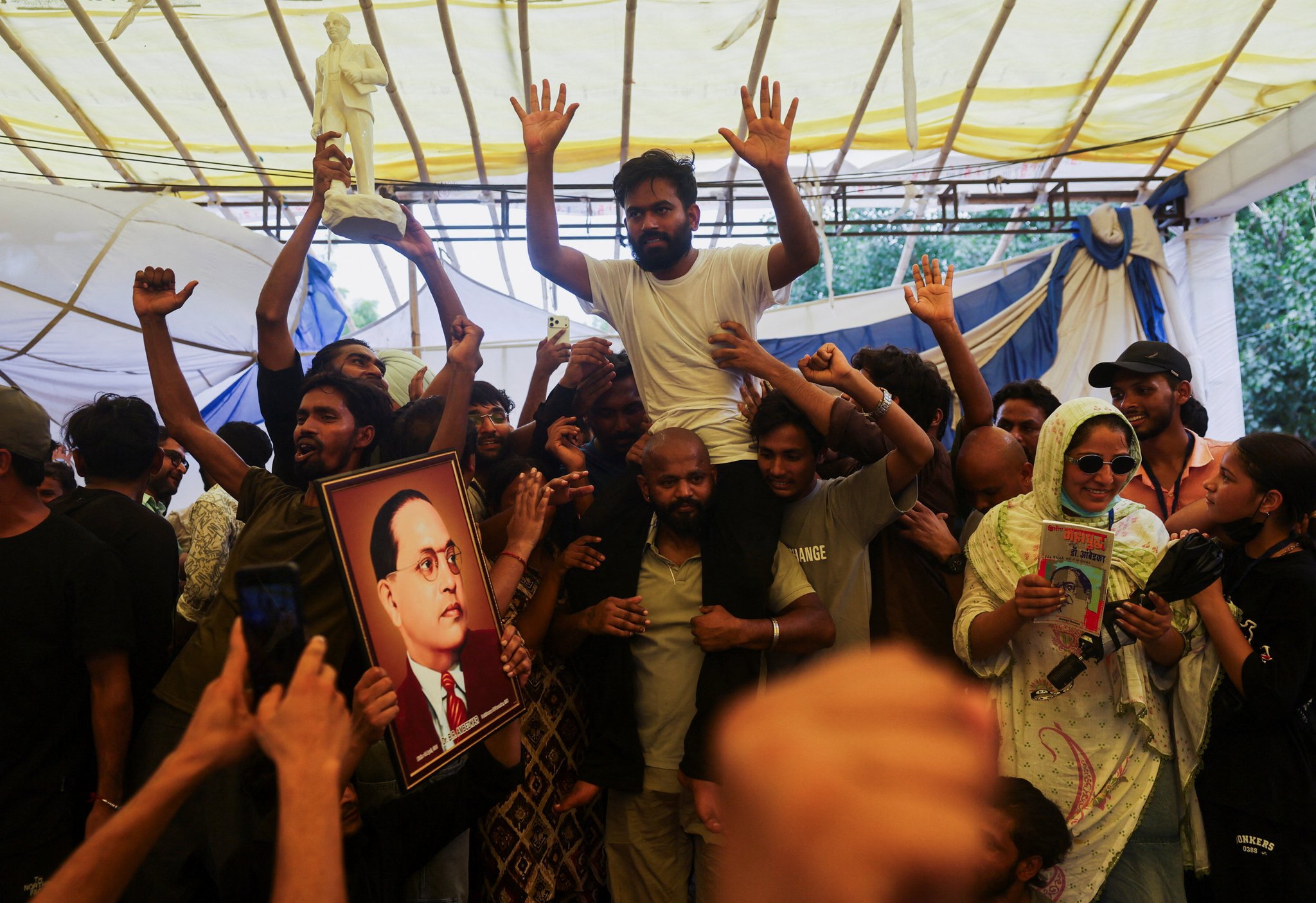
At Jantar Mantar on 19 July 2026, Rahul Gandhi did what the Congress leader had conspicuously avoided for days: he publicly defended Sonam Wangchuk's right to camp on the Mughal-era observatory's dusty apron in central New Delhi and accused the Narendra Modi government of removing the Ladakhi climate activist to suppress peaceful dissent. The intervention, carried live by Hindi and English news channels from the site, dragged a localised eviction dispute back onto national prime time and re-framed it as a test of India's federal compact with the cold-desert union territory of Ladakh.
What looks, at first reading, like a routine political scuffle over a tent is actually the latest round in a longer contest over who speaks for Ladakh and on whose terms. Wangchuk's fast-unto-death in 2019 won him special protected status for the region; his current sit-in is a narrower demand, but the political geometry around him has widened. By drawing the line at Jantar Mantar, the government has turned a peripheral geography into a metropolitan stage, and the opposition has decided to play there.
The eviction, and why it landed
Wangchuk had been camped at Jantar Mantar since early July, reviving a demand for statehood and constitutional safeguards for Ladakh under Article 371 of the Indian constitution. On 18 July, Delhi Police personnel, acting on the orders of the Lieutenant Governor of Delhi, dismantled the protest site and asked Wangchuk to move to a designated location in Burari on the city's northern fringe. Wangchuk refused. According to a LiveMint report carried on 19 July 2026 at 09:46 UTC, the dispute has now acquired a national political dimension because Gandhi has chosen this moment to speak.
That choice matters. The Congress has spent the past year recalibrating its position on Ladakh, wary of being outflanked on regional identity by the Bharatiya Janata Party's own Himalayan outreach. By publicly defending Wangchuk, Gandhi has forced a binary: a sitting government that physically removes a fasting activist from a protest ground, and an opposition that frames that removal as authoritarian drift. Both frames are now in circulation, and the BJP has not yet laid out, in detail, the legal basis for the eviction in public.
The federal undercurrent
Ladakh was carved out of the former state of Jammu & Kashmir in August 2019 and placed directly under central administration, bypassing the elected legislature that J&K retains. The arrangement stripped the new union territory of the legislative power its sister UT inherited, and left Ladakh's autonomy questions in the hands of a lieutenant governor appointed by New Delhi. Wangchuk's original 2019 fast won Sixth Schedule protections for the tribal populations of the region, a partial concession that bought the government two election cycles of quiet.
That quiet is over. The Jantar Mantar eviction is the first time the central government has used Delhi Police against a Ladakhi protester in the capital, and the optics are deliberately pointed: the activist was a global climate figure once feted at international forums, the protest site is metres from Parliament, and the removal came in the middle of a parliamentary session dominated by monsoon-coverage and tax-bill debate. The choice of timing reads as a message to other regional satyagrahis watching from the foothills.
The opposition's calculation
Gandhi's intervention also reveals a tactical repositioning inside the INDIA bloc. The opposition coalition spent the early part of 2026 focused on bread-and-bus issues; the Ladakh file gives it a constitutionally legible cause to organise around, one that ties climate justice, tribal rights and federalism into a single demand. The risk for Congress is being seen to instrumentalise a personal fast; the risk for the BJP is that the eviction footage circulates without a convincing legal rationale attached.
Either way, the political cost has moved up a notch. BJP representatives have argued that protest sites are routinely rotated and that the eviction followed due process, but the party has not put a senior minister on the airwaves to make that case in detail. The default position so far is procedural defence; the default position of the opposition is principled defence of Wangchuk's right to protest. The two lines will not easily meet.
What to watch next
Three dates will determine whether this becomes a national inflection or a New Delhi newsroom story. First, the next sitting of the Delhi High Court, where Wangchuk's legal team is expected to challenge the eviction order. Second, the Lok Sabha's monsoon session, where opposition leaders have signalled they will raise statehood for Ladakh under Rule 267. Third, the September meeting of the Ladakh Autonomous Hill Development Councils, which will test whether the elected local bodies break silence on the Jantar Mantar episode or stay on the procedural fence.
The honest reading is that the substantive demands around statehood and constitutional safeguards will outlast the tent. The New Delhi protest ground will be cleared, the news cycle will turn, and the underlying federal question, what autonomy a union territory carved out in 2019 actually enjoys, will still be on the table in October. Whether that question gets answered in Parliament or on the streets of Leh is now the more interesting bet.
Desk note: Monexus treats the Wangchuk episode as a federalism story first, an opposition-versus-government story second. The wire framing has leaned on the personality contest; the structural question is whether Ladakh's 2019 constitutional settlement still commands consent in the territory it created.
Wire provenance
This editorial synthesis draws on the following public wire/social posts:
- https://t.me/LiveMint/
- https://en.wikipedia.org/wiki/Jantar_Mantar,_New_Delhi
- https://en.wikipedia.org/wiki/Sonam_Wangchuk
- https://en.wikipedia.org/wiki/Article_371_of_the_Indian_Constitution
- https://en.wikipedia.org/wiki/Ladakh