A rocky exoplanet's atmosphere, and a fresh check on the universe's age
Two new studies tighten the case that planets like Earth can keep an atmosphere, and that the standard cosmological model is still on the right side of the data.
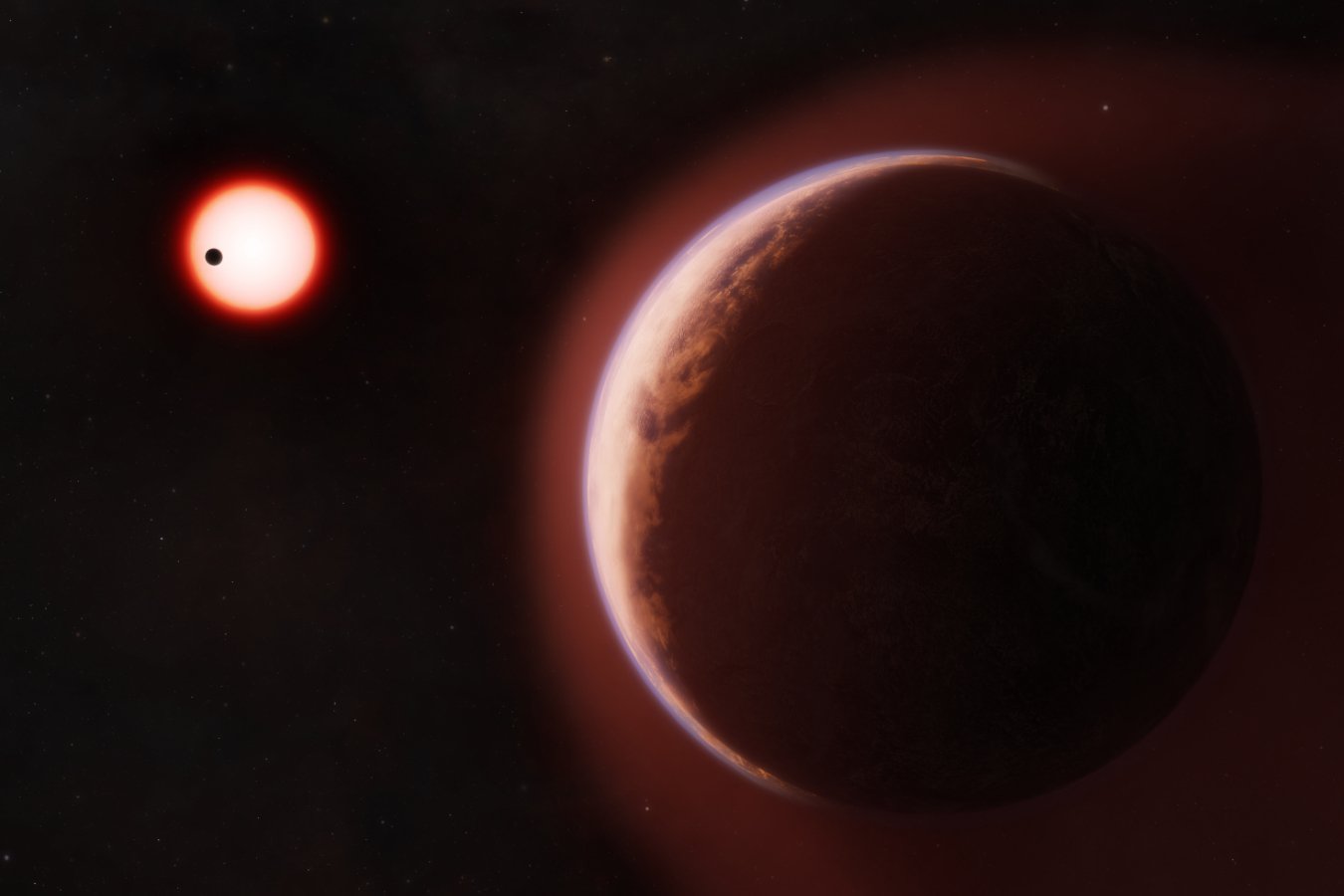
On 16 July 2026, New Scientist reported that astronomers have, for the first time, detected an atmosphere around a rocky, temperate exoplanet, a planet small enough and cool enough that liquid water could, in principle, survive on its surface. Until now, every confirmed atmospheric detection had come from worlds that were either gas giants or scorched by their parent stars. The shift, if it holds, marks the moment the hunt for habitable worlds stops being a survey of extremes and starts being a survey of neighbours.
A separate study, published the previous day in Physical Review Letters, lands a quieter but no less consequential result. By measuring the ages of more than 155,000 stars in the Milky Way, an international team has produced an independent estimate of the universe's age that lines up with the longstanding figure of roughly 13.8 billion years. Two findings, two scales, one planetary, one cosmological, and together they sketch a field that is, for the moment, holding its line against the anomalies of the past decade.
The planet that earned an atmosphere
Temperate, rocky, and bearing air. That has been the holy grail of exoplanet science since the first confirmed detection of a planet around a sun-like star in 1995. The bottleneck has not been finding candidates, the catalogue of rocky worlds in the so-called habitable zone has been filling for years. It has been measurement. Molecules such as water vapour, carbon dioxide and methane leave faint fingerprints in starlight filtered through a planet's atmosphere during a transit, and the signal is excruciatingly small for a small world. Larger planets give a bigger signal; hotter planets widen the molecular lines; older space telescopes struggled to separate the planet's glow from the star's.
New Scientist's report does not name the host star or the orbital distance, but it frames the detection as the first around a rocky body small enough and cool enough to host liquid water. That is the distinction that matters for astrobiology. A thick atmosphere is not, on its own, evidence of life. It is, however, the prerequisite the field has spent thirty years trying to confirm could exist on a world of the right size and temperature. The next round of observations will be the test: whether the chemistry read out of the spectrum resembles the runaway greenhouse of Venus, the oxidised envelope of Mars, or something closer to Earth's nitrogen-oxygen mix.
Counting stars to count the universe
The second result, published in Physical Review Letters on 15 July 2026, comes from a different angle entirely. Rather than reading the cosmic microwave background, the standard route to dating the universe, the team took a stellar census of more than 155,000 Milky Way stars and used their ages as an independent clock. Stars form continuously from interstellar gas, and the oldest among them set a lower bound on how long the galaxy, and by extension the universe, has been around.
The headline finding is continuity. The independent estimate lands within the same neighbourhood as the 13.8-billion-year figure that has anchored cosmology since the early 2000s. That matters because the field has spent the last decade in a quiet argument with itself. Disagreements between early-universe measurements and later-universe measurements of the Hubble constant, the so-called Hubble tension, have raised the possibility that the standard cosmological model, known by its shorthand ΛCDM, was missing a piece. A fresh, independent clock landing on the established age is not a resolution of that tension. It is, however, evidence that the model's age is not the piece that is wrong.
What the standard model still has to answer for
The Hubble tension is the asterisk that refuses to go away. One camp infers the expansion rate of the universe from the cosmic microwave background, the faint afterglow of the Big Bang, and arrives at one number. The other camp infers it from the local distance ladder, supernovae, Cepheid variables, the geometry of nearby galaxies, and arrives at a number several percent higher. Both methods are mature. Both teams have spent years chasing down systematic errors, and both have reported their uncertainties shrinking without the gap closing.
A stellar age estimate is not a direct measurement of the Hubble constant, but it ties into the same web. If the universe were substantially younger or older than 13.8 billion years, the stellar ages would refuse to line up with the rest of the model. They do line up, at least within the precision of this catalogue. That narrows the room in which a missing ingredient could be hiding, and it pushes the search for that ingredient, if it exists at all, toward the expansion-rate problem rather than the age problem.
What to watch next
Three timelines matter. First, the exoplanet atmosphere: the immediate question is whether a second detection from an independent instrument confirms the first. Space-based follow-up, particularly with the James Webb Space Telescope's successor instruments, will test whether the molecular signatures survive a second look. Second, the stellar census: the team's dataset is large but not the largest available. The European Space Agency's Gaia mission, in its later data releases, has pushed the number of stars with high-quality age estimates well past a billion, and subsequent catalogues will shrink the error bars further. Third, the broader cosmological test: the next generation of cosmic microwave background experiments, designed specifically to stress-test the Hubble tension, are scheduled to release their first results within the current decade.
None of that resolves the deeper question the two studies together raise, whether the catalogue of known worlds and the chronology of the cosmos will, eventually, anchor a single, coherent picture of how a planet becomes habitable, and how a universe becomes old enough for one to matter. But on 16 July 2026, the picture got two new data points, and neither of them broke anything.
This desk covered both findings as incremental, source-grounded science rather than a paradigm shift. The exoplanet detection is the more dramatic of the two, but it remains a single detection pending confirmation; the stellar-age result is the more institutionally significant, because it quietly props up the cosmological framework that underpins almost every other measurement in the field.