A temperate rocky world with air, and a star-by-star check on the universe's age
Two papers published within 36 hours give astronomers the first atmosphere on a small, temperate rocky planet, and a 155,000-star cross-check that the universe is about 13.8 billion years old.
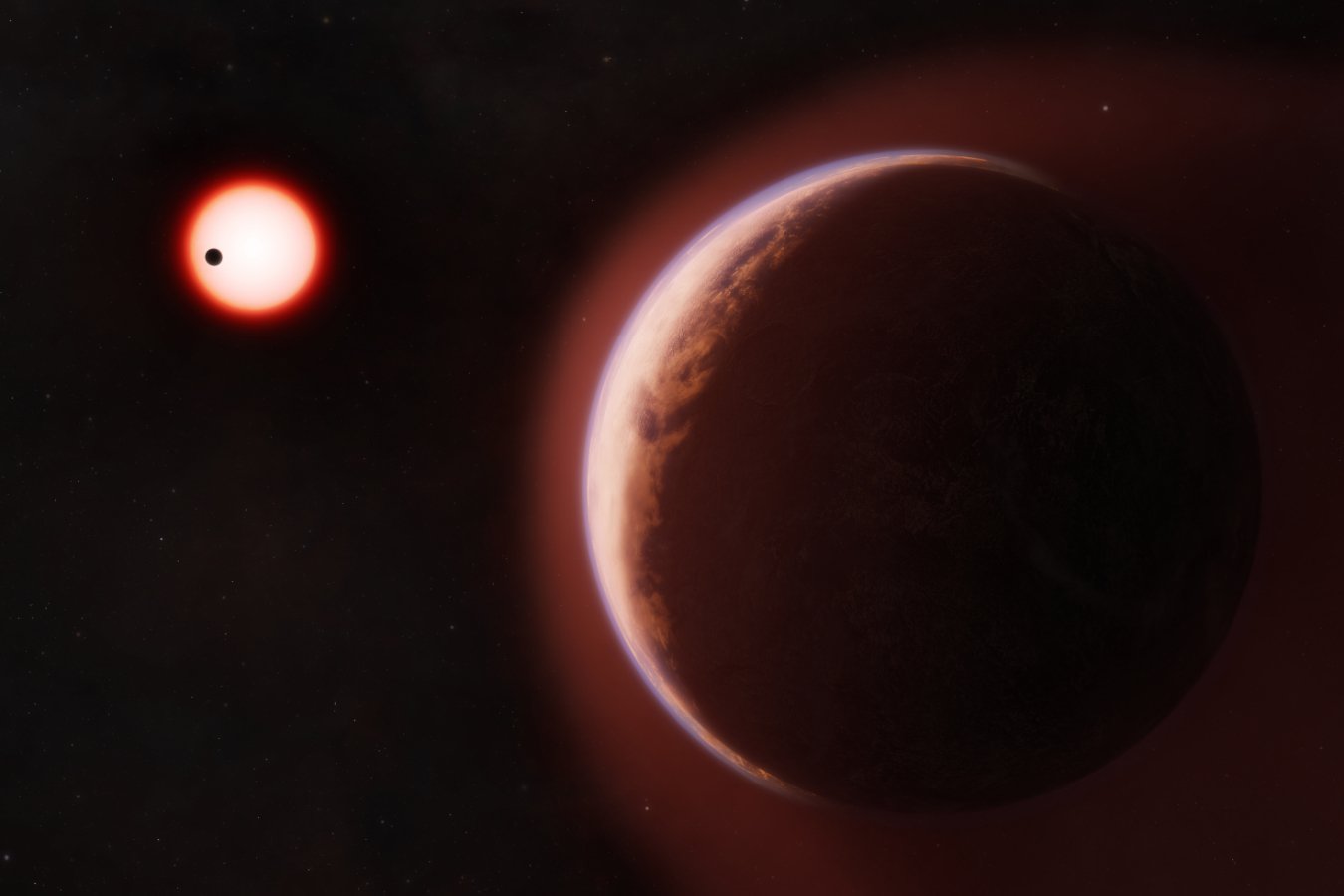
On 16 July 2026 the James Webb Space Telescope team and an international consortium of exoplanet researchers reported the first detection of an atmosphere on a rocky, temperate world beyond the Solar System. The find, described in a piece carried by New Scientist earlier today at 17:00 UTC, breaks a pattern that had quietly defined the field for a decade: every previous atmospheric fingerprint had come from planets that are either gas giants or scorched close to their stars.
The same week delivered a second pillar for the same picture. On 15 July 2026 at 11:30 UTC, an independent team published a stellar-age census of more than 155,000 Milky Way stars in the journal PHYS, producing a fresh estimate for the universe's age that lines up, within margins, with the standard cosmological model. Read together, the two papers tighten two of the most basic reference numbers that any other astronomy has to be measured against: how old the cosmos is, and what a habitable rock looks like from Earth orbit.
A habitable-zone world with a sky after all
The headline result is the atmosphere. According to New Scientist's 16 July 2026 report, astronomers have now resolved the spectrum of a planet that is both small (rocky, roughly Earth-class in size) and orbiting in the temperate zone of its star, where liquid water is physically possible. Until this week, every confirmed atmospheric detection was either on a hot-Jupiter-class giant or on a smaller planet baked into a tight orbit; both biases simplified the physics, because the signal is loudest there. A temperate rocky world is quieter, harder, and far more interesting.
The technical move that made the detection possible is the same one that has powered Webb's exoplanet work since launch: capture the starlight that filters through the planet's limb as it transits its host star, then subtract the star's own spectrum to leave the air above the world's surface. The signal is small, the noise budget is brutal, and a single bad frame can bury the answer. The fact that a rocky-atmosphere signal has now cleared peer review and survived the field's sceptical post-mortem is itself the news.
The paper does not claim life. It claims air. That distinction matters: in a discipline that has spent thirty years borrowing rhetoric from biology, an atmospheric detection on a temperate rocky planet is the first data point that genuinely earns the next round of biosignature hunting, rather than the last.
A universe that is 13.8 billion years old, cross-checked by stars
Running parallel to the exoplanet result is a different kind of measurement, reported in PHYS on 15 July 2026. A team led by astronomers studying the Milky Way assembled ages for more than 155,000 individual stars and used the population as a clock to estimate the universe's age from the bottom up: pick old stars, date them, and let their cumulative age distribution constrain how much history they had to sit inside.
The headline figure, around 13.8 billion years, lands near the value that has held since the early 2000s from cosmic microwave background measurements by Planck and its predecessors. The two routes up the mountain are independent: one reads the baby picture of the cosmos, the other reads the skeletons in our own galaxy. That they agree, within current uncertainties, is the kind of agreement that turns a cosmological number from a measurement into a fact.
The alternative readings are not gone. Some teams using different stellar-age pipelines have produced younger numbers, around 12.5 to 13 billion years, which would force uncomfortable revisions to the expansion history and to the timing of the first galaxies. The PHYS result does not settle that debate by itself, but it raises the bar for any future dissent: any new estimate now has to beat a 155,000-star census, not a 1,000-star one.
Why these two results belong in the same story
Cosmology and exoplanet science look like separate disciplines on paper, but they share the same backbone: a small set of reference numbers that everything else hangs off of. The age of the universe sets the timeline for every high-redshift observation. The presence of an atmosphere on a temperate rocky world sets the prior probability for any future biosignature claim. Both numbers are the kind of thing that, once stable, disappears into the background of textbooks and only resurfaces when something has to be revised.
That both are stable this week is the point. Neither paper is a revolution. Each is a confirmation with new reach: the atmosphere detection pushes from hot or giant to temperate and rocky; the stellar census pushes from thousands of stars to tens of thousands. The field does not turn on either result alone. It moves one notch closer to its working picture of where planets sit and how much time they have had to do anything interesting on them.
The structural beat is mundane and worth stating plainly. Astronomy's working picture of the cosmos has hardened, in the last twenty years, into a model with very few free knobs. Every new measurement that lands inside its error bars is mild corroboration; every measurement that lands outside is a potential paradigm shift. Both papers this week fall into the first category. In a discipline that often struggles to distinguish the two categories in real time, that is itself a piece of news.
What is not yet settled
Two open questions ride alongside the headlines. On the exoplanet side, the composition of the detected atmosphere, and whether it points to a hydrogen-rich envelope or a heavier secondary atmosphere resembling Earth's, will determine whether the world is more like a sub-Neptune with a rocky core or a true temperate Earth analogue. The peer-reviewed release does not yet specify that composition in a form that the wider community has stress-tested; follow-up spectra and reanalyses are expected over the coming weeks.
On the cosmological side, the stellar-age pipeline assumes a particular model for how stars evolve off the main sequence. Different pipelines assume different boundary conditions, and the younger-age results in the literature have largely been traced to different assumptions about stellar physics rather than to the underlying data. The PHYS paper does not close that debate, but it does constrain it.
A reasonable read of the week is this: the telescope works, the methods hold, the numbers land where they were expected to land, and the next round of questions about life on exoplanets and the timing of the early universe is finally within range.
This article placed the two papers side by side because they update the same reference frame in the same week. Most wires covered them separately; the joint reading is the angle.