Kuwait alert flashes across wire feeds as reports of explosions surface in Gulf
Three alerts in three hours from one Telegram channel flagged activity in Kuwait on 18 July 2026, with the middle item adding reports of explosions. The sourcing is thin, the geography is sensitive, and the silence from official channels is itself the story.
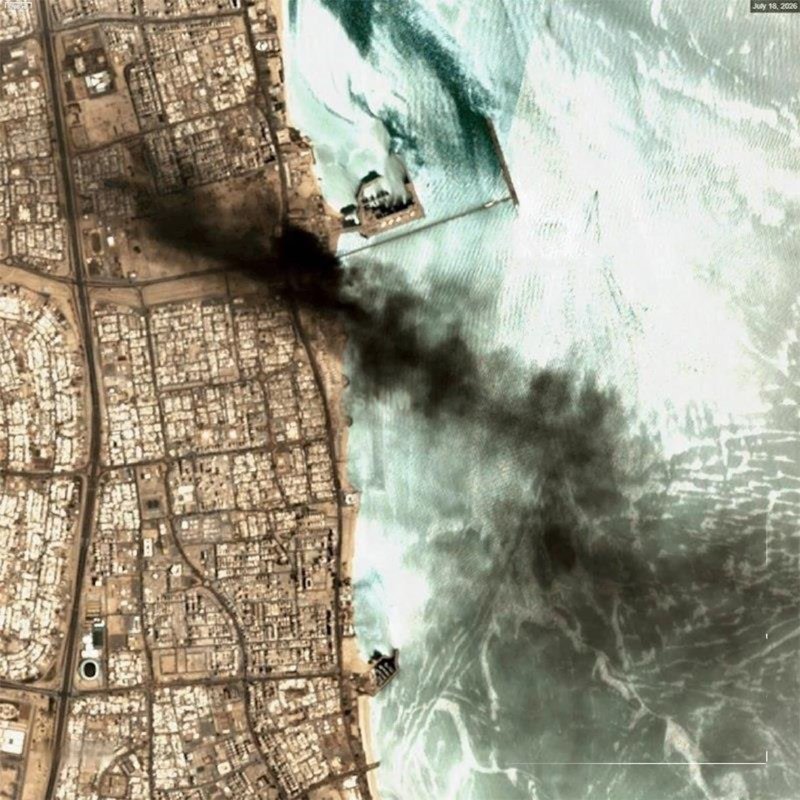
Three alerts in roughly two and a half hours on 18 July 2026, all from the same Telegram account and all pointing at the same place. The first, posted at 01:56 UTC, flagged activity in Kuwait and grouped it with Iran. The second, at 02:25 UTC, repeated the Kuwait alert and added a line about reports of explosions in Kuwait, again paired with Iran and the United States. The third, at 04:14 UTC, was the briefest of the three: "Alerts in Kuwait." No further detail in any of the three. The thread is the story, and the thread is thin.
That is, for now, the verifiable core of what is circulating about Kuwait on the morning of 18 July 2026. The Kuwaiti government has not been named in the thread. No Kuwaiti ministry, no U.S. Central Command, no Iranian outlet has been cited. The single voice on the record is an open-source intelligence account with a track record of fast, sometimes premature flashes on Middle East military activity. The geography alone is enough to make the silence conspicuous: Kuwait sits on the northern edge of the Gulf, sandwiched between Iraq and Saudi Arabia, with a long border and a deep U.S. military presence at Camp Arifjan and Ali Al Salem Air Base. Any unannounced kinetic activity there is the kind of thing that, in a normal information environment, produces a press conference inside an hour.
What three alerts in three hours actually tells you
Alert channels on Telegram are a peculiar newsroom instrument. They are built for speed rather than attribution: a short string of flags, a country pair, a flag emoji, a tag. They tell you what someone, somewhere, has decided is worth surfacing in front of an audience that wants to be first. The 01:56 alert and the 02:25 alert share the same construction (flag-flag-tag, account handle, repeated) and the same geographic frame (Kuwait, with Iran attached). The middle alert layers a second claim on top: reports of explosions. The third alert, eighty minutes after the second, drops the qualifying language and reduces the message to the bare geographic identifier. That is a recognisable rhythm in this corner of the information ecosystem: flag, escalate, reaffirm, then wait for either corroboration or a competing flash to push the story into a different register.
The pairing with Iran matters. It does not prove Iranian involvement; it narrows the analytic frame the channel is offering. The further pairing with the United States in the second alert narrows it again. A reader looking only at the thread would conclude that the channel views this as a moment in the longer U.S.–Iran confrontation, with Kuwait as the geography. That is a hypothesis, not a fact, and the thread itself does not lift it above hypothesis.
The counter-read, and why it has to be taken seriously
A second reading is available, and a responsible desk has to put it on the page. Telegram alert channels compete for attention in a market where being first is monetised in followers, reposts, and eventually influence. Three alerts in three hours from the same handle, escalating from a vague flag to a report of explosions to a stripped-down reaffirmation, can also be read as a channel managing its own credibility: plant the first marker, add the explosive detail, then return to a lower register while waiting to see if wire services catch up. Kuwait is also a venue for routine military activity that does not involve Iran at all, joint exercises, force-protection drills, U.S. logistics movements through Camp Arifjan into the wider CENTCOM area. An alert channel that aggregates flags on the Gulf by keyword will, on any given night, generate signal and noise in roughly equal proportion.
This is not a dismissal. It is a calibration. The competing explanations are (a) something kinetic and geopolitically significant happened in or near Kuwait in the small hours of 18 July 2026, and the alert channel is the first to surface it; or (b) the channel is amplifying a lower-grade event, a misread acoustic report, or an exercise into a sharper frame than the underlying facts support. Both readings are consistent with the same three messages.
The structural picture the silence draws
The more telling material here may be the gaps. By the time the third alert posted at 04:14 UTC, the major wire services that cover the Gulf, regional state media from Kuwait, Iran, Iraq and Saudi Arabia, and the press operations of the U.S. military had not produced a single named, sourced item confirming or denying the channel's framing. That asymmetry between a fast-moving Telegram account and the slow-moving official information environment is itself the story. It tells you either that the official channels are not yet ready to confirm something that did happen, or that the official channels do not yet see anything that requires them to respond. Either way, the burden of disclosure is being carried, for the moment, by a single non-institutional voice.
There is a wider pattern to be named in plain editorial terms. The Gulf's information environment has, over the last several years, been increasingly populated by fast, low-attribution accounts that surface events ahead of the wires and force the wires to play catch-up. The economics of attention reward speed. The costs of a false flash are real but, for a single account, absorbable; the cost of being late on a genuine escalation is reputational and terminal. The result is an information order in which the first signal in any Gulf flash comes from a Telegram handle, and the verified signal, if it ever arrives, comes hours later from a state or wire spokesperson, often in the form of a denial or a non-denial. The reader has to live in that gap.
Stakes, and what to watch before dawn
If the alert framing holds, the stakes are not local. Kuwait hosts a portion of the U.S. force posture that underwrites the Gulf's wider deterrence architecture; an incident on Kuwaiti soil involving Iran would not be a bilateral matter between Tehran and Washington but a stress test for the whole regional alignment, from Riyadh to Baghdad to Manama. If the alert framing does not hold, the costs are still real but more contained: a credibility hit for the channel, a quiet correction somewhere in the wire feed by mid-morning, and the slow grind of public attention back to its previous subject. The shape of the next twelve hours will be determined by who breaks the silence first, a Kuwaiti ministry, a U.S. Central Command readout, an Iranian state outlet, or a major wire, and by whether the word used is "incident," "exercise," "explosion," or something else.
The honest position is the one the evidence supports. Three alerts, one channel, no official confirmation, no denial, no casualty figures, no geographic specificity, no named source. Anything more concrete written before those gaps close is performance, not reporting. This publication will update the picture as soon as a primary source speaks in its own voice.
Desk note: Monexus is publishing on the available wire material only, three alerts from a single Telegram account, with no confirmation yet from Kuwaiti, U.S., or Iranian official channels. Where the mainstream wires have not yet spoken, this publication will not speak for them.
Wire provenance
This editorial synthesis draws on the following public wire/social posts:
- https://t.me/wfwitness
- https://t.me/wfwitness
- https://t.me/wfwitness
- https://en.wikipedia.org/wiki/Camp_Arifjan
- https://en.wikipedia.org/wiki/Ali_Al_Salem_Air_Base