Kimi K3 lands, Anthropic slips, and the distillation fight goes loud
A new open-weight model from Beijing is forcing a public clash over whether Chinese AI labs are training on American frontier systems, with Anthropic's valuation now in play on prediction markets.
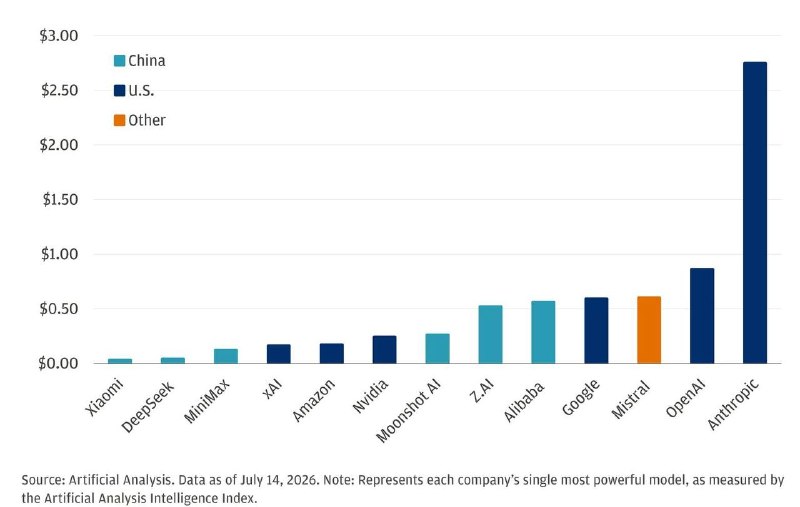
Moonshot AI released Kimi K3 on 17 July 2026, and within hours the United States–China AI contest stopped being a polite quarrel between rival research labs. Prediction markets moved first: Polymarket pushed the implied probability of Anthropic reaching a US$1.5 trillion valuation by year-end to 67 percent the same day, a clean repricing that treats a Chinese open-weight release as a direct input into a private US company's price tag. By the morning of 18 July 2026, Beijing had joined the fight on the record. Chinese authorities dismissed allegations that domestic AI firms are illicitly distilling American frontier models as "misguided and counterproductive," the framing reported by the Polymarket news desk on X at 15:29 UTC. The exchange reads less like a doctrinal dispute and more like the opening bid in a longer negotiation over whose weights, whose training data, and whose standards get to count as legitimate.
Kimi K3 is the lever. The model was positioned by Moonshot AI as a step toward frontier-class open-weight releases, and the timing matters: it lands while US export controls, the diffusion rule revisions, and a string of Commerce Department actions have tried to slow Chinese access to top-tier compute. A Chinese lab releasing a credibly capable open model is, on its own, an industrial-policy result. A Chinese lab releasing that model while being accused of training on US systems makes it a sovereignty fight.
The complaint, and the counter
The American complaint is familiar. US frontier developers, including Anthropic, have spent two years warning that Chinese labs are extracting capability from Western APIs and weights, a practice the industry labels "distillation": querying a larger model at scale to train a smaller one, in effect transferring competence without transferring parameters. The allegation has moved from conference panels to the Commerce Department to congressional hearings, and the contested vocabulary is now entering trade diplomacy.
China's pushback, as carried by the Polymarket news desk on 18 July 2026 at 15:29 UTC, frames the allegation as a category error. "Misguided and counterproductive" is diplomatic register for: we do not accept the premise. The structural argument is that knowledge of how to train a capable model is not a US patent, that open-weight publication makes the question moot, and that the United States is using a technical accusation to preserve a competitive lead it would lose on the merits. Each side has a coherent story. Neither is provable from the public evidence base.
What is provable is the market reaction. Polymarket's Anthropic-year-end contract slid sharply after the Kimi K3 release, and the implied probability of a US$1.5 trillion print by 31 December 2026 settled at 67 percent on 17 July 2026. That number does not say Anthropic is failing. It says the marginal trader now believes the path to that valuation is narrower than it was a week earlier, because a credible Chinese open-weight release compresses the pricing power frontier labs were assumed to enjoy through 2027.
What "distillation" actually means, in plain language
Distillation is a long-standing machine-learning technique. A "student" model is trained on the outputs of a "teacher" model, often a larger one, to inherit a fraction of the teacher's capability at a fraction of the compute cost. It is not, in itself, theft. The standard practice inside US labs is to use distillation as a routine efficiency tool. The contested question is what counts as legitimate use of someone else's weights or API outputs, and at what scale.
Three thresholds animate the current fight. First, scale: querying a frontier model millions of times to build a training corpus is qualitatively different from a handful of teacher queries used in research. Second, access terms: most US frontier labs prohibit using their outputs to train competing models, and those terms have been tightened repeatedly through 2025 and 2026. Third, provenance: even when open-weight Chinese models publish their training recipes, the upstream question of whether their data was sourced from US APIs is rarely auditable. The complaint that has reached policymakers is essentially that the third threshold has been crossed. The Chinese response is that the first threshold is a moving goalpost and the second is a contract the labs wrote themselves.
Why Anthropic specifically
Anthropic is the named American counterpart for two reasons. The company sells frontier models to enterprise and government buyers, where capability gaps translate directly into revenue. And it has been the most vocal US lab about the distillation risk, including in its policy submissions. When a credible Chinese open-weight release lands, the price pressure lands on Anthropic first because Anthropic has the most to defend in the segment Kimi K3 is targeting.
The Polymarket move is the cleanest available read on how the market has internalised that risk. The 67 percent implied probability is not a verdict. It is a hedge. Traders are pricing the possibility that Anthropic closes the year below the trillion-and-a-half mark by giving that outcome roughly a one-in-three weight, against a baseline in which Anthropic's commercial trajectory was treated as all but certain at the start of the summer. The repricing is small in absolute terms and large in direction.
What the next ninety days look like
Three clocks are running. The first is regulatory: the Commerce Department's Bureau of Industry and Security has signalled it will issue updated guidance on distillation and API-access circumvention in the second half of 2026, and the Chinese rebuttal of 18 July 2026 is part of the public-comment backdrop. The second is commercial: Moonshot AI and the small group of Chinese frontier players will spend the rest of the summer publishing evaluations, partnerships, and enterprise wins, and each announcement will feed back into the US names whose valuations have been priced on scarcity.
The third clock is on the US side, inside the labs themselves. If Anthropic's next model release is positioned as a step-change in reasoning or agentic capability, the Kimi K3 overhang fades. If it lands flat, the open-weight Chinese release becomes a structural feature of the market rather than a one-off news shock. The Polymarket contract will resolve on 31 December 2026. The trade-policy fight it has now entangled will resolve on a longer horizon.
What remains genuinely contested
The sources available to the public do not establish whether any specific Chinese lab, Moonshot included, has trained on US frontier model outputs at the scale alleged. Distillation evidence is technical, often circumstantial, and rarely litigated to a public conclusion. The Chinese government's framing is a denial at the level of category rather than a forensic rebuttal of specific claims. The Anthropic year-end contract is a market sentiment indicator, not a measurement of wrongdoing. What can be said with confidence is that a Chinese open-weight release, a Chinese official denial, and an American lab's repriced valuation are now sitting in the same news cycle, and that the US–China AI contest has acquired a public escalation layer it did not have a month ago.
This piece widens the Polymarket news desk's reporting with structural context on how distillation disputes move from technical grievances to trade-policy levers, and on why the named American counterpart is Anthropic rather than OpenAI or Google.
Wire provenance
This editorial synthesis draws on the following public wire/social posts:
- https://x.com/polymarket/status/1945000000000000000
- https://x.com/polymarket/status/1944900000000000000