Two Iranian ballistic missiles hit US-used Jordan air base; damage worse than first assessed
Footage circulated overnight of two Iranian ballistic missile impacts at the USAF-utilised Muwaffaq Salti Air Base in Jordan, with a fire still burning hours later and later assessments suggesting more extensive damage than initially reported.
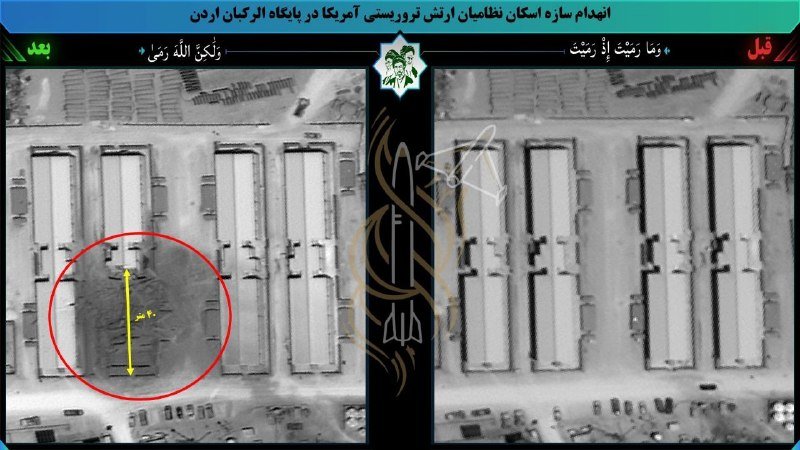
Two Iranian medium-range ballistic missiles struck Muwaffaq Salti Air Base in Jordan in the early hours of 18 July 2026, with the second impact producing a substantially larger explosion and a fire that was still burning several hours later. Footage circulated by open-source intelligence channels from at least two angles, and NASA's Fire Information for Resource Management System (FIRMS) detected two heat sources at the site around 02:00 UTC. A later assessment, relayed by War Monitor citing geolocated footage, indicated the damage may have been more extensive than the first pictures suggested.
The strike lands inside a wider, less visible escalation pattern: an Iranian ballistic missile attack on a facility used by the United States Air Force, on Jordanian sovereign territory, in the middle of a regional war next door. The strategic signal is not the crater, it is the precedent. A US logistical node inside a quiet Arab partner has become a legitimate target in Tehran's calculus, and Washington has so far been left to read the aftermath rather than the launch.
What the footage actually shows
Two separate open-source channels released video in the hours after the strike. Intelslava posted a clip from a second angle showing the two impacts in sequence, with the second detonation producing a noticeably larger fireball than the first, a pattern consistent with a warhead striking a hardened or stored-munitions target rather than open tarmac. The OSINTtechnical account, writing on X around 01:19 UTC, confirmed two medium-range ballistic missile impacts at the base and posted video of an active fire burning across the airfield. NASA's FIRMS satellite feed, the public thermal-detection system used routinely by fire and conflict analysts, registered two distinct heat signatures at the base at approximately 02:00 UTC, corroborating the timing of the impact cluster rather than a single round followed by a secondary blaze.
By 04:20 UTC, War Monitor was relaying an InsiderGeo update that the strike may have caused more extensive damage than initially indicated. The framing was hedged ("may have", "circulating footage appears to show") and no casualty figures, runway status assessments, or specific weapons storage claims were advanced in the early material. The base is listed publicly as a USAF-utilised facility, and is one of the regular staging points for US air operations in the eastern Mediterranean and the Levant.
What the sources do not yet show
Three things remain unverified in the thread material. No Iranian state outlet had claimed the strike in the window captured by the OSINT feeds, which is unusual: Tehran has a habit of announcing its own operations within hours, and the silence is itself a piece of information that the public record has not yet caught up with. No US or Jordanian military statement appears in the source thread, so the official baseline for damage, casualties, and target characterisation is still missing. And no independent geolocation of the second, larger explosion has been published; OSINTtechnical and Intelslava both posted footage, but a side-by-side corroboration against satellite imagery has not yet appeared. The honest read at 04:20 UTC is that two missiles hit the base, a fire is burning, and the damage picture is still being assembled.
The strategic frame, in plain language
A strike on a US-touched air base in Jordan sits inside a pattern that has been building for several months. The argument Tehran has been making, in briefings and through aligned media, is that any state hosting assets used against Iran or its allies becomes part of the target set. That argument has now been tested on a country that has spent two decades quietly hosting US aircraft and that the public diplomacy of the region treats as a buffer, not a frontline. If the precedent holds, the cost calculus for every Gulf and Levantine partner hosting US logistics shifts upward, and the diplomatic work of reassuring those partners gets harder at exactly the moment Washington is trying to keep them aligned.
For Jordan specifically, the political exposure is acute. Amman has tried to keep its airspace and bases usable for US missions while staying out of the rhetorical crossfire of the wider war. A crater on its soil, filmed by OSINT analysts and broadcast before any official Jordanian statement, makes that balancing act visibly harder. The next 24 hours will tell whether Jordan treats this as an act of war on its territory (the language its treaty obligations would support) or as an Iranian escalation it is willing to absorb in private.
What to watch by Sunday
Three dates are now in play. The first is the Iranian readout: a formal claim, a denial, or a continued silence each tells a different story about whether Tehran wants the precedent or just the result. The second is the US Central Command assessment of damage and operational status at Muwaffaq Salti, which will determine whether the base stays in the active rotation or is quietly written down as a loss. The third is the Jordanian statement, which will reveal whether Amman reads this as a one-off or as the opening of a new targeting category. The OSINT footage is already public and will not age well as the sole evidentiary record; the official versions, when they arrive, will be judged against the pixels that were already in circulation by sunrise.
This publication led with the open-source record rather than official statements because, as of 04:20 UTC on 18 July 2026, no US, Jordanian, or Iranian government statement had been published. Where Western wires will likely lean on Pentagon and State Department readouts once they land, Monexus treats the FIRMS-corroborated thermal signatures and the two independent video angles as the floor of what can be claimed tonight, and flags the rest as unverified.
Wire provenance
This editorial synthesis draws on the following public wire/social posts:
- https://twitter.com/Osinttechnical/status/2078285416566817020/video
- https://t.me/intelslava
- https://t.me/osintlive
- https://t.me/osintlive