Why half of Canada's wildfires now burn where no one can fight them
A new accounting shows roughly half of Canada's wildfires ignite in terrain with no road access, leaving fire agencies to watch them burn. The shift is rewriting what 'wildfire season' means.
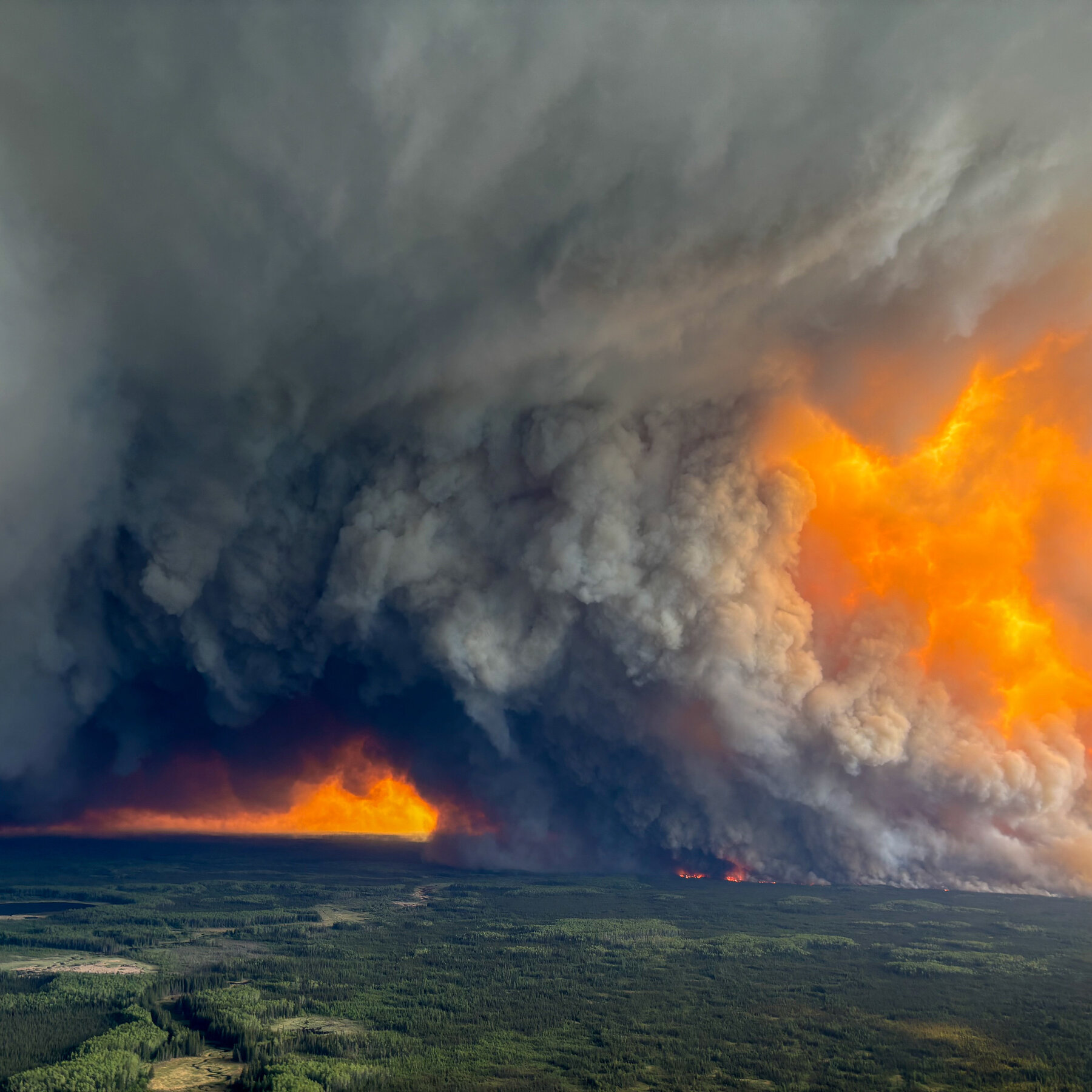
On 18 July 2026, the Canadian Interagency Forest Fire Centre published what amounts to an admission of strategic retreat: roughly half of the wildfires burning across the country this season are in terrain that fire crews have no realistic way to reach. The New York Times, in reporting that aired the same week, framed the figure bluntly: "most forest fires in Canada are simply impossible to put out." The phrase captures a quiet realignment in how North America relates to its northern forests. Where crews once tried to suppress every ignition, agencies now triage by road.
The implication is not that Canada's fire crews have grown weaker. It is that the fires have moved into territory the suppression model was never built for. Boreal spruce and jack pine stands, muskeg, and the long shield of remote drainage basins have always burned. What has changed is the arithmetic: hotter summers, drier lightning seasons, and a northward creep of the fire belt have pushed ignition into country where there is no shoulder to park a pumper on. The result is a fire-management doctrine that increasingly amounts to perimeter defence of what can be defended, and a watching brief on what cannot.
The road-access ceiling
The half-of-all-fires figure, drawn from Canadian Interagency Forest Fire Centre data and surfaced by The New York Times's climate desk on 18 July 2026, is best read as a measurement of capacity rather than intent. Canadian agencies would suppress more of these fires if they could reach them. They cannot. Helicopter bucket work, the default for remote incidents, costs roughly an order of magnitude more per hectare than ground crews and depends on visibility windows that close when smoke thickens. Air tankers, the other remote option, drop retardant in lines that mean little once wind shifts across unroaded terrain. The math is unforgiving: a fire a hundred kilometres from the nearest gravel track is, for practical purposes, a fire the province will monitor, not fight.
That ceiling is not new. What is new is how often it is binding. Smoke drift from Canadian wildfires has now reached Washington, Ottawa, and New York in four of the last five Junes. Each episode pulls the same set of agencies off the suppression ledger and onto the air-quality desk, and each episode costs provinces an escalating share of their suppression budgets. The Canadian federal government, through Natural Resources Canada, has publicly framed the shift as a transition toward landscape-level management: prescribed burning, Indigenous-led stewardship, and fuel-break construction near communities. The transition is real. It is also, by the agencies' own admission, not yet fast enough to keep pace with what the boreal is doing.
Where the suppression model breaks
The model that governed Canadian wildfire policy through the late twentieth century was built around three assumptions: a finite fire season, ignition close to roads or communities, and crews that could reach most starts within a working day. All three have eroded. Fire seasons now run from April into October across most of British Columbia, Alberta, and the Northwest Territories, with shoulder-season burns in the Yukon. Lightning ignitions cluster over the boreal plateau and the northern shield, well beyond the road network. And the suppression workforce, despite a roughly 40 percent expansion in trained wildland firefighters over the past decade, still cannot deploy meaningfully into roadless country at the speed required.
The consequence is a quiet triage doctrine. Fires near communities and critical infrastructure get aggressive initial attack, the only category where suppression has been shown to be cost-effective at scale. Fires in roadless boreal are tracked by satellite, mapped by infrared, and allowed to run until weather, fuel exhaustion, or a shift in wind brings them to a natural stand-down. Critics inside the fire-management community argue this is surrender dressed as strategy; defenders counter that pretending otherwise wastes tanker hours and crew risk on fires that will achieve their own perimeter within days.
The Indigenous-co-management variable
The variable most often underweighted in outside coverage is the role of Indigenous-led fire stewardship. Across northern Ontario, the Yukon, and parts of British Columbia, First Nations have rebuilt cultural-burning practices that were suppressed through most of the twentieth century. These programmes are small in hectares burned relative to the provincial total, but they are the only category of Canadian fire activity that has expanded consistently over the past five years. Federal and provincial funding for Indigenous-led prescribed burning has roughly tripled since 2021, a figure that provincial agencies describe as catching up to demand rather than getting ahead of it.
The structural argument runs like this. A fire regime adapted to a warming boreal cannot be built solely from provincial suppression contracts. It needs a workforce on the land year-round, intimate knowledge of drainage and fuel type, and the authority to ignite deliberately when conditions are right. Indigenous fire crews have all three; provincial contract crews have the first and intermittently the second, and almost never the third. The policy frontier, in other words, is less about aerial assets than about who has the standing to put fire on the ground.
The smoke economy
The downstream consequence is what might be called the smoke economy. Smoke from remote Canadian fires now disrupts aviation across the northeastern corridor several times a year, drives air-quality advisories in cities that never had them in living memory, and feeds a small but fast-growing market in whole-home filtration. Insurers in the United States have begun pricing Canadian smoke exposure into wildfire risk models for properties as far east as Vermont, a development that makes the cost of remote Canadian fires visible in premium notices in markets that have never burned. None of these costs show up in a suppression budget. All of them accrue downstream of the road-access ceiling.
What remains genuinely uncertain is whether the current funding trajectory, federal transfers plus provincial suppression lines plus a growing Indigenous-led budget, can keep pace with a boreal that is drying faster than the policy is adapting. The Canadian Interagency Forest Fire Centre's published indicators suggest it cannot, at least not under present deployment rules. The half-of-all-fires figure is not a forecast. It is a snapshot of a system already operating at the edge of what it was designed to do.
Desk note: Monexus framed this piece around the road-access ceiling rather than the more familiar climate-attribution angle, on the view that the operative policy question is no longer why the fires are burning but who is equipped to respond where they are.