Moonshot's Kimi K3 lands, and the cost gap that already defined China's AI race widens
Beijing-based Moonshot AI unveiled a model it says rivals OpenAI and Anthropic, built and priced in a register Washington is no longer ignoring.
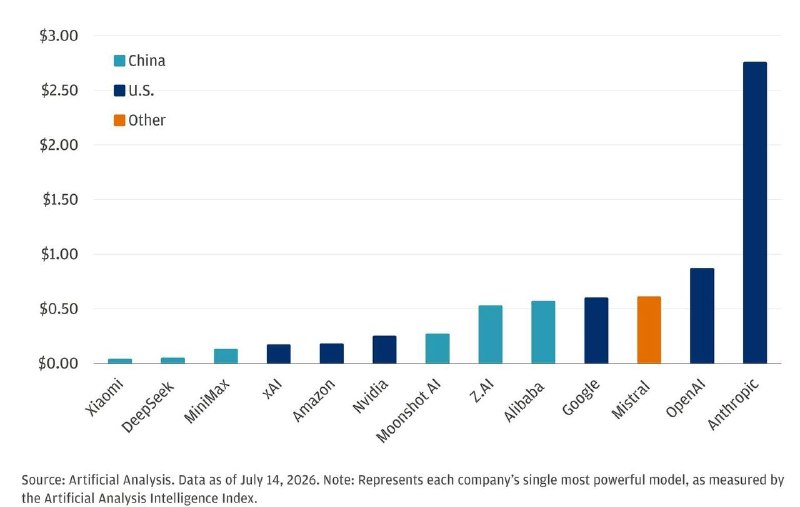
At 14:31 UTC on 17 July 2026, Nikkei Asia reported that Beijing-based Moonshot AI had unveiled a new large language model whose performance the company says approaches that of frontier systems from OpenAI and Anthropic, at a fraction of the training and inference cost that defines the US frontier. Two hours earlier, BBC News had carried the same claim to a global audience. By the end of the trading day in Hong Kong, the news was being read less as a product launch than as a marker on a curve: each successive Chinese model is closing on the American frontier not by spending more, but by spending differently.
The thesis this publication advances is straightforward. The Western coverage has framed the US-China AI contest as a story about who has the most chips, the most data centres, and the deepest capital. That framing is partly correct and partly misleading. Moonshot's announcement is the strongest available evidence yet that Chinese labs are reaching competitive performance on a fundamentally different cost architecture: cheaper inference, open-weight releases, and a domestic supply chain for accelerators that US export controls have so far failed to throttle. The geopolitics of compute is becoming the geopolitics of cost, and the latter is a contest the Chinese side has been quietly winning.
What the announcement actually says
Moonshot's claim, as relayed by BBC News on 17 July 2026, is that Kimi K3 can rival top American AI firms. Nikkei Asia's same-day dispatch specifies that the model was developed to approach the performance of Anthropic and OpenAI's flagship systems while delivering what the company describes as substantially lower operating costs. The AI-focused Telegram channel @aipost carried the announcement in parallel, amplifying it to a developer audience already primed to compare model weights and benchmark scores.
What the public-facing coverage does not yet specify, and what the sources leave open, is the precise architecture, parameter count, training compute footprint, and licensing terms of the release. That gap matters. A frontier-comparable closed-weight model sold through an API carries different industrial and geopolitical implications than an open-weight release that can be downloaded, fine-tuned, and run on domestic hardware inside Iran, Russia, or a small European research lab. Until Moonshot publishes the technical details, the market and policy reaction is being priced on the company's own framing of equivalence, not on third-party verification.
The cost gap, in plain terms
The most consequential number in the story is not a benchmark score. It is the inference price. Across 2024 and 2025, Chinese labs including DeepSeek, Qwen (Alibaba), and Moonshot have repeatedly released competitive models at API price points an order of magnitude below their US counterparts. The pattern is consistent enough that it is no longer a marketing claim but a market structure. Western frontier providers price on the assumption that they are selling a scarce, differentiated good; Chinese labs price on the assumption that the differentiation window will be short and the volume matters more.
This is the part of the story Western reporting has tended to undersell. Cost leadership in commodity compute is not glamorous. It does not produce dramatic product demos. But it produces something more durable: a price floor that the global market gradually converges toward. If a developer in Lagos, São Paulo, or Jakarta can route 80% of their traffic through a Chinese model at one-tenth the per-token cost of an American equivalent, the decision is made before any benchmark is consulted. The structural story is that the US is competing on the ceiling of capability while China is competing on the floor of cost, and the floor is where most of the world builds.
Steelmanning the counter-narrative
The dominant Western framing, evident in the BBC and Nikkei Asia coverage themselves, treats this as a model performance story first and a cost story second. That framing has weight. If Kimi K3 is in fact within striking distance of GPT-class and Claude-class systems on reasoning, coding, and long-context benchmarks, then the export-control regime built around the assumption of a widening capability gap is being stress-tested in real time.
There is a plausible alternative reading, however, and it deserves airtime. Frontier performance claims from Chinese labs have, on past occasions, been calibrated for domestic political and investor audiences as much as for global developers. Benchmark selection, prompt formatting, and the choice of comparison model all shape the headline. Independent third-party evaluations, when they arrive, sometimes confirm the claim, sometimes narrow it, and occasionally reveal that the comparison was apples-to-oranges. A serious analyst holds both possibilities open.
The structural counter to that skepticism is also worth stating. Even if Moonshot's specific claims prove overstated, the trajectory is unambiguous. Each release cycle from a Chinese lab has narrowed the gap further than the previous one. Export controls on advanced accelerators, intended to slow that trajectory, have not stopped it; they have redirected Chinese investment toward domestic chip design and algorithmic efficiency. The policy effect of the controls has been, at best, to slow convergence by a few quarters while accelerating the build-out of an alternative supply chain that will eventually compete on price as well.
What the Chinese position looks like from the inside
Coverage in Beijing-aligned and Hong Kong-based outlets treats Moonshot's announcement as confirmation of a deliberate national strategy: state-backed capital, a deep domestic talent pool, regulatory flexibility on data, and a coordinated industrial policy that treats frontier AI the way it treated EVs, batteries, and solar. There is real coherence in that framing. China's EV and battery sectors moved from laggard to dominant in roughly a decade, with state coordination playing a measurable role alongside private-sector aggression. AI is following a similar playbook, with the added advantage that software cycles move faster than hardware cycles.
From the Chinese industry's perspective, the Moonshot story is also a sovereignty story. A model that can be trained, deployed, and iterated on domestic infrastructure is not subject to the export-control risk that hangs over any deployment of US frontier models in contested jurisdictions. For buyers in the Global South, that sovereignty dimension is not abstract. It is a procurement criterion.
What remains uncertain
The sources do not specify the model's parameter count, training compute, licensing terms, or independent benchmark performance. They do not specify which Chinese accelerator silicon, if any, was used for training, or whether Kimi K3 will be released as open weights or behind a controlled API. The pricing claims are Moonshot's own, not yet verified by independent testing. Until those details are public, the announcement is best read as a signal of trajectory rather than a settled fact about capability.
The next few weeks will resolve most of these questions. Developer communities typically have independent evaluations of new Chinese models within days of release, and the resulting benchmarks tend to be more granular than the company's own marketing. Watch for those numbers; they will tell you whether the gap has genuinely narrowed or whether the announcement was, as the skeptics suspect, a strategically framed claim.
What is not uncertain is the structural shift. The US-China AI contest is no longer a story about who is ahead on a single leaderboard. It is a story about two different cost architectures competing for the same global market. Kimi K3 is the latest data point in that contest, and the curve it sits on is moving in a direction the White House has been trying, and so far failing, to bend.
Desk note: Monexus framed this as a cost-architecture story, not a model-versus-model benchmark story. Western wires led on the comparison to OpenAI and Anthropic; the structural read sits underneath that, and matters more.
Wire provenance
This editorial synthesis draws on the following public wire/social posts:
- https://t.me/aipost
- https://t.me/NikkeiAsia
- https://t.me/nikkeiasia
- https://en.wikipedia.org/wiki/Moonshot_AI