Israeli engineering crews flatten Bint Jbeil stadium and roadside trees in south Lebanon demolition sweep
Three explosions hit the southern Lebanese city of Bint Jbeil within minutes on 17 July, after which Israeli forces demolished a municipal sports complex and stripped trees along the access roads.
Three detonations ripped through Bint Jbeil in southern Lebanon inside a window measured in minutes on 17 July 2026, and the engineering crews that followed did not stop at the blast sites. Within two hours, Israeli forces had reduced the Hajj Mousa Abbas Sports Complex, including the municipal stadium and surrounding structures, to a debris field, and had stripped the trees lining the approach roads to the city. The sequencing of those operations, and the choice of targets, points to a method: shock the place, then clear the landmarks and sightlines that make a place legible to its own residents.
What is unfolding in Bint Jbeil is one of the more visible episodes in the current Israeli military posture along the Lebanese border, where demolition work and bombardment have been reported in clusters that fall outside the rhythm of the formal ceasefire monitoring. The accumulation of these episodes, more than any single detonation, is reshaping the civilian map of south Lebanon, and Bint Jbeil, a town that has carried symbolic weight since 2006, has once again become a focal point.
The afternoon in Bint Jbeil
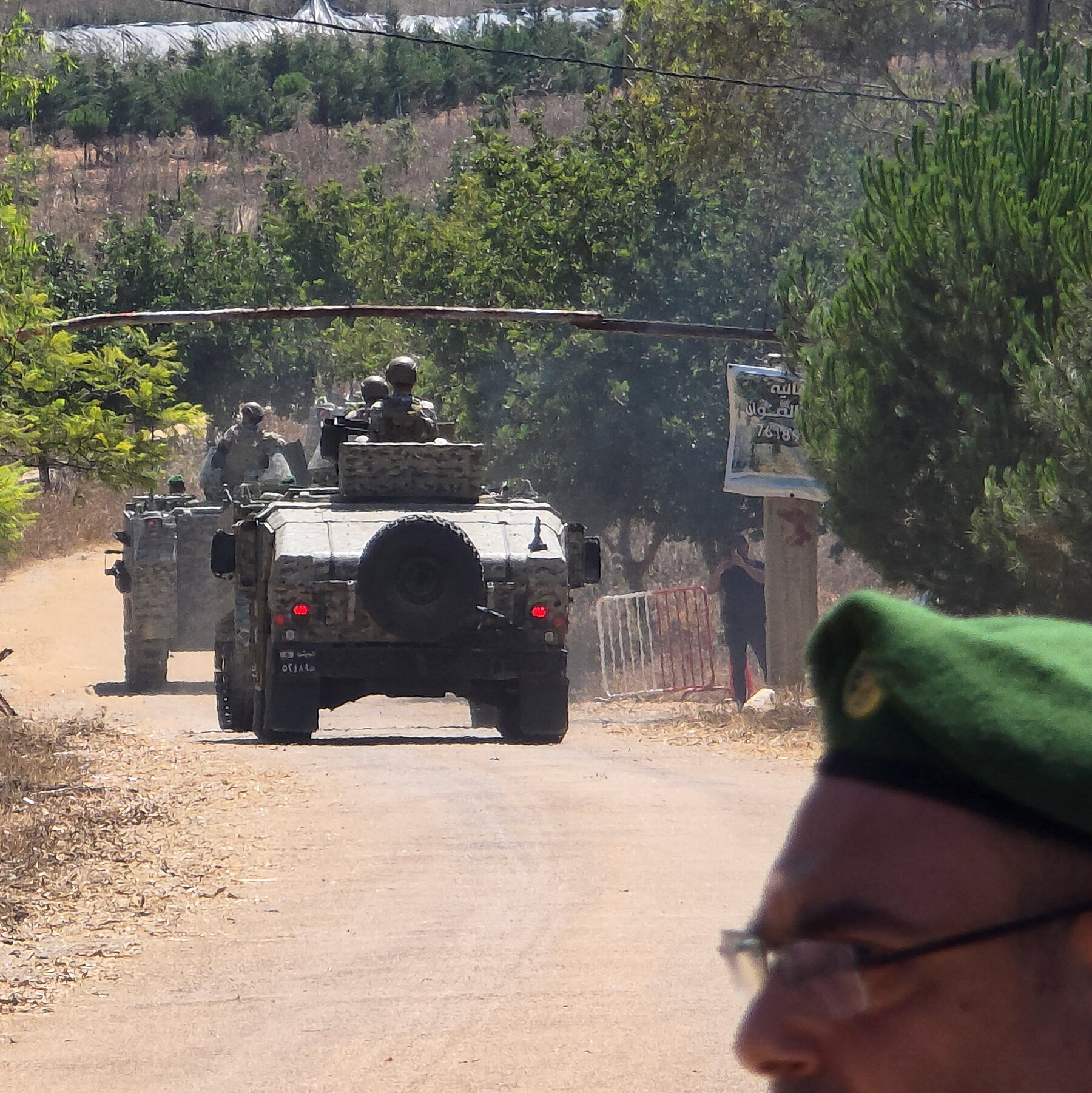
The day's reporting began at 12:37 UTC, when a Lebanese field correspondent posted footage of an Israeli military vehicle approaching the Lebanese Army checkpoint at the entrance to Mansouri, the town that sits adjacent to Bint Jbeil, according to a Telegram dispatch from the @wfwitness channel. By 12:38 UTC, Al-Alam Arabic was reporting several bombings inside Bint Jbeil itself, and two minutes later The Cradle Media posted what it described as footage of three Israeli explosions in the city, with the same channel publishing aftermath video. The pattern of initial airstrike footage, followed within roughly ninety minutes by demolition footage, was identical in shape to operations previously documented in border villages further east.
The visible payload of the afternoon came at 14:01 UTC. The Cradle Media published photographs of the Hajj Mousa Abbas Sports Complex, identifying the municipal stadium and adjacent buildings as having been struck by Israeli demolition operations, with structures in the immediate vicinity destroyed or damaged. The Cradle followed this at 14:27 UTC with a separate post stating that Israeli forces had destroyed all of the trees lining the roads leading into Bint Jbeil, a piece of terrain engineering that, on its face, removes both shade and the visual landmarks residents use to orient themselves at the city edges. The compounding effect of removing landmark civic structures and roadside tree cover in the same operational window is the kind of detail that does not register as a single dramatic event but that, taken together, changes what Bint Jbeil looks like from the road.
What the framing on each side looks like
Lebanese and Iran-aligned regional outlets led the day on Bint Jbeil, with The Cradle Media and Al-Alam Arabic carrying the substantive photography and footage, and field accounts arriving through Telegram correspondents. Reporting of this kind travels inside an established regional framing in which Israeli operations inside Lebanon are described in terms of occupation and destruction, and in which civilian infrastructure is treated as a deliberate target rather than incidental collateral. The mainstream Israeli and Western-wire read, by contrast, has historically treated operations in south Lebanon through the lens of dismantling Hezbollah infrastructure, with demolitions and tree-clearing explained as the removal of cover used by militant cells to conceal rocket launchers, observation posts and tunnel entrances. Neither framing is wrong on its own; the friction sits in how the same physical act is described, and the choice of words matters because it determines whether a reader registers the operation as necessary counter-militant engineering or as the systematic un-building of a town.
The structural issue is that this kind of operation is rarely documented in the same place, at the same time, by both camps. Lebanese outlets publish the photographs. Israeli and Western-wire outlets publish the rationale. The two strands meet only rarely in the same paragraph in the international press, which means the international reader usually sees either the rubble or the briefing slide, and not the relationship between them. Coverage that holds both at once is what would let a reader judge whether the engineering being done is consistent with stated aims, and that combined view is what remains missing in the open record for this particular afternoon.
What the method reveals
Three signatures of the Bint Jbeil operation are worth isolating. First, the time compression: airstrike footage at 12:38 to 12:40 UTC, demolition footage at 14:01 UTC, terrain-clearing footage at 14:27 UTC, all inside a roughly two-hour window. That sequencing is consistent with a combined-arms template in which air-delivered munitions soften or mark a target set and ground engineering crews move in to complete the physical erasure, rather than with the slower tempo of a single airstrike followed by an assessment phase. Second, the target set: a municipal sports complex and roadside tree cover are not dual-use infrastructure in the conventional sense, and Israeli briefers have not, in this set of source items, identified them as such. Third, the cumulative direction: this is not the first reporting of demolitions in border-adjacent Lebanese villages in recent months, and Bint Jbeil's status, given the symbolism the city carries from earlier wars, makes it a notable site at which to consolidate such a pattern.
The pattern sits inside a wider approach to southern Lebanese border zones that has relied on three instruments: airstrikes against what Israeli briefers identify as militant infrastructure, controlled demolitions of structures on or near the border, and the clearing of vegetation along likely line-of-sight routes. None of these instruments is new. What is worth watching is whether they are now being applied in tighter operational windows and on a wider set of targets than in earlier phases of the post-ceasefire period, because that is the variable that would mark a real change in posture rather than a continuation of it.
What to watch next
Three near-term tests will determine whether the Bint Jbeil episode is a discrete incident or the opening move of a wider operation. First, whether the Israel Defense Forces publish a target list for the afternoon, with specific identification of the structures struck and the rationale for treating the stadium complex and roadside tree cover as military objectives. Second, whether UNIFIL or the Lebanese Armed Forces file a formal complaint, and on what evidentiary basis, given that an Israeli military vehicle was filmed approaching the Mansouri checkpoint earlier the same day. Third, whether reporting from international wire outlets corroborates the demolition work independently of the regional outlets that broke the story, because that corroboration is what would convert the footage currently circulating into the verifiable international record.
What remains genuinely uncertain is the operational intent behind the targeting sequence. The sources document the destruction; they do not document the order that produced it. Until an authoritative Israeli statement on the specific target set is on the record, the most defensible reading is the procedural one: that this afternoon in Bint Jbeil followed a templated method that has been visible elsewhere in the border zone, applied at a site of particular symbolic and demographic weight.
Monexus framed this against the regional outlets that broke the footage first; mainstream Western wires had not, by 14:30 UTC on 17 July, published independent confirmation of the demolition work, and the international record on this particular afternoon is currently held by Telegram correspondents and Lebanon-based outlets rather than by the wires that would normally anchor a Western audience's understanding of south Lebanon.
Wire provenance
This editorial synthesis draws on the following public wire/social posts:
- https://t.me/wfwitness
- https://t.me/alalamarabic
- https://t.me/thecradlemedia
- https://t.me/thecradlemedia
- https://t.me/thecradlemedia