Six nights over Iran: what CENTCOM's strike cadence actually tells us
U.S. Central Command has now logged six consecutive nights of strikes on Iran. The pattern says more about Washington's escalation calculus than the daily target list.
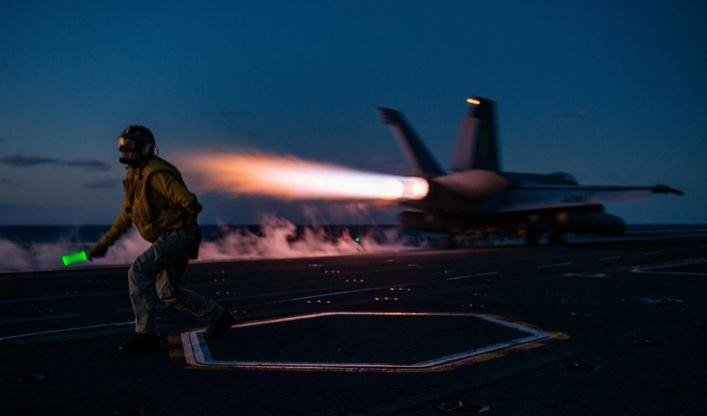
At 2 p.m. Eastern Time on 16 July 2026, U.S. Central Command announced that American forces had begun a fresh wave of strikes against Iran, the sixth consecutive night of operations under the same public framing: "to further degrade Iranian military capabilities." Within an hour, open-source monitors reported explosions across multiple western Iranian cities, confirming that the announcement and the kinetic phase had moved in lockstep, as they have each afternoon since 11 July.
What is unfolding is not a one-off retaliation. It is a sustained, scheduled air campaign, announced in advance, calibrated in nightly tranches, and broadcast by the same military spokesperson each evening. The cadence itself is the message: Washington is signalling that escalation is bounded, that the target set is finite, and that diplomacy, or at least the option of it, is being held open in parallel. Whether that reading survives contact with the next 72 hours is the open question.
What CENTCOM is actually saying
The statement issued on 16 July at 18:00 UTC by U.S. Central Command repeats a phrase that has become boilerplate: strikes are intended to "further degrade Iranian military capabilities," language that fits inside the legal architecture of the existing authorisation without invoking new war powers. The phrasing is deliberately narrow. It does not name a campaign name, does not announce a regime-change objective, and does not enumerate target categories publicly. It does, however, embed a claim of incremental progress: each night's tranche is presented as a continuation of work already underway.
The Liveuamap wire carried the CENTCOM release verbatim, as did the Clash Report channel and the Russian-aligned rnintel feed, the latter translating the statement without editorial overlay. The OSINTtechnical account, posting via X at 19:30 UTC, added a layer of geographic specificity: explosions reported across multiple western Iranian cities roughly an hour after the announcement. That sequence, statement first, detonations second, has been the nightly pattern since the campaign opened.
The phrasing is doing work that the target list is not. "Degrade" is a capability term, not a territorial one. It implies the attrition of specific weapons systems, production capacity, command-and-control nodes, and storage sites, rather than the occupation or destruction of population centres. That distinction matters for two audiences simultaneously: a U.S. domestic audience that reads the word "degrade" as contained, and an Iranian audience the operation is meant to coerce.
The counter-narrative from inside Iran
Reporting from inside Iran remains sparse, and the sources do not specify a casualty toll or a confirmed target list for the 16 July wave. State-aligned outlets in Tehran have, in previous nights, framed the strikes as an act of aggression against civilian infrastructure, a framing that the open-source monitors have not corroborated and that CENTCOM's own language does not support. What can be said from the available material is that the strikes are hitting western Iranian cities, a geography consistent with missile-production facilities, air defence installations, and Revolutionary Guard Corps logistics nodes, rather than the Tehran metropolitan centre.
Two readings compete. The first holds that the campaign is a serious, if limited, effort to set back Iran's conventional retaliatory capacity before a diplomatic window closes. The second holds that the nightly cadence is a pressure tactic designed to demonstrate resolve while keeping a negotiation track alive, and that the target set has been chosen to degrade without provoking a wider regional war. CENTCOM's public language is consistent with both. The distinction between them is a question of intent, and intent is the variable the daily briefing does not disclose.
A campaign that announces itself
What sets this operation apart from previous U.S. air campaigns against Iran-linked targets is the regularity of the public announcement. Strikes on Iraqi militia positions in 2024, and on Houthi infrastructure in Yemen across 2024 and 2025, were typically confirmed after the fact, sometimes hours later, sometimes the following morning. The current Iran campaign inverts that pattern: the spokesperson statement precedes the detonations, and the open-source community then geolocates the impacts in real time.
The structural effect is to convert a military operation into a scheduled broadcast. Each evening becomes a news cycle of its own, and each morning's coverage opens with a tally of what was hit overnight. That cadence imposes a discipline on escalation: any deviation, a skipped night, a much larger payload, a strike on a previously untouched category of target, would register instantly as a signal change. Conversely, a continuation of the pattern registers as confirmation that the campaign is proceeding within its announced parameters.
The pattern also creates a forcing function for Tehran. Iran's options narrow as the nights accumulate. Retaliation against U.S. bases in the Gulf, attacks on Israeli territory, disruption of shipping through the Strait of Hormuz, all carry costs that rise with each additional night of attrition inflicted on Iranian assets. So does the decision not to retaliate, which progressively hardens the perception of Iranian weakness among regional actors. The campaign's design appears to be making both paths costly, a textbook coercion logic rather than a maximalist one.
What to watch in the next 72 hours
Three signals will determine whether the cadence holds, intensifies, or breaks. First, the wording of the 17 July CENTCOM statement: a sixth night phrased identically to the first five reads as continuity; a shift in target language, or the appearance of a named objective, would read as escalation. Second, any Iranian retaliatory move, whether direct at U.S. assets, via proxy, or in the maritime domain, would force a recalculation on both sides and likely compress the announcement cycle. Third, the diplomatic track, if one is active, becomes visible through third-party readouts from Oman, Qatar, or Switzerland, the channels that have historically carried back-channel traffic between Washington and Tehran.
The sources do not specify which of these paths is more likely, and the available material does not include readouts from any Gulf intermediary. What the sources do establish is that, as of 19:30 UTC on 16 July 2026, the campaign is on its announced schedule, the targeting remains in western Iran, and the public framing has not changed. For now, that is the news: not a single strike, but a six-night pattern, and the architecture of language and timing that holds it in place.
Monexus framed this as a study of cadence and signalling rather than a target-by-target strike report; the available material does not support granular claims about specific sites or casualty figures.
Wire provenance
This editorial synthesis draws on the following public wire/social posts:
- https://twitter.com/Osinttechnical/status/207
- https://t.me/rnintel
- https://t.me/ClashReport