F-35A emergency over the UAE: what four channels said, what none confirmed
A US Air Force F-35A reportedly squawked 7700 over the Emirates on the evening of 16 July 2026. Four open-source channels carried the alert within minutes. None had pilot, cause, or base by press time.
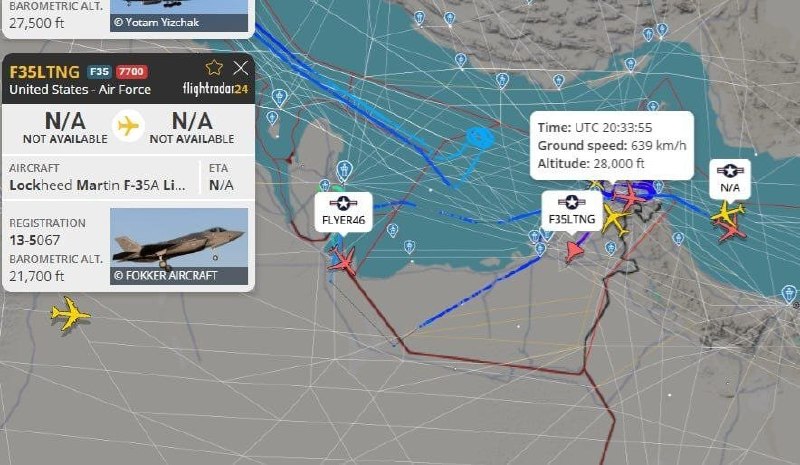
At 20:58 UTC on 16 July 2026, the open-source mapping channel AMK_Mapping posted a short item: a US Air Force F-35A multi-role fighter had declared an in-flight emergency over the United Arab Emirates, squawking the international emergency transponder code 7700. Within seven minutes, the same alert had been mirrored by Intelslava (21:01 UTC) and by two Fars-affiliated channels (Fars News International and farsna, both at 21:05–21:06 UTC). No Western wire, no US Air Force public affairs office, and no UAE official had spoken by the time those four posts went out. The incident is real in the narrow sense that something caused a 7700 squawk to appear in flight-tracking feeds visible to open-source analysts. The incident is unconfirmed in every other sense the word can carry: aircraft disposition, pilot status, base of origin, mission profile, and cause.
That gap between an emergency code on a transponder and a verified aviation event is the actual story. Open-source channels have spent the last two years getting much faster at catching the first signal, and Western outlets have not noticeably sped up the second step. The result is a public record in which an F-35A is reported as having "crashed" by one channel, "declared an emergency" by three others, and "landed" or "not landed" by none, all inside an eight-minute window. Readers who never see a follow-up will carry the loudest version forward.
What the four channels actually said
The cleanest version is AMK_Mapping's 20:58 UTC post: an F-35A declared an in-flight emergency over the UAE and squawked 7700. Intelslava, three minutes later, added the detail that the aircraft "has landed" – a verb the other three channels do not echo. The two Fars posts use slightly different language. One describes "unconfirmed reports" of an F-35A "multi-role fighter" that "has crashed while flying over the UAE"; the other uses the softer "declared an emergency … and activated" (the sentence is truncated in the source item). None of the four names a tail number, a unit, a base, a pilot, an altitude band, a cause, or a casualty status. The cluster's centre of gravity is the 7700 squawk itself, which is a standard transponder code any properly equipped civilian or military receiver can pick up and which several independent flight-tracking services would have logged simultaneously.
The fact that the same alert was relayed by channels with different editorial alignments is, in itself, the most useful information. Iranian state-adjacent Fars outlets and the Russia-aligned Intelslava have little reason to coordinate on a minor aviation event over the Emirates, and AMK_Mapping is an open-source map project that rarely touches either Tehran's or Moscow's preferred narratives. A four-channel independent relay at this speed is more consistent with a signal that genuinely appeared in shared flight-tracking data than with a single-source rumour being laundered across networks.
What a 7700 squawk does and does not tell you
7700 is the universal transponder code for any in-flight emergency: engine failure, hydraulic loss, gear malfunction, bird strike, pilot incapacitation, fuel exhaustion, or a controlled descent after a battle damage hit. It is not a crash code, and a pilot who squawks 7700 is, in the standard procedure taught across Western air forces, expected to land at the nearest suitable airfield and then file a report. The transponder does not record outcome. A 7700 event can end in a textbook wheels-up landing, a hard engine-out arrival, an ejection, or a hull loss. Flight-tracking feeds that surface the code do not distinguish between those four. The unverified "has crashed" wording in one of the Fars items is therefore a stronger claim than the underlying signal supports, and "has landed" in the Intelslava item is a stronger claim of a different kind. Neither has been corroborated by a primary source in the thread.
The structural problem: open-source first, official last
The shape of this incident is now familiar. A transponder signal appears in a shared tracking feed. Independent OSINT channels pick it up within minutes and post in compressed, often truncated form. The strongest available version lands first, because that is what gets shared. Western wires and the relevant air force public affairs office arrive hours later, if at all, with a more careful statement that may partially contradict the early framing. By that point the public record is already set: readers who saw the first post will discount the official line as cover, and readers who saw only the official line will treat the OSINT posts as noise. Neither reaction is well-calibrated to what the underlying signal actually meant.
In this case the asymmetry is especially stark because the F-35A is a sensitive platform. The United States does not routinely publish the operating locations, serial numbers, or mission profiles of forward-deployed F-35s in the Gulf. The UAE is not a public member of the F-35 export programme and is not known to operate the type, which makes any F-35A airborne over the Emirates almost certainly a US Air Force or US Marine Corps asset, and therefore a US asset on a US mission that the US alone is positioned to explain. Until an Air Force Central Command or USAF public affairs release names the jet and the base, the only honest reading is that an emergency code was logged, that the aircraft is a US F-35A, and that nothing more can be said with confidence.
What to watch and what remains contested
Three things would move this from a four-channel alert to a reportable event. First, an official US Air Force or US Central Command statement identifying the aircraft, the unit, the departure base, and the disposition of the airframe. Second, imagery: a tail number visible on a burned-out airframe, a canopy, or an ejection seat would let independent OSINT analysts tie the event to a specific airframe. Third, NOTAMs and runway closure records at the nearest suitable airfields in the UAE, plus Al Udeid in Qatar and Al Dhafra, which is the principal US air base inside the Emirates and the most likely diversion field. None of those data points is in the public source set at the time of writing. The sources disagree on a single material point – whether the aircraft crashed, declared an emergency, or landed – and that disagreement is unresolved. The remaining uncertainty is not a question of editorial caution; it is a genuine information gap that the relevant authorities have not yet filled.
Until that gap closes, the prudent summary is the one the four channels converged on, stripped of their differences. On 16 July 2026 at approximately 20:58 UTC, a US Air Force F-35A squawked 7700 over the United Arab Emirates. That is the verified minimum. Everything else is reconstruction.
Desk note: Monexus read four open-source channel posts in a nine-minute window and one transponder-code standard. Western wire coverage had not arrived at press time, and the official US Air Force line is absent. We have leaned toward the lowest claim that all four sources support and flagged each stronger claim as unverified rather than splicing them into the lede. No causal claim is made. No casualty figure is asserted. No aircraft disposition is stated as fact.
Wire provenance
This editorial synthesis draws on the following public wire/social posts:
- https://t.me/AMK_Mapping
- https://t.me/intelslava
- https://t.me/FarsNewsInt
- https://t.me/farsna
- https://en.wikipedia.org/wiki/Transponder_(aeronautics)#Emergency_codes
- https://en.wikipedia.org/wiki/Al_Dhafra_Air_Base