Trump pauses Iran strikes as Omani shuttle opens Hormuz track
President Trump on Friday ordered the US military to suspend new strikes on Iran, ending nearly two weeks of daily attacks after an Omani delegation arrived in Tehran to negotiate over the Strait of Hormuz.
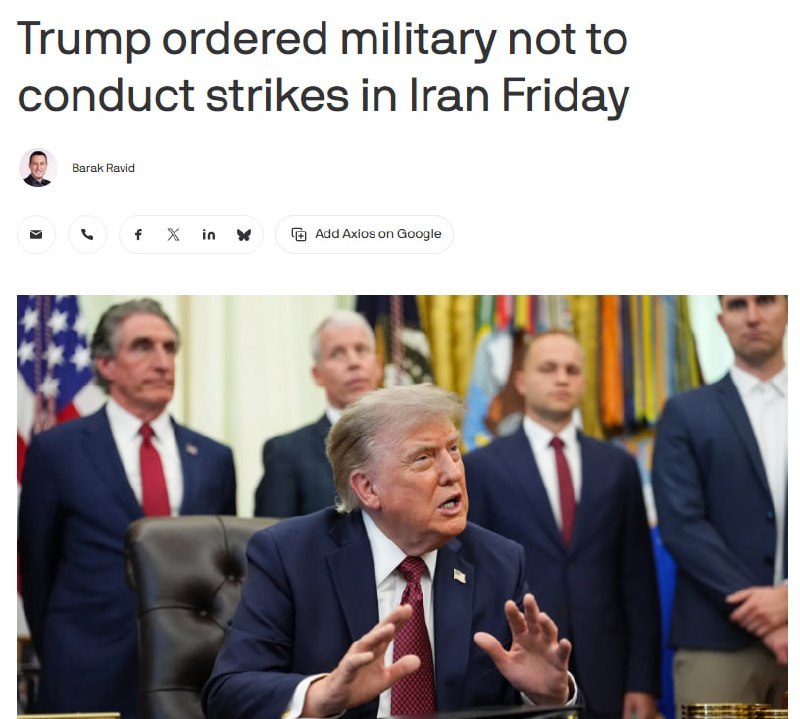
President Donald Trump on Friday ordered the US military to suspend new strikes on Iran, ending nearly two weeks of daily attacks, according to reporting carried by Axios and relayed through European and Gulf outlets on 25 July 2026. The pause, per the same reporting, was timed to an Omani delegation's arrival in Tehran for talks on the Strait of Hormuz. By Saturday evening Tehran time, the channel Iran Military had counted Trump repeating, for the 81st time, that the Strait of Hormuz is "open and under US control," a line that has done duty as both operational claim and political taunt across the conflict.
The diplomatic move and the military move arrived on the same day, and that simultaneity is the story. Strikes that had been running at a daily cadence for roughly a fortnight stopped within hours of an Omani shuttle landing in the Iranian capital. The pattern fits a familiar Gulf-routed backchannel: Muscat hosts the preparatory contacts, Tehran receives the delegation, Washington reads the optics before authorising further force. Whether the arrangement produces a durable de-escalation or merely a tactical breathing space is the open question hanging over the next 72 hours.
What changed on Friday
Clash Report's wire on the 25 July pause describes the decision as ending "nearly two weeks of daily attacks," a phrase that matches the Axios frame carried by Euronews and Al Alam Arabic. Al Alam Arabic's urgent bulletin, citing Axios sources, places the stop-order "hours after an Omani delegation arrived in Tehran to hold talks on the Strait of Hormuz." That sequence matters more than the strike count: it suggests Washington is treating the Omani track as the operative signal, not the on-the-ground military pressure, even when the military pressure has been relentless.
The pause is not a withdrawal. US forces remain in posture across the Gulf, CENTCOM's task force organisation in the region has not been stood down in any reporting this desk has seen, and the president's daily rhetorical claims of control over Hormuz have continued undiminished. What changed is the willingness to add new strikes to the ledger while a negotiation is live.
Why Oman, and why now
Oman has long played the role of discreet interlocutor between Washington and Tehran, a function the late Sultan Qaboos institutionalised and that Muscat has continued under Sultan Haitham. The geographic fit is obvious: Omani ports sit on the Strait of Hormuz itself, Omani diplomacy has working-level contacts with both the Iranian foreign ministry and the US National Security Council, and the Omani position is small enough to be ignored by Gulf hawks and large enough to host a delegation.
The substantive agenda, as framed by Axios's relays, is the Strait of Hormuz rather than the broader nuclear file. That is itself a tell. A full nuclear negotiation would route through Vienna, the IAEA board, or a multilateral track; a Hormuz-specific negotiation routes through a Gulf capital and concerns freedom of navigation, tanker insurance, escort arrangements, and the price of shipping crude through the choke point. If the channel is real, it suggests the US and Iran are trying to de-conflict the maritime question while leaving the nuclear and proxy questions for another day.
The Hormuz claim as leverage
The Strait of Hormuz claim has functioned as both assertion and bargaining chip. The 25 July repetition, marked by Iran Military as the 81st, is the visible surface of a longer contest over who controls the sea lanes through which a fifth of global seaborne oil transits. Iran's own doctrine treats Hormuz as a defensive lever; US Central Command treats it as a force-projection surface. The two readings cannot both be fully correct at once, which is precisely why the claim keeps getting repeated.
From a market and shipping perspective, the dispute is not abstract. Insurance war-risk premiums for tankers transiting Hormuz spiked during the daily-strike phase and have eased only modestly since the pause announcement, which suggests commercial actors are pricing the de-escalation as provisional rather than durable. Monexus analysis: the gap between political rhetoric of "open and under US control" and the premium quoted to a VLCC captain is the cleanest real-time gauge of how the market reads the diplomatic track.
The two readings
The dominant Western-wire framing is that Trump is using strikes to set the table for a deal, and that the Omani track is the table being set. The alternate reading, which carries weight in Tehran and in parts of the Gulf, is the inverse: that the strikes were the leverage, and the pause is the political reward Iran has been offered in exchange for a Hormuz arrangement that the US already, in effect, controls by posture. Both readings can be partially correct. The reason the strikes stopped within hours of the Omani arrival is consistent with the first reading. The reason the US has not demanded a binding public Iranian concession is consistent with the second.
A third, more sceptical reading sits behind both: that the pause is a tactical move to manage escalation risk before an unrelated political calendar event, that the underlying dispute will re-erupt inside a week, and that the daily-strike pattern will resume under a different trigger. The cited reporting does not establish which reading will prevail. The available sources do not specify a deadline for the Omani talks, a public Iranian statement on the pause, or a written US readout beyond the Axios-sourced reporting. That gap is itself the news, because a real deal would, at this stage, be accompanied by statements from both capitals.
What to watch
Three signals over the next 72 hours will determine which reading holds. First, whether the Iranian foreign ministry confirms publicly that the Omani delegation has met with a named counterpart at deputy-minister level or above; silence would suggest the talks are narrower than reported. Second, whether CENTCOM publishes or a credible wire reports a drawdown of naval task force posture in the Gulf; a drawdown would price in durability, a static posture would price in provisionality. Third, whether tanker-insurance war-risk premiums for Hormuz transits fall below the levels quoted during the strike phase; that is the market's own verdict on whether the maritime question has actually moved.
The strike count is now zero, the talks count is one, and the public-statement count is zero. That arithmetic is the cleanest summary of where the dispute stands at 25 July 2026, 19:31 UTC.
Desk note: Monexus ran this off a thin Axios-sourced wire relayed through Euronews, Al Alam Arabic, Clash Report and Iran Military, and is treating the underlying scoop as a single relay rather than four independent confirmations. The piece names what the cited posts contain and does not assert silence by Tehran or Muscat beyond noting that the available source items do not specify a public statement.
Wire provenance
This editorial synthesis draws on the following public wire/social posts:
- https://t.me/IRIran_Military/9308
- https://x.com/SprinterPress/status/2081086281342185851
- https://t.me/euronews/19008
- https://t.me/ClashReport/90371
- https://t.me/alalamarabic/489826