IRGC claims strikes on US assets in Jordan and Kuwait, addresses Gulf publics in Arabic-language video messages
Iran's IRGC has released Arabic-language video addresses to the publics of Kuwait and Jordan claiming strikes on US fighter hangars, a Patriot battery and satellite facilities. The claims originate solely with Iranian state media and cannot yet be independently verified.
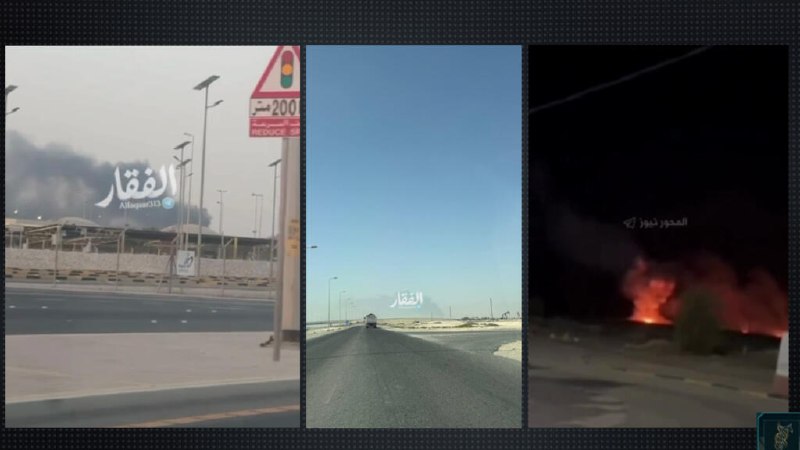
At 03:27 UTC on 15 July 2026, Iran's Islamic Revolutionary Guard Corps released Announcement No. 14, a video address directed in Arabic at the people of Kuwait and claiming the destruction of a US satellite communications centre, missile and air-defence radar systems, a Patriot air-defence complex and associated US military infrastructure on Kuwaiti territory. Twenty-three minutes earlier, at 03:04 UTC, a parallel Fars News Agency dispatch had claimed the destruction of hangars housing F-15, F-16 and F-35 fighters, plus a number of US MQ-9 strategic drones, at Jordan's Al-Azraq air base. A third PressTV item, timestamped 02:43 UTC, framed the same package of strikes as retaliation for "more than four months" of US military action.
What is currently on the public record is not the strikes themselves but a coordinated Iranian state-media package: three bulletins, two video addresses to neighbouring Arab publics, and a narrative frame that names the United States as "the Great Satan" and "child-killing army." None of the three items has been corroborated by US Central Command, the Jordanian government, the Kuwaiti government, or any wire service. As of 15 July 2026, the sourcing chain runs exclusively through Tehran.
What Iran is claiming
The IRGC's Announcement No. 14, as carried by Tasnim News Agency, lists four distinct target sets struck on Kuwaiti soil: a satellite communications centre, missile and air-defence radar installations, a Patriot air-defence complex, and additional US military infrastructure described in generic terms. The PressTV bulletin frames the strikes as revenge for a US war it says began "more than four months ago." Both messages are addressed not to the governments of Kuwait and Jordan but to "the people," in Arabic, using the rhetorical register of public appeal rather than diplomatic protest.
The Fars dispatch, by contrast, is addressed to "the honourable people of Jordan" and zeroes in on a specific site: Al-Azraq air base, a Royal Jordanian Air Force facility that has hosted US aircraft and US personnel on rotation for years. The Fars claim is granular, naming F-15, F-16 and F-35 hangars and MQ-9 strategic drones, and asserts that these assets were destroyed in a dawn strike.
Why the framing matters
Iranian messaging in this episode is aimed at a regional, not a Western, audience. The Arabic-language address, the explicit invocation of "the people of Kuwait" and "the people of Jordan," and the choice to name a US Patriot battery and US fighter hangars in the same breath all point to a calculation about domestic politics in two US partners that host American forces on their soil. Kuwaiti and Jordanian public sentiment toward the US military presence is not uniform; both governments have navigated the relationship carefully even as the base footprint has expanded since late 2023.
The choice of target language is also telling. Patriot systems and satellite communications centres are not the kind of high-casualty infrastructure that produces dramatic footage; they are precisely the systems the US and its Gulf partners would use to defend against Iranian missile and drone attacks. Claiming their destruction is a deterrent claim as much as a battlefield claim: a signal to planners in Doha, Manama, Riyadh and Abu Dhabi that Iranian precision-strike capability now extends, in Iran's telling, to the most sensitive enablers of US power projection in the region.
The evidentiary problem
The sourcing here is unusually thin for claims of this magnitude. Iranian state media, IRGC-affiliated outlets, and the IRGC's own video arm are reporting the strikes, but no imagery has been independently published, no independent outlet has confirmed damage, and no on-the-ground reporting from Amman or Kuwait City corroborates the timeline. The US and Jordanian militaries have not, as of the timestamp on these items, commented. Kuwaiti state media has not, on the evidence available to this publication, broken from routine.
The framing on the Iranian side is also consistent with a longstanding pattern in which Tehran couples kinetic action with a multi-platform information operation. Telegram channels operated by Tasnim, Fars and PressTV are the primary dissemination layer, with announcements numbered in sequence (No. 14 implies thirteen prior bulletins in the same series) and video addresses circulated as standalone propaganda artefacts for re-uploading to Arabic-language social media. Whether the kinetic component matches the messaging component is the central open question.
The structural read
Stripped of rhetoric, what the package signals is an Iranian attempt to redraw the public map of the US presence in the Gulf. By addressing the people of Kuwait and Jordan directly, in Arabic, and by choosing to name Patriot radars, satellite uplinks and fifth-generation fighters, the IRGC is reframing a war between states as a war between the United States and Arab publics who happen to host US bases. That is a message that, if it sticks, complicates basing access and overflight rights for Washington at a moment when the US is already juggling crises on multiple fronts.
It is also a test of credibility. The four-target list in Kuwait, the three-aircraft-and-MQ-9 list in Jordan, and the "more than four months" frame in PressTV together assert that Iran can hit, simultaneously, the most sensitive enabling systems of US forward presence in two Arab host states. If the claims are credible, the strategic implications for US force posture in the Gulf are severe. If the claims are inflated, the credibility cost for Tehran's deterrent messaging, and the political cost for any Arab government seen as unable to defend US-partnered infrastructure, is severe in the other direction. The next 48 hours, when satellite imagery, crater analysis, and on-the-ground reporting should resolve at least the physical-damage question, will tell which direction the evidence moves.
How Monexus framed this: the wire has, predictably, lagged. The three items currently on the public record come exclusively from the Iranian side. This article treats the claims as claims, names them as such, and refuses to import the rhetorical register of either Tehran or Washington until the physical record is on the table.
Wire provenance
This editorial synthesis draws on the following public wire/social posts:
- https://t.me/presstv/1850
- https://t.me/farsna/2120
- https://t.me/tasnimnews_en/9450