Armed man arrested at north barricade of US Capitol as police investigate motive
A man carrying a firearm was arrested at the north barricade of the US Capitol on 13 July 2026, where firearms are prohibited. Capitol Police say they are investigating why he drove there.
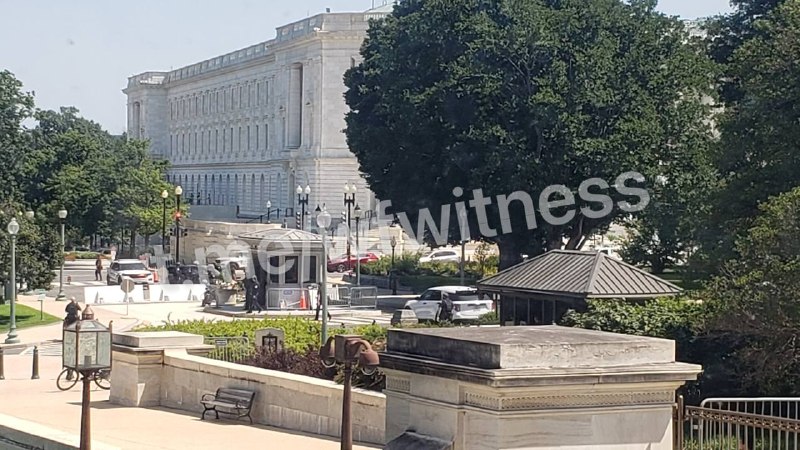
At 16:07 UTC on 13 July 2026, US Capitol Police arrested a man carrying a firearm at the North Barricade of the US Capitol Building. The agency's own statement, carried by witness channels monitoring its public feed, was terse: firearms are prohibited on Capitol grounds, and the north barricade is where the man was taken into custody. By 16:40 UTC the same afternoon, open-source intelligence accounts had matched the reporting, confirming that the arrest occurred outside the Capitol and adding that investigators were now trying to establish why the man had driven there at all.
The incident is small in raw arithmetic. One person, one firearm, one arrest at a perimeter checkpoint that exists precisely to keep firearms off Capitol grounds. But the checkpoint matters. The north barricade sits on Pennsylvania Avenue at the foot of the Capitol's Senate-side steps, the most public face of the legislature and one of the most heavily surveilled perimeters in the country. A man turning up there armed triggers a sequence of responses calibrated to a worst-case reading of the threat, even when the actual intent turns out to be confused, confused, or simply unlawful curiosity. Capitol Police have not yet named the suspect, charged him, or released a mugshot, and the motive question is the one every federal and local outlet will spend the next 24 hours trying to answer.
What is known and what is not
The factual spine of the incident is narrow. A man arrived by car at the north barricade carrying a firearm. Capitol Police officers assigned to that checkpoint stopped him, took him into custody, and recovered the weapon. The arrest was made on the spot. No shots were fired. No members of Congress were reported to have been on the steps at the time, and there is no indication in the initial reporting that the man breached the perimeter or attempted to force entry. The agency's own statement, relayed by witness monitors at 16:07 UTC, used the language of a routine enforcement action: an armed individual at a prohibited location, arrested without further incident.
Beyond that, the record thins quickly. Authorities have not yet said what kind of firearm was recovered, whether it was loaded, or whether the man held a valid carry permit in any jurisdiction. The sources do not name the man, his home state, or his age. They do not say whether he was cooperative or resistant, whether he made any statement to officers, or whether investigators have invoked any specific statute beyond the underlying prohibition on firearms on Capitol grounds. The follow-up reporting carried at 16:40 UTC added only one new piece of context: that Capitol Police are actively investigating why the man drove there. That sentence is doing most of the work in the public framing of the incident, because it leaves the motive field wide open. Confused, suicidal, intent on a publicity stunt, intent on violence, or simply ignorant of the jurisdiction's rules, each reading produces a different threat picture and a different political reaction.
The north barricade in context
The north barricade is not an arbitrary checkpoint. It is one of several vehicle-screening points that control access to the Capitol grounds, layered with magnetometers, K-9 units, and a permanent USCP perimeter team. The architecture of the security apparatus is itself a record of how the threat model has shifted over two decades. Before 2001, the perimeter was a formality. After the anthrax attacks of that autumn, it became a controlled corridor. After the 2021 breach of January 6th, the fencing was replaced by retractable steel bollards, the screening lanes were rebuilt, and the Capitol Police Board's posture was reset to treat every vehicle approach as a potential hostile act. That posture has not loosened under successive Congresses; if anything, it has hardened, with additional vehicle barriers installed around the House and Senate office buildings in the years since.
Arrests at the perimeter are not common, but they are not unheard of. In any given year, USCP officers turn away or detain dozens of people at the various checkpoints for a range of reasons: outstanding warrants, prohibited items, mental health crises, and politically motivated gestures. What makes the 13 July incident notable is the combination of three elements. The location is the most visible public face of the legislature. The prohibited item is a firearm, not a knife, not a chemical, not a hoax device. And the question of intent has been flagged publicly by the agency itself, rather than being quietly logged in a closing report. That combination elevates a single arrest from a local police blotter entry into a story with national security framing, even before any of those framings have been earned by evidence.
Why the motive question is doing so much work
The honest read of the public record is that authorities do not yet know what the man intended. Every available account agrees on the action, the location, and the prohibition. None of them agrees on the motive, because none of them has motive information to report. That gap is being filled, predictably, by the editorial preferences of whoever is covering it. For some outlets, the default frame is mental illness: a confused man who drove to the wrong address with a legally owned pistol in his car. For others, the default frame is political: a protest gesture aimed at the legislature in a polarised summer. For still others, the default frame is lone-actor extremism, the kind of reading that gets attached to any armed appearance at a high-profile federal target in the years after 6 January 2021 and the 2024 attempts on multiple political figures.
The structural reality underneath those framings is that the motive question is doing the work because the threat architecture treats every armed approach as potentially hostile until proven otherwise. That posture is the legacy of a specific decade of decisions, and it has its own biases. It assumes bad faith by default. It escalates response levels faster than it de-escalates them. And it tends, over time, to produce a public record in which ambiguous incidents get sorted into familiar categories whether or not the evidence supports the sorting. The 13 July arrest will be sorted in the next 24 hours, one way or another, by the same set of journalistic reflexes.
What the next 48 hours will determine
Three concrete items will shape what this incident becomes. First, the charging decision: Capitol Police and the US Attorney's Office for the District of Columbia will decide whether to charge the man with a felony under the federal statute prohibiting firearms on Capitol grounds, with a lesser unlawful-carry charge, or to refer him for a mental health evaluation before charging. The choice will signal how seriously the system is treating the case. Second, the public release of identifying information: once the man is in federal custody and charges are filed, his name, age, residence, and prior record will become public record, and the first wave of editorial framing will lock in around those facts. Third, any link the man turns out to have to extremist networks, protest movements, or prior federal investigations. Each of those data points will arrive on a different timeline, and the order in which they arrive will shape the narrative more than the data itself.
What this publication will be watching is the gap between the agency's public statement, which is presently limited to confirming the arrest and the prohibition, and the political-media reflex to attach motive before motive has been established. The two are not the same thing, and the difference matters. A man armed with a firearm at the north barricade of the Capitol is a legitimate security event; the same man retroactively cast as a symbol of one tendency or another is editorial product. The record should distinguish the two.
The reporting we have and the reporting we do not
The available accounts are consistent on the action and the location and silent on the motive. They are also limited in scope: two independent witness channels, one relaying the Capitol Police statement and the other confirming the north-barricade detail and the active motive investigation. There is no on-the-ground press footage in the public thread, no congressional statement, no statement from the US Attorney's Office, and no comment from any member of the Capitol Police Board. That is the entire evidentiary base as of publication.
What the sources do not say is, in some respects, as important as what they do. They do not name the man. They do not name the firearm. They do not name a charging attorney. They do not describe the man's behaviour on approach, whether he declared the firearm, whether he was searched on contact, or whether officers used force. Each of those gaps is a legitimate reporting question, and each will be answered, or not, by the agency's own statements and by court filings over the next several days. The temptation, in the meantime, will be to fill those gaps with the editorial priors that have become standard equipment for covering the post-2021 Capitol. The discipline is to wait.
This piece was written using two independent witness-channel reports carrying the Capitol Police statement and the open-source confirmation at 16:07 UTC and 16:40 UTC on 13 July 2026. The available record confirms the arrest, the location, the firearm, and the active motive investigation; it does not yet support any claim about intent, ideology, or threat level.
Wire provenance
This editorial synthesis draws on the following public wire/social posts:
- https://t.me/wfwitness
- https://t.me/osintlive
- https://www.uscp.gov/the-capitol-campus/perimeter-security-access
- https://www.uscp.gov/media/news
- https://www.justice.gov/usao-dc
- https://www.uscourts.gov/educational-resources/educational-activities/difference-between-state-and-federal-courts