Cargo ship ablaze in Hormuz: third US strike wave on Iran in 72 hours
A Cyprus-flagged cargo vessel is hit by an Iranian strike in the Strait of Hormuz. Within hours the US military launches a third round of strikes on Iranian targets this week.
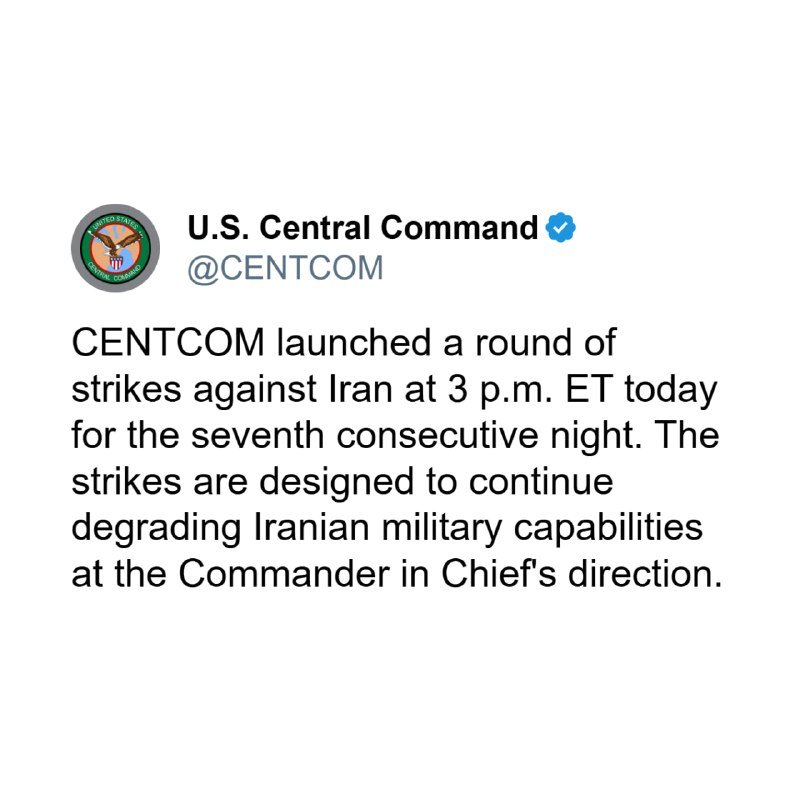
At 23:37 UTC on 11 July 2026, the US military opened a third round of strikes against Iranian targets in the Strait of Hormuz area, hours after the Islamic Revolutionary Guard Corps hit a Cyprus-flagged cargo vessel with a drone or missile. The cargo ship, the M/V GFS Galaxy, suffered severe damage to her engine room; her crew abandoned ship and evacuated in lifeboats, with at least one reported casualty among the crew, according to OSINTtechnical's monitoring of the incident. Iran's military said afterwards that the vessel had been using an "unauthorized route" and that the strait was, again, closed to traffic.
The exchange marks the sharpest escalation of the week in a corridor that already carries roughly a fifth of the world's seaborne oil. It also resets the diplomatic clock. Each side is now operating inside the other's escalation timeline, and the margin for de-escalation has narrowed to the hours between CENTCOM press releases and Iranian state-media rebuttals.
What happened on the water
The first signal came through OSINT feeds at 01:53 UTC on 12 July, with monitoring channels reporting that the M/V GFS Galaxy had been "severely damaged" by an Iranian strike and that the crew had abandoned ship. The earlier update, timestamped 01:06 UTC from OSINTtechnical, identified the weapon as a drone or missile fired at the engine room and noted that at least one crew member had been injured. The ship is registered in Cyprus; her flag state has not yet, as of the time of writing, issued a public statement on the strike.
Iran's framing of the incident arrived quickly. According to NPR's reporting on the day's events, Iranian officials described the vessel as having taken an "unauthorized route" through the strait, and reasserted that the waterway was closed to commercial traffic. The language echoes Iran's intermittent claims of authority over the northern part of the strait, claims that have no foundation in international law but carry weight in practice whenever Iranian fast craft, anti-ship missiles, or drone units are positioned along the Omani and Emirati coasts.
Within roughly thirty minutes of the strike, US Central Command was moving against coastal targets in Iran. A widely-circulated internal paper feed timestamped 23:46 UTC on 11 July described the action as a "third round of strikes this week," following two earlier rounds targeting Iranian facilities supporting the IRGC Navy and the drone launch infrastructure that has menaced shipping since 2024. The Axios report that triggered the alert, timestamped 23:37 UTC on 11 July, named the M/V GFS Galaxy strike as the proximate cause for the new wave.
Why this round feels different
The two previous US strike rounds this week hit fixed sites: missile storage, drone production lines, radar nodes tied to the IRGC's coastal surveillance chain. Hitting a moving commercial vessel in the world's most sensitive energy choke-point changes the geometry. Insurance underwriters in London and Piraeus will reprice Hormuz transit on Monday morning. Charterers will demand war-risk riders. Tanker operators that loaded at Ras Tanura or Ruwais in the last ten days will start to calculate whether the Cape route, around southern Africa, costs less than running Hormuz with a 0.5 percent additional premium per voyage.
The other shift is legal exposure. A strike on a vessel flagged in an EU member state invites a flag-state response under the United Nations Convention on the Law of the Sea and the customary duty to render assistance to vessels in distress. Cyprus's foreign ministry has not yet commented; the silence is itself a signal. If Nicosia speaks, it will be calibrated to protect a shipping registry that competes with Malta and Liberia, and to avoid dragging the European Union into a kinetic frame it has spent two years trying to stay out of.
The Iranian read
Tehran's public line, that the vessel had used an "unauthorized route," is not a legal argument so much as a signalling exercise. The point is to put commercial operators on notice that Iranian forces will continue to discriminate between compliant and non-compliant traffic in the northern lane. For shipowners, "compliant" in practice means carrying documentation of coordination with IRGC naval liaisons, which is a form of de facto Iranian control over a waterway that the rest of the international system treats as international.
There is a counter-read worth taking seriously. From Iran's strategic perspective, the US has spent six months tightening an enforcement regime in Hormuz through sanctions, naval deployments, and the expanded Forward Deployed Naval Forces posture in Bahrain. The IRGC's command believes, with some evidentiary backing, that the United States is using commercial transit as a pressure point to extract concessions on the nuclear file and on Iranian support for the regional axis. A strike on a single vessel is, in that frame, a way of reminding Washington that Hormuz is a shared vulnerability, not an American lake.
That framing does not make the attack lawful. It does explain why Tehran's risk calculus is not converging with Washington's.
What the next 72 hours will tell
Three observable markers will shape the next three days. First, whether the M/V GFS Galaxy is recovered, scuttled, or salvaged, and whether the crew reaches shore safely; the humanitarian question is also the legal trigger for any flag-state claim. Second, whether Brent crude sustains a move above the levels already priced in for a Hormuz disruption; the futures market will be the cleanest public signal of how the trade reads the escalation. Third, whether Iran's regional partners, the Houthis in the Red Sea and the Shia militias in Iraq, choose to widen the frame by striking US positions or commercial shipping elsewhere; the historical pattern, going back to 2019 and again to early 2024, is for escalation to radiate across the axis rather than stay in one corridor.
The structural fact underneath the news cycle is that the US-Iran confrontation has moved from a sanctions regime into a kinetic one, in a maritime space where neither side can afford a sustained shutdown. Roughly a fifth of global seaborne crude transits Hormuz. Both Washington and Tehran have said, on the record, that they will not allow the other to close it. Closing it anyway, even briefly, is the scenario neither side has a clean exit from.
What remains uncertain
The source material for this article is fragmentary. Casualty figures on the M/V GFS Galaxy are unconfirmed beyond the single injured crew member reported by OSINTtechnical; the number of crew aboard and their nationalities are not yet on the public record. The exact nature of the US strikes, whether they were launched from surface combatants in the Gulf, from submarines, or from air assets based in Qatar or the UAE, has not been disclosed by CENTCOM. The Iranian framing of an "unauthorized route" rests on a single Iranian military statement relayed by NPR, with no supporting documentation released by Tehran or the vessel's managers. Cyprus's flag-state response, which will set the legal tone for the next forty-eight hours, is still outstanding.
What can be said with confidence is narrow but consequential: a flagged merchant vessel was struck by an Iranian weapon in the strait; her crew abandoned ship; the United States has now conducted three rounds of strikes against Iranian targets inside a week; and Iran's military has stated that the strait is closed. The line between a contained incident and a regional conflagration now runs through the next set of CENTCOM and IRGC communications.
Monexus framed this as a kinetic escalation in a shared-energy corridor, leading with the strike on the merchant vessel and the immediate US response rather than the wider diplomatic backdrop. We carried the Iranian "unauthorized route" framing in full because shipowners need to see the operational logic, not just the rhetoric.
Wire provenance
This editorial synthesis draws on the following public wire/social posts:
- https://t.me/ClashReport
- https://t.me/insiderpaper
- https://t.me/wfwitness