A third round, a missing sailor, and a press release that did the framing for everyone
A US Central Command statement at 23:42 UTC on 11 July 2026 said forces had begun a third weekly round of strikes against Iran after the IRGC allegedly attacked a Cyprus-flagged container ship in the Strait of Hormuz. One civilian crew member is reported missing.
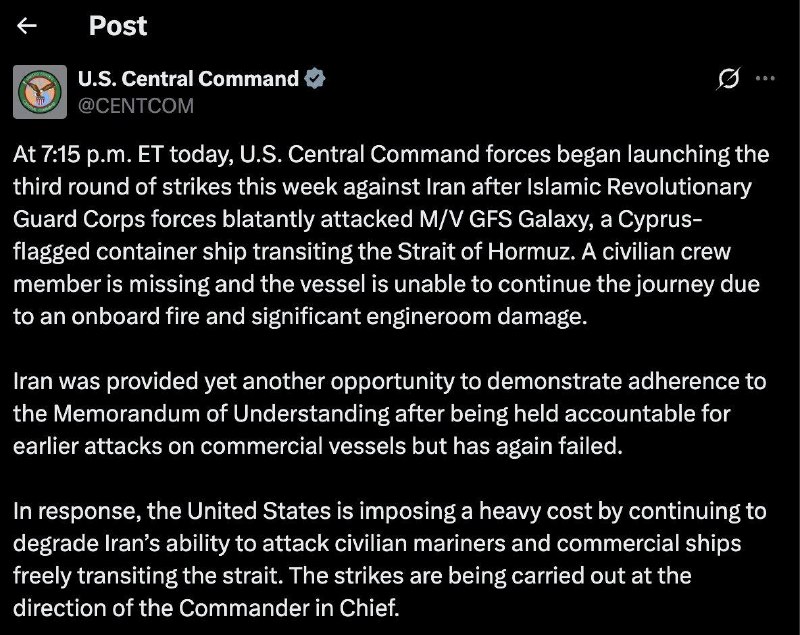
At 23:42 UTC on 11 July 2026, channels monitoring US military messaging carried a single paragraph from US Central Command: "At 7:15 p.m. ET today, U.S. Central Command forces began launching the third round of strikes this week against Iran after Islamic Revolutionary Guard Corps forces blatantly attacked M/V GFS Galaxy, a Cyprus-flagged container ship transiting the Strait of Hormuz." The release added that a civilian crew member was reported missing. Within an hour, the same five sentences had been re-captioned, re-translated, and re-framed by outlets based in Beirut, London, Tehran, and the wider geopolitical-Telegram ecosystem, with each iteration doing its own small editorial work on what the statement actually meant.
The operative fact is narrow and sourced. US Central Command said its forces had begun a third round of strikes against Iran in the same week, that the trigger was an alleged IRGC attack on a Cyprus-flagged container ship in the Strait of Hormuz, and that one civilian crew member was missing. The framing question, which is where this story actually lives, is what it means that the public record of the incident arrives almost entirely inside a CENTCOM press release and the channels that carried it.
One release, four reframings
The four wires in the thread treated the same paragraph in four registers. ClashReport reproduced the statement as released, with the timestamp and the boilerplate preserved. Geopolitical Watch, a channel that aggregates Western and Israeli-adjacent feeds, presented the statement under a US-versus-Iran flag pairing that framed the action as a direct tit-for-tat. DDGeopolitics, a Russian-aligned aggregator, captioned the same paragraph "CENTCOM released PR slop," signalling that the channel considered the statement a piece of public relations rather than a factual disclosure, while still carrying the underlying text. The Cradle, a Beirut-based outlet that routinely foregrounds Iranian, Iraqi, and Lebanese perspectives, carried the second sentence about the missing sailor under a "❗️" flag, lifting the human-cost detail out of the wider operational paragraph and giving it top billing.
The statements underneath the headlines are identical. The editorial weight is not. That is the story.
What the statement does and does not tell us
The CENTCOM release names the ship (M/V GFS Galaxy), its flag (Cyprus), its location (the Strait of Hormuz), and the alleged attacker (the IRGC). It does not name the operator of the vessel, the cargo, the port of origin or destination, or the number of crew on board. It does not say when the alleged IRGC action took place relative to the 7:15 p.m. ET strike window, or whether the missing crew member is Iranian, Indian, Pakistani, Filipino, or European, a routine composition for a Cyprus-flagged boxship. It does not name the targets struck in the third round, the weapons used, or the location of those strikes inside Iran.
That asymmetry is structural. Western-wire reporting on Iran operations has long led with the institutional voice of the attacking power, treating the target state's account as a counter-claim to be carried in parallel rather than as a primary factual basis. The Iran-aligned counter-frame in DDGeopolitics's caption is a response to that pattern: when one side owns the official text, the other side owns the editorial register. Both moves are legible.
The Strait of Hormuz variable
The Strait of Hormuz is the relevant geography, and it does most of the analytical work. Roughly a fifth of global oil passes through it on any given day. A single missing crew member on a single Cyprus-flagged boxship is, in itself, a consular and maritime-protection story, not a market story. But the ship was reportedly attacked in the same chokepoint where, over the past several years, commercial vessels have been seized, shadowed, or struck amid escalations between Tehran and Western naval task forces, and the strike that followed took place inside Iran, not at sea.
This pattern matters for the read. Iran has, in the past, framed maritime incidents in the Strait as defensive responses to the presence of Western naval forces and to Israeli-linked shipping in its near seas. Western statements have framed the same incidents as Iranian aggression against freedom of navigation. Both framings are present in the wider public record; neither is resolved by the four channels in this thread. The CENTCOM release, on the face of it, treats the alleged IRGC action on the M/V GFS Galaxy as the sole trigger for a third weekly round of strikes, with no Israeli, Iraqi, or Houthi variable acknowledged. That is either a deliberate editorial choice inside the press release, a reflection of the release's narrow remit, or both.
What remains contested
Three things are unsettled in the source material. First, the condition of the missing civilian crew member: the CENTCOM release says the sailor is missing, and no channel in the thread reports a rescue, recovery, or naming. Second, the operational identity of the targets struck. "Third round of strikes against Iran" is a phrase that can describe anything from a small set of pinpoint hits on IRGC facilities to a wider campaign across multiple provinces. Third, the ship's operator and crew composition, which would clarify whether the missing sailor is the kind of foreign seafarer whose fate tends to draw sustained consular and humanitarian attention, or the kind whose case goes quiet inside a week. The thread does not address any of the three, and any further reporting on this incident should be expected to surface them first.
A fourth, quieter uncertainty is the question of what "this week" means. A third round inside seven days implies a tempo of strikes that is either escalating, holding at a new plateau, or already on a glide path to a wider campaign. The CENTCOM statement does not say which. No channel in the thread asks it.
Stakes and forward view
If the missing sailor is named and recovered, the story shifts from operational to humanitarian; expect the family, the flag state, and the operator to press for accountability and compensation. If the sailor is not named, the case risks becoming a single line inside the next CENTCOM round-up, where human-cost details tend to age quickly. If the third round is followed by a fourth within seventy-two hours, the cycle has become a campaign, and the political conversation in Washington, Tehran, and the Gulf capitals will move accordingly. If it does not, the release reads, in retrospect, as a peak rather than a slope.
For shipping, the immediate marker is the M/V GFS Galaxy's owner and insurer. Re-routing decisions in the Strait of Hormuz are made at the level of the war-risk premium and the P&I club, not the press release, and operators will be reading the same paragraph for the same reason everyone else is. The longer the cycle holds, the higher that premium climbs, and the higher the premium climbs, the louder the cargo-owners' lobby in Brussels, Beijing, and New Delhi becomes.
That is the structural frame, stated plainly: in chokepoints, the press release does the political work and the insurance market does the economic work, and the two move on different clocks. The four channels in this thread caught the first. The premium is the next thing to watch.
How Monexus framed this versus the wire: the four channels in the thread carried the same CENTCOM statement in four different editorial registers. Rather than reproducing any single one of those framings as the news, this piece separates the operational facts the release actually discloses (a third weekly strike round, an alleged IRGC attack on a Cyprus-flagged ship, one missing crew member) from the editorial choices each channel made in carrying it, and treats the human-cost detail the Beirut-based outlet foregrounded as a first-order fact on equal footing with the operational paragraph.
Wire provenance
This editorial synthesis draws on the following public wire/social posts:
- https://t.me/ClashReport
- https://t.me/GeoPWatch
- https://t.me/DDGeopolitics
- https://t.me/thecradlemedia
- https://t.me/TheCradleMedia