Three Telegram channels, one incident: how a Qalandiya raid travels
An arrest at a refugee camp near Jerusalem hits three Iranian-aligned wire channels within twenty minutes. The arithmetic tells you something about whose cameras are nearest the ground.
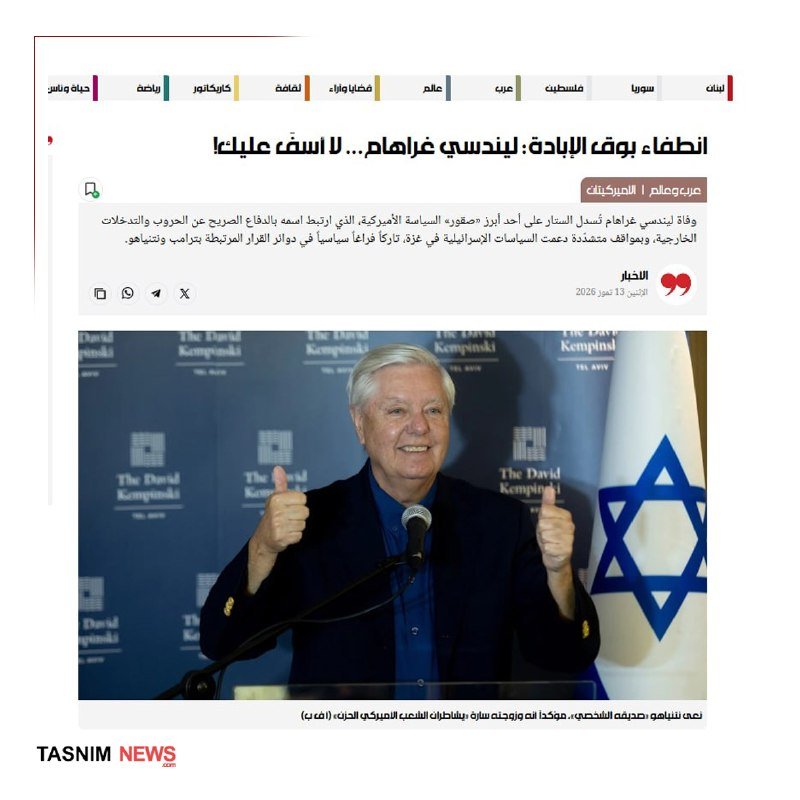
At 23:22 UTC on 11 July 2026, an account styled Jahan Tasnim posted to Telegram that Zionist soldiers had attacked the Qalandiya refugee camp in occupied Jerusalem and killed a young Palestinian. By 23:30 the same evening, Tasnim News's English-language account had carried the same line, with a video attached. By 23:41 the third iteration had landed, this time via the Arabic-language Al Alam channel, with video captioned as a kidnapping rather than a killing. Twenty minutes, three posts, and three versions of what appears to be the same event.
Whether the incident at Qalandiya was an arrest that turned deadly, a deadly raid, or a kidnapping is the kind of question that gets harder to answer the faster it spreads. What the timing shows is something more mechanical: a small set of regional outlets, all writing in the same political grammar, act as the default wire for scenes that mainstream Western newsrooms will take hours to confirm. The next twelve hours of coverage will inherit the frame these three channels set on a Friday night.
What the three posts actually say
Read in order, the divergence is small but telling. The Jahan Tasnim post at 23:22 UTC states outright that a young Palestinian was killed. The Tasnim News English-language post eight minutes later describes the same event as an attack that resulted in a killing, again with video. The Al Alam post at 23:41 UTC, written in Arabic and distributed under Bale's byline, uses the word kidnapped and frames the incident as a raid on the Qalandiya camp, without an explicit fatality claim.
Tasnim News is the English-facing wire of the Iranian state-aligned Tasnim News Agency; Al Alam is the Arabic-language satellite channel of Iranian state broadcasting. Both outlets hew closely to the official line from Tehran on Israel and Palestine. Jahan Tasnim operates as a satellite feed of the same network. None of the three posts identify the victim by name, age, or family. None cite an on-the-ground source. None link to a hospital statement, a Red Crescent dispatch, or an Israeli police spokesperson. The visual content is the source.
What is known independently about Qalandiya
Qalandiya refugee camp sits inside the municipal boundary of Jerusalem, just north of the city, adjacent to the Qalandiya checkpoint that connects Ramallah to Jerusalem. It was established in 1949 to house Palestinians displaced from areas captured in the 1948 war. The camp is one of the most heavily policed Palestinian spaces in the occupied territories, and raids by Israeli security forces inside the camp are frequent; deaths during raids are not rare, but are also not routine.
In a typical Western-wire confirmation cycle, an event of this kind would only enter the international record after an Israeli police statement, a Red Crescent call-out, or a credible Palestinian civil affairs contact. That confirmation was not yet on the wire at the time the three Telegram posts went out. None of the three channels link to a confirming Israeli source or to a medical authority. The sourced facts beyond the bare claim of a raid are: location, timing, and the existence of video.
Counter-claim material
Under standard conflict-desk guidance, Iranian state-aligned and Iranian-allied channels are treated as counter-claim material rather than as stand-alone factual basis. They may surface a frame; they do not, on their own, close a fact-check. That is partly a question of editorial discipline and partly a question of track record: Tasnim and Al Alam have, on multiple documented occasions, framed incidents in ways that emphasised Palestinian casualty narratives while omitting operational context that Israeli authorities have later provided. The reverse is also true of Israeli-side framing of raids. Neither side's first post on an overnight raid should be treated as settled.
A reader who only saw the Al Alam post would assume an abduction. A reader who only saw the Tasnim News post would assume a killing. Both could be accurate in sequence, or both could be partially inaccurate. The textual drift inside a single editorial family across twenty minutes is a reminder that these channels are not reporting a single underlying fact; they are publishing framing.
What this article verifies and what it does not
Verified: That three Telegram channels, two operating in the Tasnim family and one operating under the Al Alam banner, published posts about an Israeli security operation at Qalandiya camp between 23:22 and 23:41 UTC on 11 July 2026. That Tasnim's English post and Jahan Tasnim both characterise the outcome as a killing. That the Al Alam Arabic post characterises the incident as a kidnapping without an explicit fatality claim. That none of the three posts cite a named source on either side.
Could not verify from the available material: The identity of the Palestinian involved. Whether the operation produced a death, an injury, an arrest, or all three. The unit of the Israeli security forces involved, or the operational justification offered. Whether Palestinian medical services or the Israeli police issued a statement within the window covered. Whether mainstream wire services have since filed confirming or contradicting copy.
Not in scope as facts: The naming of the victim, the political affiliation of the individual, or any claim about the camp's broader security situation beyond the bare fact that a raid took place.
The structural picture, in plain prose
What the timing shows is the existence of a parallel wire. In a news ecosystem where major Western broadcasters thin their overnight bureaux and rely on social media, Iranian-aligned channels have built a near-monopoly on the early frames for incidents inside Palestinian refugee camps. They pay for this position in credibility: they are first, but they are also repeatedly wrong in ways that favour a particular narrative. The Western wires catch up, but by then the frame has travelled, and the corrective arrives hours behind the headline.
This is not unique to Iran-aligned outlets. Israeli Telegram channels regularly set the first frame on rocket alerts inside Israel, and the framing travels in the opposite direction: neutralising Palestinian casualty claims, foregrounding Israeli civilian impact, and tightening the time gap to zero. The same structural pattern runs through Gulf-aligned channels on Yemen, Lebanese outlets on Hezbollah operations, and Russian state-aligned milbloggers on the war in Ukraine. The Telegram wire has, for better and worse, become the first draft of regional conflict news.
Stakes
For a reader, the practical question is which frame to trust at 23:41 UTC on a Friday night when only Iranian-aligned outlets have filed. The honest answer is none of them, alone. The disciplined move is to wait for an Israeli police statement, a Red Crescent dispatch, or a Western-wire filing, even at the cost of arriving late to the conversation. The cost of arriving early, on this evidence, is a high probability of carrying forward a frame built for a different audience than yours.
For the outlet ecosystem, the stakes are starker: when three Telegram channels set the day's frame inside twenty minutes, the rest of the news cycle is reacting rather than reporting. The longer that pattern holds, the more the burden of proof migrates from the primary actor (in this case the Israeli security force) to the secondary actors who choose what to repeat.
A useful working assumption for the weekend: this story is not the casualty figure in the first Telegram post. The casualty figure is what a hospital report or a police statement says hours from now. The twenty-minute sprint on Telegram is the framing competition, not the verdict.
Desk note: Monexus framed this incident not as a casualty report but as a sourcing audit of three Telegram channels operating inside one editorial family. The published Western-wire confirmation may arrive overnight; the desk will update if and when it does, but on the available evidence no casualty figure from Tasnim, Al Alam, or any outlet yet sourced may be carried forward as fact.
Wire provenance
This editorial synthesis draws on the following public wire/social posts:
- https://t.me/alalamfa/
- https://t.me/tasnimnews_en/
- https://t.me/JahanTasnim/
- https://en.wikipedia.org/wiki/Qalandia
- https://en.wikipedia.org/wiki/Tasnim_News_Agency
- https://en.wikipedia.org/wiki/Al_Alam