Two Israeli drone strikes hit Nabatieh al-Fawqa before dawn; separate Al-Qusayr detonation reported hours later
Two Israeli drone strikes hit the southern Lebanese town of Nabatieh al-Fawqa before dawn on 28 July 2026; a separate detonation was reported in Al-Qusayr roughly ninety minutes later. The day's available record rests on five Telegram posts from channels with varying editorial alignments.
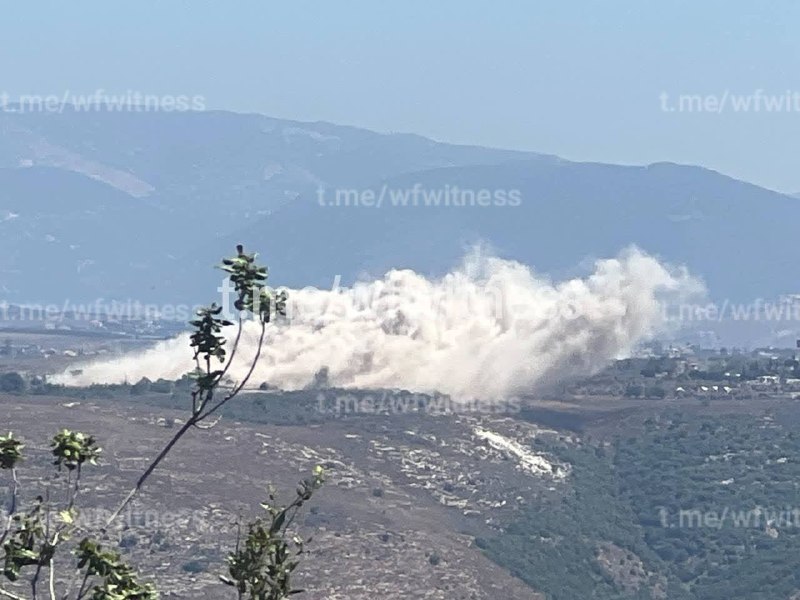
Two Israeli drone strikes hit the town of Nabatieh al-Fawqa in southern Lebanon at 06:45 UTC on 28 July 2026, according to a Telegram post from the channel wfwitness. Three further Telegram posts within roughly an hour carried their own accounts of strikes on the same town. Hours later, at 08:03 UTC, The Cradle's Telegram channel reported that Israeli forces had targeted Al-Qusayr, also in southern Lebanon, with what the channel described as a massive explosion; a second wfwitness post at 08:09 UTC added its own account of a detonation in Al-Qusayr. The five source items available for this article are all Telegram-channel posts; none specifies a casualty count.
The day's record is small but specific. Two strikes on Nabatieh al-Fawqa, then a separate detonation reported in Al-Qusayr, fit a pattern of dispersed, sequential targeting rather than a single concentrated operation. Reading the record honestly requires saying both what it shows and what it does not: the cluster establishes that five channels, with varying editorial alignments, all carried reports placing Israeli air or drone action at Nabatieh al-Fawqa within a span of about thirty-seven minutes, and that two of the five feeds separately reported a detonation at Al-Qusayr.
What the Telegram record shows
The earliest item in the cluster is a 06:45 UTC post from the channel wfwitness, reporting two Israeli drone strikes on Nabatieh al-Fawqa in southern Lebanon. At 06:47 UTC, Al-Alam Arabic carried an urgent bulletin logging two raids, framed in the channel's editorial language as coming from "the occupation march," against Nabatieh Al-Fawqa. At 07:22 UTC, the englishabuali channel added a confirming report of two UAV strikes in the village of Nabatieh al-Fawqa. A second wfwitness post, timestamped 08:09 UTC, repeated the Nabatieh al-Fawqa strikes and added a separate line that an Israeli detonation was carried out in Al-Qusayr, described by the channel as falling "within the security zone in southern Lebanon," a phrase common in Lebanese-press accounts for the band of southern Lebanese territory where Israeli forces have historically operated, not a fixed legal designation.
The Al-Qusayr report was carried independently by The Cradle's Telegram channel at 08:03 UTC, which described the action as Israeli occupation forces targeting Al-Qusayr "with a massive explosion." The Al-Qusayr detonation is therefore established, within the cited material, by two channels: wfwitness and The Cradle. The Nabatieh al-Fawqa strikes are established by four: wfwitness, Al-Alam Arabic, englishabuali, and (in its second post) wfwitness again. Convergence on Al-Qusayr is narrower than convergence on Nabatieh al-Fawqa, and that asymmetry is a feature of the source set, not an inference about the underlying events.
What we verified and what we could not
Verified from the cited posts: that on 28 July 2026, between 06:45 UTC and 07:22 UTC, three distinct Telegram channels posted accounts of Israeli drone or air action at Nabatieh al-Fawqa; that a fourth post from wfwitness at 08:09 UTC repeated the Nabatieh al-Fawqa strikes and added a separate Al-Qusayr report; that The Cradle independently carried an Al-Qusayr report at 08:03 UTC; that the two channels carrying the Al-Qusayr detonation (wfwitness and The Cradle) reached that account by different routes and roughly within six minutes of each other.
Not verified from the cited posts, and outside the scope of this article: any casualty count from either town; the type of munition used in either event; the specific target or alleged militant infrastructure involved; any official Israeli military position on the day's events; any UNIFIL situational report covering the period; any Western-wire dispatch from Reuters, the Associated Press, Agence France-Presse, the BBC, or any other international outlet. The available Telegram cluster is the entire evidentiary base for this article; the cited material does not specify a casualty count, a munition type, coordinates within either town, or which target the strikes were aimed at, and this article has not independently established any of those details.
Analysis: the sourcing lane and what it allows
Taken in isolation, two drone strikes on a single Lebanese town before dawn are a tactical event. The structural observation worth flagging is narrower than a critique of any individual channel and broader than a complaint about a single day: the cited material on the 28 July cluster rests on accounts from Telegram feeds whose editorial alignments vary, and the convergence across them on Nabatieh al-Fawqa is what permits a basic event claim. The convergence on Al-Qusayr is thinner; only two of the five channels carry it, and the second post arrived roughly six minutes after The Cradle's. That asymmetry in coverage is a property of the source set under review, not a finding about the wider conflict.
The harder analytical question is what the day's record does not say. The cited items do not contain an Israeli Defense Forces (IDF) spokesperson bulletin, a UNIFIL situational report, a Lebanese Ministry of Public Health casualty statement, or a Western-wire dispatch. That silence is a silence of the cited posts, not an established fact about whether those institutions commented. Anyone seeking corroborated figures on casualties, munitions, or target identification will need to wait for, or seek out separately, an IDF bulletin, a UNIFIL release, a wire-service dispatch, or a Lebanese-government statement. Monexus's assessment is that until one of those appears, the day's record is what the five Telegram posts make of it.
Stakes and what to watch
Nabatieh al-Fawqa and Al-Qusayr both sit in the southern Lebanese border district that has appeared in earlier reporting cycles on the cross-border air campaign. The 28 July posts do not address civilian displacement, infrastructure damage, or casualty figures; the cited material contains no figure on any of these. Reporting on either town in this article therefore stops where the cited posts stop.
The clear next reads against the cited material are: any later Telegram post from the five channels that adds casualty, target, or munition detail; any later retraction or correction from those same channels; and any independent first-party bulletin that this article's sourcing has not captured. Until any of those appears, the day's record is the cluster of five Telegram posts summarised here.
This article is built entirely on five Telegram-channel posts from wfwitness, The Cradle, Al-Alam Arabic, and englishabuali. The cited items do not specify a casualty count, munition type, target, or coordinates within either town, and they do not contain an Israeli, UN, Lebanese-government, or Western-wire first-party statement on the 28 July events. Readers seeking corroborated figures on casualties, targets, or munitions should treat the situation as unresolved beyond the cited posts.
Wire provenance
This editorial synthesis draws on the following public wire/social posts:
- https://t.me/wfwitness/105158
- https://t.me/wfwitness/105169
- https://t.me/thecradlemedia/65119
- https://t.me/alalamarabic/490426
- https://t.me/englishabuali/76899
- https://t.me/TheCradleMedia/65119