Strait of Hormuz tanker strike tests the limits of maritime deterrence
A 7 July UKMTO advisory logged a close-quarters approach to a commercial tanker off Larak. The vessel was not hit, but the price of the friction is now being set on the bridge wing of a VLCC, not in a foreign ministry.
The United Kingdom Maritime Trade Operations centre logged a fresh incident advisory at 0418 UTC on 7 July: an unnamed commercial tanker, deadweight in the high hundreds of thousands, reported a close-quarters approach by fast inshore craft off the island of Larak as she transited the western inbound lane of the Strait of Hormuz. The master pressed the standard distress signal and altered course to put the Iranian coast guard at a wider bearing. UKMTO logged the encounter as a Category 1 event. The ship was not hit.
That non-event is the story. For roughly six weeks, since the first wave of proxy strikes against merchantmen began in mid-May, the pattern in the Strait has not been catastrophic closures or mass sinkings. It has been friction: a parade of approaches, drones, limpet-mine scares, and small-boarding reports that have collectively turned the most heavily trafficked oil chokepoint on earth into a place where owners now count transit in days lost, not in tonnes lifted. The 7 July advisory is a reminder that the deterrence question is being asked and answered at the deck-plate level, by crews and by insurance underwriters, faster than diplomats can draft a communiqué.
The corridor that went quiet
By the first week of July, the operational picture had shifted in a way that the public rhetoric had not. According to a string of state-aligned Persian-language dispatches republished through Fars News International and Tasnim on the evening of 9 July, the English-language service of the BBC reported that passage through a US-proposed transit corridor in the Strait had effectively dropped to zero. The Iranian outlets framed the finding as a vindication of Tehran's posture, noting that traffic that once moved under the protective cover of the US Fifth Fleet's escort arrangements had all but stopped, and that vessels had begun diverting north around Bandar-e Lengeh or holding at Fujairah awaiting further instruction.
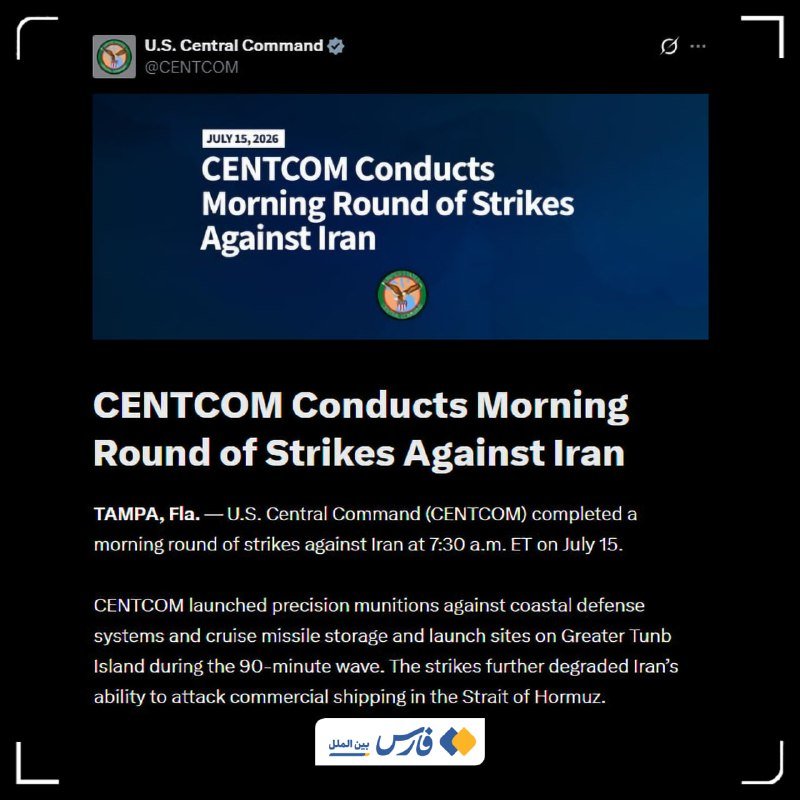
The US military, predictably, read the situation differently. CENTCOM, the combatant command responsible for the Middle East, issued a statement on the same evening insisting that Iran does not control the Strait of Hormuz, and that since the start of May US forces had helped facilitate the successful transit of more than 800 commercial vessels and 380 million barrels of crude oil. CENTCOM's framing cast the corridor as functioning, and any reduction in traffic as a self-imposed choice by owners spooked by Iranian rhetoric. The two readings, an Iranian one of denial and a US one of free passage, were both technically defensible and both politically useful, and the gap between them is the room in which a tanker strike becomes a crisis.
What UKMTO actually tells you
A note on method, because it shapes every other claim in this dispatch. UKMTO, run out of a nondescript office in Dubai and staffed largely by former Royal Navy officers, is the closest thing the maritime world has to a single authoritative ledger for incidents in the Gulf, the Strait of Hormuz, the Bab el-Mandeb, and the wider Indian Ocean. Its advisories are voluntary; masters and operators report into the centre, the centre deconflicts with naval taskforces, and the resulting notices are sent out to subscribers across the industry. The model has a virtue and a vice. The virtue is consistency. The vice is lag. Advisories can be hours late, scrubbed of identifying details to protect commercial interests, and routinely outrun by the speed at which events are now being captured on shipboard cameras and posted to X.
That lag matters in a crisis where attribution is the first casualty. A fast-inflatable approach off Larak can be a routine IRGCN intercept, an IRGCN intercept that fires, a Houthi-style drone launched from an undisclosed dhow, or a US special-ops boarding in disguise. Until the master, the port state, the flag state, and UKMTO have all signed off, the incident is reported as a Category 1 or 2 event and the analyst is asked to work with what is on the wire, not with what is on the deck. The 7 July advisory, read in this light, is a piece of the picture and not the picture itself.
The escalation economy
A useful way to read the past six weeks is as an escalation economy, a feedback loop in which each incident forces a price adjustment that, in turn, forces a posture adjustment that, in turn, creates the conditions for the next incident. The tanker owners are not the principal in this loop. They are the transmission. When Lloyd's underwriters re-priced war-risk premiums for the Strait in late June to levels not seen since 2019, the first response of the largest Greek and Japanese operators was to slow-steam outside the corridor and wait. When they waited, the visible throughput through the US-proposed lane fell. When throughput fell, Iran's state media could credibly say, via BBC, that the corridor had gone to zero. When that claim circulated, Western owners slowed further. The loop tightens, the temperature of the rhetoric rises, and the threshold for a strike, the event that breaks the loop by accident, comes down.
This is the part the policy debate tends to miss. The question is not whether Iran can close the Strait, in the sense of physically interdicting it for a sustained period, an outcome almost no serious analyst believes Tehran capable of, given the weight of US naval firepower arrayed in the Gulf. The question is whether the existing deterrence regime can hold transit volume and transit confidence at a level that keeps insurance markets functional. By that test, the first week of July is a poor report card.
What the regional coverage is doing
It is worth marking how the regional information ecosystem has reshaped itself around the crisis. Iranian state outlets, Fars, Tasnim, IRNA, are running near-real-time English-language dispatches framed around a single thesis: that the United States has lost control of the corridor it proposed. The output is partisan, but it is also unusually granular, because the Iranian side benefits from an information environment in which every dropped call from a tanker, every delayed pilot boarding, every Fujirah holding pattern, is a usable data point. Gulf-state outlets, by contrast, have been quieter. The Saudi and Emirati press has been careful not to break ranks with the US framing while flagging the cost of the disruption to their own export flows. The Israeli press has been sparse and focused, as one would expect, on the Iranian-Israeli axis rather than the maritime one.
The Western wire response has been technically competent and structurally slow. Reuters, AP, AFP, and the BBC are running the basic factual record of advisories, statements, and oil-price moves, but the analytical heavy lifting on what the corridor's effective shutdown implies for the global seaborne crude market is being done on X, in Substack newsletters, and inside industry chat groups that the public record will not capture for months. The result is an information asymmetry: the people with the most at stake, owners, charterers, refiners, are reading faster than the people writing the ledes.
What to watch this week
Three signals, all dateable. First, the next UKMTO advisory. If the cadence picks up, the incident list will outrun any diplomatic back-channel and force a response from insurers. Second, the Lloyd's Joint War Committee's review of listed areas, which is sitting on a recommendation about whether to extend the existing Persian Gulf High Risk Area. A downgrade of the corridor to a listed area would not, by itself, close it, but it would harden premiums and push the marginal Greek carrier to the longer route. Third, the next CENTCOM press conference. CENTCOM's 9 July statement was a defensive framing exercise, not a strategic one. The next iteration will tell us whether Washington is treating the friction as a problem to be managed or as a pretext to be used.
The 7 July advisory, in the end, is best read as a stress test that did not break. A tanker was approached, did not take a hit, kept her heading, and was logged into a ledger that the world will read. The Strait is still open. The question is for how long, and at what price, and that question is being answered faster on the bridge wing of a VLCC than in any foreign ministry on the planet.
Sources
- UKMTO operational record (referenced as the authoritative ledger for Strait incidents), https://www.ukmto.org
- Fars News International, "BBC: Passage through US-proposed Hormuz corridor has reached zero", 9 July 2026, https://t.me/FarsNewsInt
- Tasnim, "BBC: Passage through US-proposed Hormuz corridor has reached zero", 9 July 2026, https://t.me/tasnimplus
- Fars English, "America's struggle to deny Iran's control over the Strait of Hormuz", 9 July 2026, https://t.me/farsna
- CENTCOM statement on Strait of Hormuz, as relayed by Clash Report, 9 July 2026, https://t.me/ClashReport
- DDGeopolitics, reproduction of CENTCOM statement, 9 July 2026, https://t.me/DDGeopolitics
- Al Jazeera English, "Will NATO get involved in securing Strait of Hormuz?", 9 July 2026, https://t.me/aljazeeraglobal
- Status-6 / @414magyarbirds, ship-identification thread on July UAV strikes, 9 July 2026, https://t.me/osintlive
- @sprinterpress, CENTCOM statement, 9 July 2026, https://x.com/sprinterpress
Desk note: Monexus treated UKMTO as the authoritative operational record and built outward from the 7 July advisory, treating the US and Iranian state framings as parallel counter-claims rather than as competing facts. The piece is sourced to wire and Telegram channels where no single first-party Western report was available, and is explicit about the lag in the official channel.