Houthis claim shootdown of Saudi-operated Turkish Bayraktar Akıncı over Al-Jawf
Houthi military spokesperson says the group downed an armed reconnaissance Bayraktar Akıncı operated by the Saudi Air Force over Al-Jawf Governorate, then displayed wreckage on 26 July 2026.
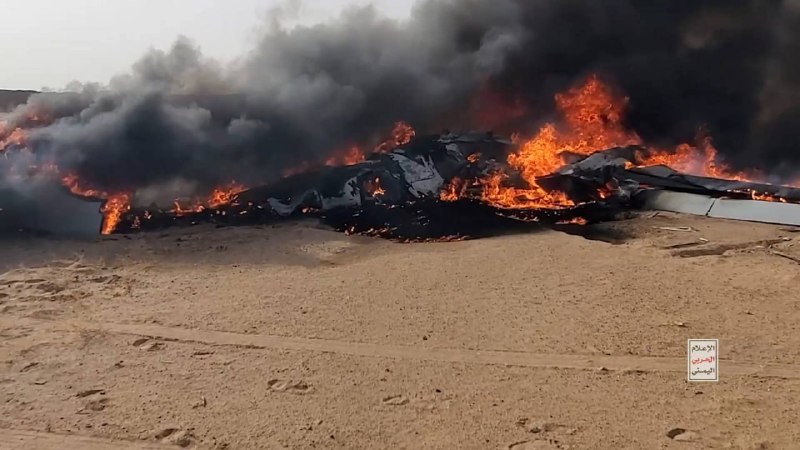
Yahya Saree, the military spokesperson of the Houthis, announced at 18:13 UTC on 26 July 2026 that the group had shot down an armed reconnaissance Bayraktar Akıncı unmanned aerial vehicle operated by the Saudi Air Force, with the engagement taking place over Al-Jawf Governorate in northern Yemen. Within roughly fifty minutes, Houthi-aligned outlets had published photographs of the wreckage, identifying the airframe as Turkish-built and listing the platform among the more expensive members of the Baykar product line.
The claim, if confirmed, would mark a notable intercept: the Akıncı is a high-altitude, long-endurance platform marketed for armed reconnaissance and strike, and Saudi Arabia is one of its earliest export customers. The shootdown sits inside a wider aerial campaign in which both sides have traded strikes for the better part of a decade, and it lands against the backdrop of a fragile regional pause that has, at intervals, frayed.
What the Houthis said
Saree's statement, relayed by the Houthi-aligned channels al-Masirah and the abuali network, framed the intercept as a routine battlefield success. According to the English-language abuali feed at 18:35 UTC, the spokesperson said the group had succeeded in downing "an armed reconnaissance UAV of the 'Bayraktar Akıncı' type, manufactured in Turkey, belonging to the Saudi enemy." A second post from abualiexpress twenty-two minutes earlier carried the same wording, attributing it directly to the Houthi military spokesman. Both posts were followed within the hour by image carousels showing twisted airframe sections, with one post adding an estimated unit price of around $30 million, though the source does not specify the basis for that figure.
The pattern matches Houthi practice across the war: claim, present wreckage, name the platform and operating service. Independent verification has historically lagged such announcements by days, and the Saudi-led coalition has, at times, neither confirmed nor denied individual losses.
What remains unverified
The available source material does not specify the altitude or location within Al-Jawf where the intercept occurred, nor the weapon system used to bring the aircraft down. The Houthis have fielded a mix of surface-to-air missiles, man-portable air-defence systems recovered from coalition stocks, and domestically modified air defence units, but the source items do not identify which system was credited with the kill. There is also no independent imagery from open-source intelligence accounts that this article could rely on at the time of publication.
The Saudi-led coalition's spokespeople did not respond in the cited posts, and this article has not independently established whether Riyadh has commented. The platform's manufacturer, Baykar, has not been quoted in the available material. The price tag cited alongside the wreckage, roughly $30 million, is reported by the abuali feed but is not cross-referenced against a public Baykar price list in the source set.
The Akıncı in context
The Akıncı is a twin-engine, satellite-communication-equipped drone first flown by Baykar in 2021 and formally inducted into Turkish service the following year. Saudi Arabia signed for the type as part of a wider defence relationship with Ankara, and deliveries have been reported by trade outlets, though the source items here do not quantify fleet size. The platform's appeal to operators rests on payload, endurance and the option to fire indigenous Turkish smart munitions, factors that have made it a benchmark for second-generation armed drones in the Middle East and beyond.
For the Houthis, claiming an Akıncı kill serves two distinct audiences. Domestically, it is a propaganda asset: a sophisticated, expensive Turkish-built platform brought down by Yemeni gunners, in a war that began in 2015. Externally, it is a signal to prospective customers of the platform, several of whom have been weighing Turkish drones against American, Chinese and Israeli alternatives amid a tighter export environment.
Why the claim lands differently this time
The Akıncı is a relatively new platform in the Saudi inventory, and visible losses have so far been limited. The Houthi announcement also lands at a moment when Yemeni airspace has become a quieter theatre than it was in 2022 and 2023, with both sides operating mostly through standoff strikes and periodic intercepts rather than the saturation drone-and-missile barrages that marked earlier phases of the war. Against that quieter baseline, any claimed shootdown of a high-end platform tends to attract more attention than during periods of heavier attrition.
There is also a competitive angle that the Western wire services have under-reported and that this publication reads as relevant: Ankara and Riyadh are not aligned on every regional file, and visible losses of Turkish-made equipment in a Saudi-led coalition war carry a quiet diplomatic cost for the original manufacturer. Whether that materialises in any procurement conversation is a question for the months ahead.
What to watch next
Three markers will determine whether the claim matures into confirmed fact. First, an open-source intelligence community geolocation of the wreckage within Al-Jawf Governorate, ideally matched to a launch site or impact crater. Second, any statement from the Saudi-led coalition's Joint Forces Command, which has historically been the only Riyadh-aligned body that confirms or denies air losses. Third, a confirmation or denial from Baykar, which has been unusually forthcoming in past cases of confirmed Turkish-platform losses and would, on past form, issue a technical statement within seventy-two hours if wreckage serial numbers matched a delivered airframe. The Houthi claim is a starting datum; until at least one of those three markers lands, it remains a stated success by one side of a war that has long rewarded combatants who control the first frame.
Monexus framed this as a single-event intercept claim with a clean provenance trail, rather than a strategic narrative piece, because the source set contains only the announcing party. The platform's strategic significance is addressed in structural prose, without naming any academic framework.
Wire provenance
This editorial synthesis draws on the following public wire/social posts:
- https://t.me/englishabuali/76819
- https://t.me/abualiexpress/127333
- https://t.me/englishabuali/76825
- https://t.me/abualiexpress/127339
- https://t.me/englishabuali/76826