SCO foreign ministers convene in Kyrgyzstan with Iran, Belarus, and roughly two dozen resolutions on the table
Foreign ministers from the Shanghai Cooperation Organization convened in the Cholpon-Ata area of Kyrgyzstan on 24 July 2026, with about 25 resolutions on the agenda and a Wang Yi-Ryzhenkov bilateral already underway.
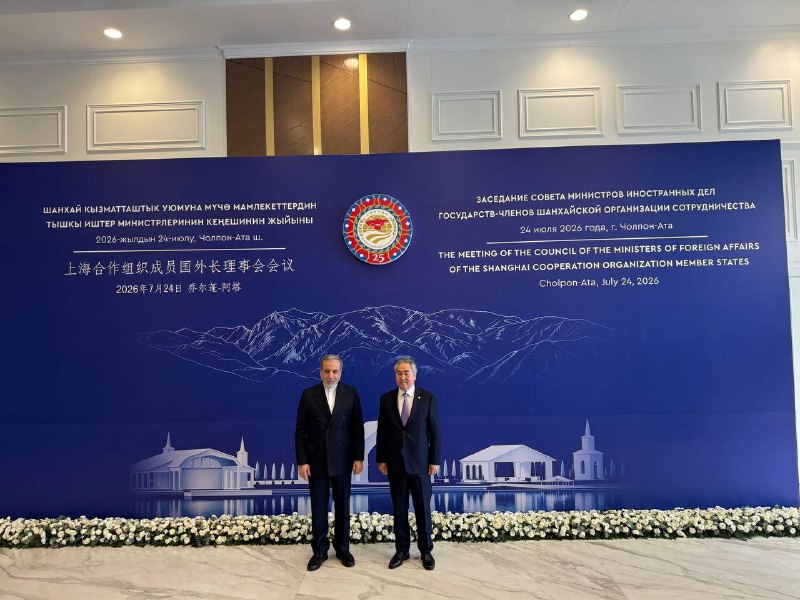
Iran's Foreign Minister Seyyed Abbas Araghchi walked into the venue of a Council of Ministers of Foreign Affairs gathering in the Cholpon-Ata area of Kyrgyzstan shortly before 04:00 UTC on 24 July 2026, according to the English-language service of Iran's Tasnim News Agency, becoming one of the first senior figures on site for a session that will work through roughly two dozen resolutions over the day. The Iranian delegation's arrival, reported at 03:14 UTC by Tasnim's English channel and at 03:12 UTC by its Persian-language outlet Jahan Tasnim, set the tempo for a Council of Ministers meeting whose agenda is unusually crowded for a routine SCO coordination session.
Around the same time, China's top diplomat was already holding a bilateral on the sidelines. Chinese Foreign Minister Wang Yi met Belarusian Foreign Minister Maxim Ryzhenkov in Kyrgyzstan ahead of the ministers' council, China's state broadcaster CGTN reported at 04:00 UTC on the same day. The meeting, framed by Beijing as coordination ahead of the SCO session, put Minsk and Tehran on the same stage within hours of each other and signalled how much bilateral work is being layered onto the formal agenda.
The Council of Ministers of Foreign Affairs is the SCO's second-highest regular body, sitting below heads of state and above the senior officials' meetings that prepare its work. It is the venue where foreign-policy priorities for the bloc are aligned, communiqué language is negotiated, and the calendar for the year's upcoming summits is set. Roughly 25 resolutions are scheduled for discussion, Tasnim's correspondent reported from the venue at 03:56 UTC.
The agenda, and what is not on it
For an SCO foreign ministers' meeting, the resolution count is high. The body typically issues a smaller package of communiqués focused on regional security, counter-terrorism cooperation, and institutional housekeeping. A draft programme that runs into the mid-twenties usually signals either an expansion of the bloc's working agenda, or a deliberate effort by the host to use the meeting as a delivery vehicle for political messaging that other forums cannot carry. Monexus analysis: a heavier agenda is most plausibly read as the host's instrument. The cited posts confirm only the count and the calendar; they do not document which policy domains the roughly 25 draft texts cover.
What the cited reporting specifies is narrow: about 25 resolutions, a single day of ministers' talks, and a string of bilaterals on the margins. The available source items do not specify the substantive contents of the draft resolutions, the full list of attending foreign ministers, or whether the Iranian and Belarusian meetings are the only sidelines encounters on the schedule. The agenda items themselves are not enumerated in the cited posts.
That detail matters. Each new policy domain added to the ministers' council agenda, from connectivity to counter-narcotics to financial-sector coordination, becomes a foothold for the bloc's institutional identity beyond its original Central Asian security remit. That pattern is a contextual reading, not a sourced fact for today's meeting.
Bilaterals as the real product
The Wang-Ryzhenkov meeting is the second visible signal that this Kyrgyz session will be defined as much by what happens in side rooms as on the council floor. The CGTN report frames the encounter as coordination ahead of the SCO session, without specifying substantive deliverables. Beijing and Minsk have layered cooperation across security, industrial supply chains, and joint infrastructure projects in recent years, and a foreign-minister sit-down on SCO margins gives both sides a venue to align positions, including on Ukraine-adjacent diplomacy, without the optics of a standalone bilateral summit. The cited posts confirm only the meeting itself, not its content.
Iran's bilateral calendar at this meeting is the more closely watched track. Araghchi's appearance at an SCO foreign ministers' meeting comes at a moment when Tehran's regional diplomacy is unusually active, with separate negotiations underway in different channels. The cited reporting confirms only his arrival at the venue. The available source items do not specify which counterparts Araghchi will meet, whether he will hold a formal bilateral with Wang Yi, or whether a Russia-Iran-China trilateral is scheduled on the margins. Monexus assessment: the structure of these meetings matters as much as the communiqués. An SCO foreign ministers' council with a crowded agenda and active bilateral tracks is a working institution. One with a thin agenda and a single joint statement is a photo opportunity. The cited reporting points firmly to the first scenario.
What the SCO is, and what it is not
The Shanghai Cooperation Organisation began as a security-focused grouping of China, Russia, and Central Asian states in 2001, and has since grown to ten full members, with Belarus and Iran among the most recent entrants. The bloc operates on consensus, has no mutual-defence clause comparable to NATO's Article 5, and runs its work through rotating chairs. Its structural limit is binding authority. SCO communiqués signal alignment, not joint action. Where the bloc has accumulated concrete outputs, they tend to sit in technical domains: counter-terror exercises, joint training, information-sharing protocols, and the slow construction of financial-cooperation instruments that allow member-state central banks to settle trade in national currencies.
That second track is the quietly consequential one. The ministers' council routinely receives updates on local-currency settlement, on the expansion of the bloc's Interbank Association, and on the slow build-out of non-dollar payment rails between member-state commercial banks. The cited posts do not specify whether financial-architecture items are on the 24 July agenda. The available source items do not specify which working committees have submitted draft texts to the ministers' council.
Stakes, and what to watch
The narrow stakes are procedural: does the council deliver the roughly 25 resolutions cleanly, and which drafts get softened or pulled during closed sessions? The wider stakes are positional. For Beijing, a well-run session ratifies China's standing as the institutional convener of the bloc. For Moscow, the meeting is one of the few multilateral forums where the Russian foreign minister can still operate at full diplomatic tempo. For Iran, an SCO setting offers diplomatic cover that several other multilateral venues do not. Monexus assessment: the meeting is most likely to matter where its communiqués intersect with work being done elsewhere, in particular in currency-settlement arrangements, in counter-terror cooperation that touches Afghanistan, and in any language the ministers adopt on Ukraine-adjacent diplomacy or on the Middle East. The cited posts specify none of that language. They specify only the agenda size and the early arrivals.
What remains unresolved as the ministers convene is straightforward. The published source items do not specify the full text or even a substantive summary of the draft resolutions, the final list of attending ministers, or the schedule of bilateral meetings beyond the Wang-Ryzhenkov encounter. A clean read of the day's diplomatic product will require the joint communiqué and the official bilaterals readout, neither of which the cited posts contain. Until those drop, the meeting's actual content is best treated as in progress.
Desk note: Monexus framed this on the basis of two Iranian state-affiliated outlets (Tasnim, in English and Persian) and one Chinese state outlet (CGTN), all of which locate the 24 July 2026 SCO Council of Ministers of Foreign Affairs meeting in the Cholpon-Ata area of Kyrgyzstan. Where the three diverge in tone, we have not invented a discrepancy; the cited posts are consistent on venue, arrival times, agenda size, and the Wang-Ryzhenkov meeting, and silent on most other details. The structural context, including the SCO's institutional history, member composition, and working methods, is plainly labelled as Monexus analysis where it goes beyond the cited posts.
Wire provenance
This editorial synthesis draws on the following public wire/social posts:
- https://t.me/tasnimnews_en/27628
- https://t.me/JahanTasnim/226462
- https://t.me/JahanTasnim/226464
- https://news.cgtn.com/news/2026-07-24/Chinese-foreign-minister-meets-Belarusian-counterpart--1P1Yujx9Wda/p.html
- https://x.com/CGTNOfficial/status/2080503241847316667