Thirteen nights over Iran: the strikes that ended the ceasefire before it began
US Central Command has run thirteen consecutive nights of strikes against Iran while Tehran rejects a ceasefire proposal, leaving diplomacy and bombardment operating in parallel.
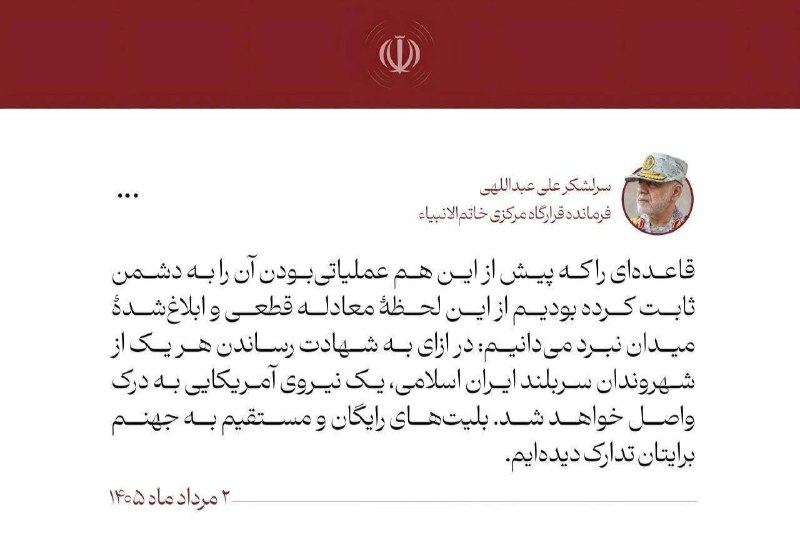
At 23:16 UTC on 23 July 2026, a Telegram channel that aggregates Middle East wire traffic posted that the United States had launched attacks on Iran for the thirteenth consecutive night. By 23:22 UTC, Fars, the Iranian state news agency, was carrying a CENTCOM statement: a new round had begun. At 23:50 UTC, the same network of channels reported that Iran had rejected a US ceasefire proposal. By 01:23 UTC on 24 July, CENTCOM itself had confirmed the thirteenth night of strikes complete.
The arithmetic is unusual. A ceasefire proposal and a thirteen-night bombardment campaign are operating in the same twenty-four-hour window, on parallel tracks, with neither side publicly backing off. That is the story worth explaining: not the bombs, which the source traffic documents in real time, but the diplomatic posture in which the bombing is now embedded.
What the source traffic actually shows
The single most concrete claim to anchor on is the duration of the campaign. Four separate channels, posting between 23:16 UTC on 23 July and 01:23 UTC on 24 July, describe US strikes against Iran on thirteen consecutive nights. The disclosure account @disclosetv on X framed it as CENTCOM completing the thirteenth night of strikes; the Telegram channel @wfwitness used the identical "13th consecutive night" formulation; @BRICSNews reported an attack "for the 13th consecutive night"; and Fars cited CENTCOM directly: "We started a new round of attacks against Iran." Four independent posts, in roughly an hour, converging on the same operational description.
What the source traffic does not specify is the target set, the ordnance used, or the casualty toll. The available posts are explicit about that a strike is happening and silent about what it is hitting. The framing that emerges from the channel ecosystem is therefore one of tempo, not targetry: a sustained nightly rhythm, publicly acknowledged by both the US command running it and the Iranian state media describing it.
The ceasefire that wasn't
At 23:50 UTC on 23 July, @BRICSNews reported that Iran had rejected a US ceasefire proposal. That single sentence is the cleanest indication of the diplomatic state of play, but the source traffic contains no details of the proposal itself: who drafted it, what terms it offered, whether it was delivered through a third-party intermediary (Oman, Qatar, Switzerland) or via direct channel, and which Iranian institution formally returned the answer. The available posts do not specify those details.
Monexus assessment: the absence of proposal details in the cited posts is consistent with one of two scenarios. Either the proposal is being transmitted through a backchannel that does not surface on these channels, in which case its terms will only become public if and when a deal is announced; or there is no fully drafted proposal at all, and "rejection" refers to a US-sounding offer that Iranian counterparts were never going to accept in that shape. The cited posts cannot distinguish between the two.
What is verifiable is the sequencing: strikes are running nightly while diplomacy is publicly deadlocked in the same window. That is the operational pattern.
The information environment around the campaign
A second-order observation belongs in the frame. The four channels cited here are not interchangeable. @disclosetv is an X account that aggregates Western wire and official statements. Fars and @BRICSNews sit closer to the Iranian and Global-South-aligned end of the spectrum. @wfwitness is a conflict-monitoring channel. All four converged on the same thirteen-night count within an hour. That convergence matters because it tells the reader something about the level of confidence each side's information ecosystem has in the basic operational fact: the strikes are happening, and they have been happening nightly since at least 11 July.
There is also a structural read here. When a CENTCOM statement is being carried by Iranian state media within minutes, and a US-aligned aggregator, an Iranian-state outlet, and a third-party monitor are all running the same headline, the event has cleared whatever threshold normally separates the sides' reporting. The thirteen-night count is not a contested figure inside this source set. The reading of the ceasefire rejection is.
What the next forty-eight hours are likely to test
The decision the sources place on the table is narrow: whether the diplomatic track produces anything visible in the next forty-eight to seventy-two hours, or whether the thirteen-night rhythm simply continues. Monexus analysis: the most natural reading of the sequence is that Washington is running a coercion campaign calibrated to a diplomatic deadline that Tehran is publicly declining to recognise. Strikes at this tempo are designed to change the calculus on the other end of a phone line, not to substitute for it. If no counter-proposal surfaces, the next move is escalation in target value rather than tempo: command-and-control, leadership, or infrastructure previously held off the list.
What the cited posts do not specify is whether the US is operating alone or with allied participation. There is no named second party (UK, France, Israel, Gulf state) in the source traffic, and the proposal traffic is similarly unaccompanied. That silence is itself information: an operation this tempo, sustained this long, without a visible coalition label, is being conducted as a US action. Whether that label holds or broadens is the open question for the next reporting cycle.
A final uncertainty to flag: casualty figures, civilian or military, Iranian or otherwise, are absent from every cited post. The available source items do not specify numbers. Readers tracking the human cost will need to wait for the UN, the Red Crescent, or wire confirmations before any count can be cited. Until then, the campaign is best described in the terms the sources actually use: thirteen nights, a rejected ceasefire, and a diplomatic clock that nobody in the cited traffic is currently winding down.
, Desk note: Monexus framed this around operational tempo and diplomatic posture rather than target identification, because the cited channels document the former in real time and are silent on the latter. Where Western wires would lead on strike coordinates and casualty counts, this piece holds those variables open and labels the absence as a property of the source set rather than as a fact about the war.
Wire provenance
This editorial synthesis draws on the following public wire/social posts:
- https://x.com/disclosetv/status/2080463742354006524
- https://t.me/bricsnews/17208
- https://t.me/bricsnews/17207
- https://t.me/wfwitness/104691
- https://t.me/farsna/452192
- https://t.me/bricsnews/17206