Kyiv swaps its top general under street pressure
President Zelenskyy dismissed General Oleksandr Syrskyi as commander-in-chief after public protests and named Mykhailo Drapatyi, a Mariupol veteran, as his replacement on 21 July 2026.
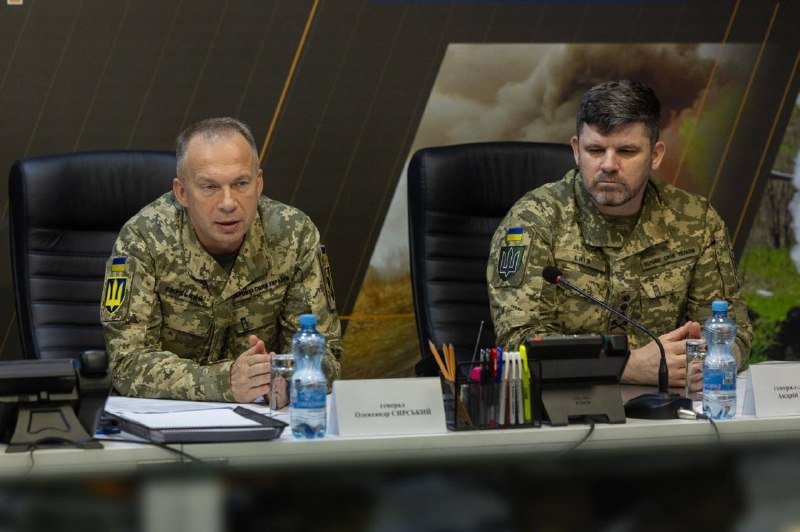
On the evening of 21 July 2026, President Volodymyr Zelenskyy signed the order removing General Oleksandr Syrskyi as commander-in-chief of Ukraine's armed forces. Within minutes the same channels that track the war in real time were reposting the announcement: Syrskyi out, Major General Mykhailo Drapatyi in. The change, reported at 19:52 UTC by the open-source investigator @noel_reports and confirmed within the hour by the Telegram channels WarMonitors, GeoPWatch, OSINTdefender and @rnintel, came after days of public demonstrations demanding Syrskyi's removal. No successor statement has been issued from Moscow; the battlefield implications, and the political ones, will take longer to settle than the announcement itself.
The episode puts a question at the centre of wartime Kyiv that the West rarely asks out loud: who gets to choose the general, and on what evidence. Ukraine's constitution reserves that appointment to the president, and Zelenskyy used it. He also did so under street pressure, in a country where public legitimacy and military credibility are the same currency. That is the lens through which the swap has to be read.
A firing and a thank-you in the same hour
The replacement moved fast. By 20:00 UTC, @rnintel was carrying the headline that Syrskyi had been removed and Drapatyi appointed. By 20:09 UTC, Drapatyi had already posted a public statement thanking Zelenskyy for his trust, the defence minister for support, and Ukraine's defence forces for what he called "a new stage of service," while also thanking Syrskyi explicitly. The courtesy is not incidental. Ukrainian command changes during an active invasion are choreographed around continuity of operations; the outgoing chief does not get to slink away in silence if the brigades on the line need to hear that the rotation is orderly.
Syrskyi had served as commander-in-chief for 894 days, according to a 20:19 UTC post by @GeoPWatch tracing the tenure back to his February 2024 appointment. That figure matters because the second-anniversary marker has been a known pressure point. Veterans' groups, military bloggers and family associations have used calendar milestones to amplify complaints about manpower policy, rotation cycles and the human cost of attritional defence. The protests that preceded the dismissal were not a single rally but a rolling demand that built for weeks before it broke the surface this week.
Drapatyi's record, and what is being asked of him
Drapatyi is not a fresh face. A widely circulated image referenced by the Telegram channel Visioner shows him on 9 May 2014 commanding a BMP-2 of the Ukrainian 72nd Mechanised Brigade as it broke through barricades held by pro-Russian separatists in occupied Mariupol. Twelve years on, the symbolism is pointed: the general now taking over Ukraine's general staff began his wartime career in the city that became the war's defining symbol of resistance and destruction.
His task list is short and unforgiving. He must hold the line on whatever stretch of front his predecessor was defending on 20 July, manage the rotation and mobilisation controversies that triggered the protests in the first place, and signal to Western capitals that operational planning has not skipped a beat. He also inherits a force structure that has been shaped, in part, by Western aid conditionality: ammunition constraints, brigade reconstitution timelines, and a manpower model that the Street has been arguing about openly since at least the spring.
The new commander-in-chief's public statement, captured by @noel_reports at 20:09 UTC, was framed in the language of continuity rather than rupture. That, too, is a tell. A clean break would imply that Syrskyi's command had been a mistake. A seamless transition implies that the change is personnel, not doctrine. Both readings are available, and both are doing political work in Kyiv right now.
The street versus the staff
The dismissal is the second time in this war that Ukraine's military leadership has been removed under explicit public pressure rather than quiet presidential reshuffle. The earlier case, in February 2024, saw Syrskyi installed in place of General Valeriy Zaluzhnyi amid a similar, if smaller, wave of commentary. The pattern is the political story. A country fighting for its existence is also a country that can, within institutional limits, fire its top general because enough people chanted for it.
That dynamic sits awkwardly alongside two competing framings of wartime command. The first holds that a commander-in-chief must be insulated from politics, because any military decision made under protest pressure is by definition compromised. The second holds that in a democracy at war, public consent is itself a strategic asset, and a general who has lost the trust of the people he is asking to fight cannot command effectively no matter how sound his maps look. Zelenskyy's call on 21 July is, in effect, a vote for the second framing, delivered in the only currency a wartime president has: personnel.
It is also a signal to Kyiv's partners. Western military assistance is increasingly being discussed in capitals that ask, off the record, whether Ukraine can sustain the fight with the manpower it has. A leadership change made under protest pressure is, on one reading, evidence that the system still works: grievances surface, institutions respond. On another reading, it is evidence that the system is closer to its tolerance limit than the official communiqués admit. Both readings are circulating in Brussels and Washington tonight.
What we do not yet know
Three things remain unresolved at the time of writing. First, the immediate operational effect: command centres do not rotate overnight, and the first 72 hours of any new commander-in-chief's tenure are typically consumed by orientation rather than redesign. Second, the political choreography around Syrskyi himself. He has been thanked publicly by his successor, but the absence of any public defence from the outgoing general leaves open whether he was given a face-saving alternative role, a quiet retirement, or simply shown the door. Third, the protest movement's appetite. Demonstrations that produce a resignation tend to grow, not shrink; the next demand is rarely the last. Kyiv's Kalenskyy-administration will now be operating under the same public scrutiny that produced the change in the first place.
Desk note: Monexus is treating this as a Ukrainian-led story sourced primarily through Ukrainian-aligned open-source channels and the Telegram accounts of established OSINT investigators. The framing leads with Zelenskyy's constitutional authority to appoint and dismiss the commander-in-chief, with the protest pressure as context rather than as the headline. No Russian state-media sourcing has been used; claims about battlefield effect are held back where the sources do not yet support them.
Wire provenance
This editorial synthesis draws on the following public wire/social posts:
- https://t.me/noel_reports/
- https://t.me/WarMonitors/
- https://t.me/GeoPWatch/
- https://t.me/osintlive/
- https://t.me/rnintel/
- https://t.me/megatron_ron/