A US soldier dies in Erbil, and the controlled-detonation story starts to bend
The Pentagon has named Sgt. Michael Emmanuel Swinton of Fayetteville, North Carolina, as the US service member killed at Erbil Air Base on 19 July 2026. The official line calls it a controlled detonation. The geography, and the pattern, suggest a harder question.
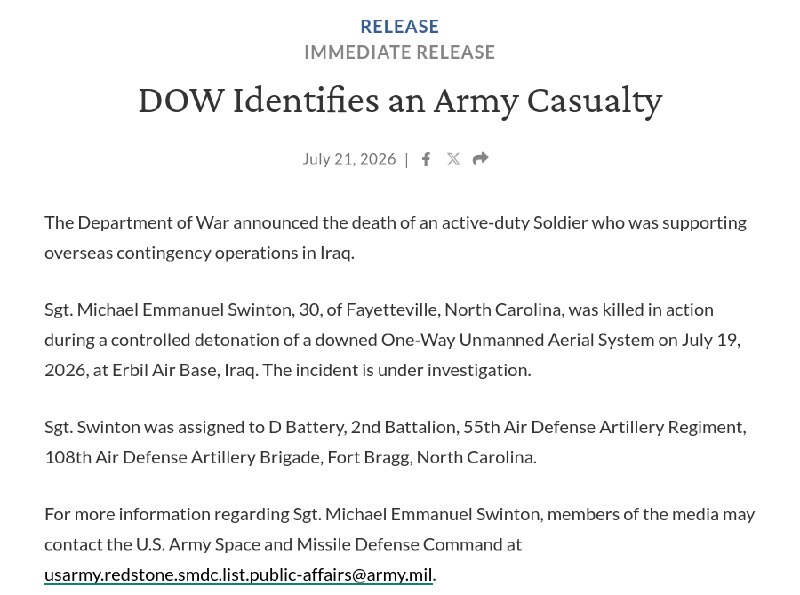
On 21 July 2026, in three short wires minutes apart, the name moved from anonymous to identified. The US Department of Defense released the identity of Sergeant Michael Emmanuel Swinton, 30, of Fayetteville, North Carolina, as the American soldier killed at Erbil Air Base, Iraq, on Sunday 19 July 2026. Iran's Tasnim News was first among the regional outlets to confirm the Pentagon's announcement, citing the Department of War. Al-Alam Arabic ran the identification as breaking news. The OSINT channels WarMonitor and OSINTdefender carried the same line from the Pentagon, almost word for word: a 30-year-old sergeant from North Carolina, killed in action during what officials called a "controlled detonation" at the base.
The Pentagon's account is careful in a way that draws attention to itself. A soldier does not die in a controlled detonation unless the ordnance is meant to be neutralised, not to kill him. The fact that someone has had to put those two words together, in that order, in an official release, is itself the story. It signals that what happened at Erbil was, at minimum, an ordnance-disposal incident with lethal consequences, and at maximum an attack dressed up in disposal language while the evidence is still being collected.
This is a long read about the gap between those two readings, and what the gap tells us about the position the United States is holding in northern Iraq in mid-2026.
What the Pentagon has said, and what it has not
The lines on the wire are spare. The Department of Defense identified Swinton, gave his age and his home town, named his rank, and dated his death to 19 July 2026. The Pentagon called the incident a "controlled detonation." There is, in the public record made available through 21 July 2026 UTC, no identification of the explosive, no description of the disposal team, no statement on whether the device had been removed from the base's weapons storage or brought in from outside, and no attribution to any specific actor.
The restraint is conventional. US military identification of a fallen service member usually comes after notification of next of kin, and the Pentagon's first job in the hours after a death is to name the soldier and his unit, not to litigate causation. But the phrase "controlled detonation" is doing unusual work in this release. It is technically a descriptor of a planned explosive event, used routinely for EOD range work and for the destruction of captured munitions. It is not, in normal US Central Command usage, the language attached to a soldier killed by enemy action. The two phrases can appear in the same sentence only if the official position is that the soldier died during an authorised disposal of munitions and not during an attack.
That word choice will draw scrutiny from two directions simultaneously. Congressional notifications and the casualty's family are entitled to the underlying record. Investigators from US Army Criminal Investigation Division and, depending on the read, the Bureau of Alcohol, Tobacco, Firearms and Explosives will look at the site. If the line holds, Swinton's death becomes one of a small but recurring category of US military deaths in Iraq caused by mishandled ordnance rather than hostile fire. If the line does not hold, the Pentagon will have to walk back its own release in public, and the public record will record that the walk-back was forced.
Why Erbil, why now
Erbil Air Base is not a quiet posting. It sits in the Kurdistan Region of Iraq, hosts US and coalition personnel, and has been a launchpad for US operations against the Islamic State and for the wider US military presence in northern Iraq. It is also within range of the drone and rocket profiles that Iranian-backed Iraqi militias have used, intermittently and sometimes denied, against US positions in Iraq and Syria since 17 October 2023 and before.
The pattern that matters is not the existence of these attacks. It is the cadence. After the October 2023 onset of the Gaza war, militia strikes on US positions in Iraq and Syria rose sharply, then fell, then rose again as US force posture shifted and as Tehran's proxies recalibrated. Each cycle has produced at least one US death and a US response calibrated to avoid an open war with Iran, but large enough to be visible: strikes on militia facilities, sanctions on individuals, interdictions at sea. The cycle is now a feature of the regional architecture. It is, in the language of analysts who have spent years on the file, a managed conflict, in which each side inflicts costs on the other inside a corridor the wider system can absorb.
A death at Erbil on 19 July 2026, four days before the article's filing window, fits inside that pattern, with two caveats. The first caveat is that a single death inside a controlled-detonation story is not, on its face, an attack, and the pattern only matters if the reading of the event as an attack is right. The second caveat is that the timing falls into a window in which the diplomatic traffic between Washington and Tehran has been publicly quiet and privately unquiet, and in which the Iraqi government's room to manoeuvre between its US partner and its Iranian neighbour is unusually narrow. Both caveats make the question of what actually happened at Erbil more politically loaded, not less.
The counter-read: a disposal, not an attack
The Pentagon's framing has to be taken seriously, not waved away. EOD work is genuinely dangerous, and US forces at Erbil handle a wide range of munitions: stockpiled Iraqi materiel, captured Islamic State caches, returned coalition equipment. A 30-year-old sergeant killed in the line of an authorised disposal is a loss his family and his unit will mark as such, regardless of how the death is parsed in commentary. A controlled detonation gone wrong is a known, documented category of fatal incident on US bases. The official line is therefore coherent. It does not require us to assume a cover-up to be plausible.
The structural argument for the official line is also real. Naming the soldier and the cause at the same time, in a single release, is consistent with an institution that believes it has the facts and is willing to be transparent. If the Pentagon were concealing an attack, the easier move, in the short term, would be to defer the identification and the cause-of-death language until a fuller story could be assembled. Naming both on the same day is, if anything, the move of an institution that is not managing a crisis.
So the question is not whether the official line is sincere. It is whether the available evidence is yet sufficient to say it is complete.
The pattern in plain language
It is worth being plain about what the longer arc looks like, without resorting to borrowed vocabulary. The arc is one in which a dominant outside power maintains a forward presence in a country whose government is itself balancing between that power and a regional rival. The rival's allied militias are willing to fire on the outside power's bases, sometimes with deniability, sometimes without. The outside power retaliates in ways that hurt the militias and signal resolve, but that stop short of striking the rival directly. The result is a steady, low-volume exchange of violence that occasionally breaks the surface, in the form of a US death, a militia commander taken out, a shipping seizure, a sanctions designation. The system absorbs each event and continues.
The arc is also one in which the outside power's domestic political base, in this case the United States, has been moving away from the costly forward presence for years. The Trump administration's 2025 posture, including the renaming of the Department of Defense to the Department of War, the drawdown of US personnel in Syria, and the contested status of US forces in Iraq, has not produced a clean exit. It has produced a thinner, more politically exposed presence. Thinner presences get probed more, because the cost of probing them is lower and the political reaction to a probe is more uncertain.
Erbil sits at the intersection of those dynamics. The base matters because it is the only large US position in the north. It matters because the Kurdistan Regional Government relies on the US presence for its own security. It matters because any attack on Erbil is, in the calculation of Iran's proxies, an attack on a high-value, low-defence-density target. None of that proves the controlled-detonation story is wrong. All of it is what makes the story worth examining.
What the next ten days will show
The forensic record will be the first tell. If Swinton was killed in an authorised EOD disposal, the incident report will identify the ordnance, the disposal method, the safety perimeter, and the failure mode. That report, or a summary of it, usually reaches the press inside two to three weeks. If the device was not part of an authorised disposal, the same window will see leaks to the contrary, and the Pentagon's own language will start to migrate, often in the form of a follow-on statement that retains the original noun but qualifies the verb. "Under investigation" is the phrase that bridges the two. Once a Pentagon statement starts to say "the incident remains under investigation," the controlled-detonation line has stopped being a finding and has become a placeholder.
The political record will be the second tell. The Iraqi government's interior and defence ministries will, almost certainly, be asked by Baghdad-based diplomats whether the explosion was a discharge of US weapons, an attack by a third party, or a domestic Iraqi incident. The answer they give, and the speed with which they give it, will be a measure of how confident the US side is that the official line will hold. Iraqi officials, who have been balancing between Washington and Tehran for years, are sensitive to being made to defend a story that turns out to be wrong. Their silence, or their pointed vagueness, will be a signal in itself.
The regional record will be the third. Iranian-backed Iraqi militia channels are a known ecosystem, and they tend, when they are responsible for an event, to claim it within hours rather than days. The absence of a claim, in the first seventy-two hours after a US casualty, is not proof of non-involvement, but it shifts the prior. A claim in the second week, on the other hand, would be a tell that the event was inside the militia playbook and that the controlled-detonation line was, from the start, the wrong shape for what happened.
What the next ten days will not show, unless something breaks loose, is a definitive answer. A single soldier's death in northern Iraq is, in the scale of US force posture, a small event. It does not move a budget line or a deployment order by itself. What it does is add one more data point to a curve that, in the second half of 2026, is bending in a direction that the regional architecture has not yet absorbed.
A line that will be watched
The Pentagon has put a 30-year-old sergeant's name on the record. The phrase attached to his death is technically precise and politically careful. The pattern in which that death sits, if it is in fact an attack, is the one that has been running between the United States and Iran's Iraqi proxies for almost three years. The disposal story, if it holds, is a reminder that the dangerous work of handling ordnance is also part of what US soldiers in Iraq do, and that this one died doing it. The pattern story, if it holds, is a reminder that the architecture of managed conflict around Iran is not as managed as its managers would like to claim.
Both readings are live. Neither is, as of 21 July 2026, settled. The wire will tell us which one is right, and the controlled-detonation line, in the days ahead, will tell us a great deal about the state of the relationship between Washington and the forces that have, in the past three years, been willing to test it with ordnance and with denials.
This publication has framed the Erbil incident around the gap between the official "controlled detonation" line and the pattern of militia strikes on US positions in Iraq, rather than as a straight wire report. The wire line, by 21 July 2026 UTC, had not yet been overtaken by an alternative account, and the forensic record had not been released.
Wire provenance
This editorial synthesis draws on the following public wire/social posts:
- https://t.me/alalamarabic
- https://t.me/tasnimnews_en
- https://t.me/osintlive
- https://t.me/osintlive