Trump pressures Carney on Ontario wildfire smoke as transboundary air crisis drags into a second month
A July 20 message from the US president tells Ottawa to step up its fire management. Ottawa says it already is, and that the air crisis respects no border anyway.
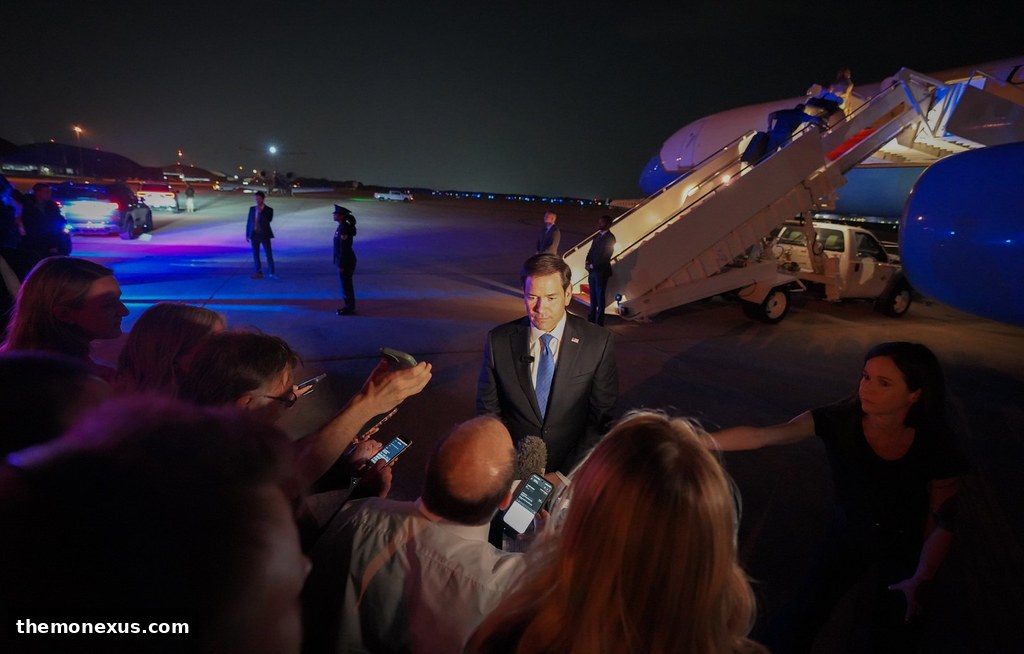
On 20 July 2026, U.S. President Donald Trump said publicly that he had told Prime Minister Mark Carney that Canada needs to do more to manage the Ontario wildfires that have been pumping smoke and fine particulate matter south across the Great Lakes border for weeks. The remarks, reported overnight by Epoch Times via its Telegram wire, put a pointed, on-the-record pressure call from the White House into a story that had been running as a domestic Canadian hazard story for most of the summer.
The dispute is not really about firefighting. It is about who owns the air when a forest fire burns in one country and chokes the lungs of people in another. Trump is framing Ottawa as a laggard. Ottawa, less loudly, is framing the smoke as a shared atmospheric problem with no neat national attribution. Both framings have merit, and the gap between them is the policy story.
What Trump actually said, and what he didn't
The substance, as carried by Epoch Times, is narrow: the U.S. president has communicated to Carney that Canada needs to intensify its efforts. There is no claim, in the wire text, of a specific operational ask. No request for a firefighting contingent, no demand for resource sharing, no figure for acreage burned or dollars owed. The remark sits in the category of presidential signalling, the kind of message that reads louder in its phrasing than in its policy content.
That matters. Presidential pressure of this shape usually precedes either a tangible ask (rare, in environmental diplomacy) or a tariff-shaped lever (less rare, in this administration's pattern). The sources do not tell us which is being readied. They tell us only that the public pressure is now on the record, dated, and attributable.
Canada's position: the fire is already a federal file
For Ottawa, the response is partly procedural and partly substantive. Ontario is the lead operational authority on wildfire response inside the province, with the Canadian Interagency Forest Fire Centre coordinating mutual aid across provinces and with federal agencies such as Natural Resources Canada and the Canadian Armed Forces providing surge capacity when asked. Smoke, once airborne, is governed by the Canada-U.S. Air Quality Agreement, last updated formally in 2000 but operating through a continuous notification regime run by Environment and Climate Change Canada and the U.S. Environmental Protection Agency.
In other words, the institutional plumbing for transboundary smoke is already built. What's missing from the public record is evidence that any of it has broken. Ottawa's likely counter-message is that Canada is already doing the work the agreement envisages, that fire activity this season has been within historical envelopes for some metrics and outside them for others, and that any additional U.S. ask should be specified in writing so it can be costed.
The structural frame: air as foreign policy
The deeper pattern here is that smoke, like water before it, has become an item of bilateral statecraft. The Columbia River Treaty renegotiation dragged for years in part because water does not stop at the 49th parallel. Smoke from Siberian boreal fires has been tracked across the Arctic into North American air sheds for more than a decade. Wildfire smoke from Canadian provinces has reached U.S. cities including New York, Detroit, and Minneapolis in recent seasons with enough frequency that hospital admissions for asthma and cardiovascular events have become a measurable line item in public-health reporting.
What we're watching is the slow arrival of air on the diplomatic agenda, with all the friction that brings. Air pollution does not negotiate. It does not recognise tariff lines, immigration queues, or alliance commitments. A country that wants to be paid for its smoke, or that wants its neighbour to do more to suppress it, is asking for something the atmosphere will not respect: clean accountability for an event that is, by its nature, shared.
Stakes, and what to watch next
If the pressure call stays rhetorical, the practical cost is mostly political face. Carney's government absorbs the criticism, points to the existing air-quality agreement, and moves on. If it hardens into a request for Canadian personnel or equipment deployment under some new bilateral framework, the cost shifts to provincial budgets and to the federal procurement line. The third possibility is the most uncomfortable: that the remark is a placeholder for a future trade move, with wildfire management folded into a broader argument about Canadian economic and regulatory slack.
For readers, the cleanest things to watch are three: an official Canadian response from the Prime Minister's Office or Minister of Environment and Climate Change, dated and on the record; any change in the operational tempo of cross-border air-quality notifications on the EPA's AirNow feed; and any movement at the Canada-U.S. Air Quality Committee, which is the venue where these asks have historically been processed when they have been processed at all. The sources do not, at this point, give any of those three a date. They give only the fact that the phone call has now been made public, by one side, and is awaiting a reply from the other.
What remains genuinely uncertain is whether this is the opening move of a longer bilateral argument or a single rhetorical shot. The wire text carries the pressure without the policy texture around it. Until either side adds detail, the story sits in the gap between signal and substance, which is where most transboundary environmental disputes begin.
Desk note: Monexus is framing this as a bilateral environmental-governance story with a diplomatic pressure overlay, not as a fire-suppression story. The wire text is a pressure call, not an operational ask, and the article holds that distinction throughout.
Wire provenance
This editorial synthesis draws on the following public wire/social posts:
- https://t.me/s/epochtimes