Trump to Lebanon's Aoun: Hezbollah is a problem Washington intends to solve
At the White House on 21 July 2026, the US president told Lebanon's Joseph Aoun that the Hezbollah question is solvable, then warned the Houthis against blockading Saudi ports and declared the United States "not finished" with Iran.
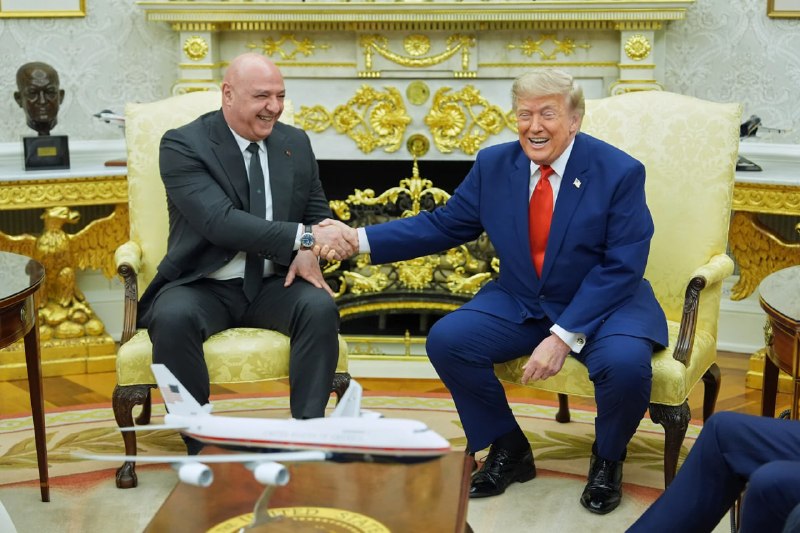
Lebanese President Joseph Aoun walked into the Oval Office at roughly 15:25 UTC on 21 July 2026 and walked out two hours later with something rarer than a joint communiqué: a US president publicly committing, on camera, to dismantle a Lebanese armed faction on his behalf. Standing beside Aoun, Donald Trump told reporters the United States would "solve a lot of problems" for Lebanon and that the Hezbollah question was one of them. Hours later, in two separate exchanges with the press, the same president warned Yemen's Houthis against blockading Saudi ports in the Red Sea and declared that Washington was "not finished at all" with Iran. The day stitched together three regional files that the Trump administration has been trying to keep apart, and the stitching did not look accidental.
The pattern is straightforward enough to state plainly. Washington is signalling that the residual armed presence of Iranian-aligned forces in Lebanon, the Houthi campaign against Saudi maritime traffic, and the broader question of Iran's regional posture are now being treated as one negotiation. Each of those files has its own history and its own local logic. Each, the White House is now arguing, has the same address.
What Trump actually said in the room
The Lebanese file produced the day's most concrete language. Asked about Hezbollah during the bilateral meeting, Trump said the United States would "solve a lot of problems" for Lebanon and that "there's a Hezbollah problem, but we've done some [work]" already, per White House press pool footage distributed by War Footage Witness at 15:41 UTC. Trump described Lebanon as "a country of great intellect" and said Washington intended to help it, language the Aoun government has long sought from a US administration. The framing matters. Aoun, a former commander of the Lebanese Armed Forces, came to Washington with an explicit ask: continued US support for the LAF as the country's sole legitimate military, and continued US backing for the November 2024 ceasefire framework. Trump, in turn, used the platform to publicly anchor a US stake in disarming Hezbollah. The two agendas overlapped enough that both leaders could declare a win on the same set of microphones.
According to a Telegram alert from Insider Paper at 16:16 UTC, Aoun used the meeting to urge Trump to "keep supporting" the Lebanese army. The phrasing is the giveaway: Aoun is not asking for new commitments, he is asking for continuity. He is also implicitly reminding Washington that the LAF, not any external coalition, is the institution through which any internal Lebanese settlement will be enforced.
The Houthi warning, and what is really being threatened
The Red Sea file is older and louder. At 15:31 and 16:02 UTC, Insider Paper reported Trump telling reporters that the United States would "take care of" the Houthis if they blockaded Saudi ports. At 15:20 UTC, Clash Report quoted Trump more cautiously: "We'll see what happens. So far, it hasn't happened. It might happen, but we'll take care of things if something like that happens." The hedging is the news. The US is not announcing an operation; it is drawing a tripwire. Saudi maritime traffic through the Bab el-Mandeb strait and the southern Red Sea has been intermittently targeted since late 2023, and the Kingdom's appetite for absorbing that pressure has narrowed considerably since the 2022-23 détente phase. By tying any future Houthi escalation explicitly to a US response, Trump is converting a Yemeni war into a bilateral US-Saudi security guarantee that the Saudis do not have to ask for in real time. That is a gift to Riyadh's negotiating position and a warning to Sanaa.
The Iran line is the connective tissue. At 16:36 UTC, Insider Paper reported Trump saying the United States was "not finished at all" with Iran. Read against the Hezbollah comments and the Houthi warning, the meaning is the one the administration has been signalling for months: the regional file is one file, and the residual Iranian presence in Lebanon and Yemen is the residual obstacle.
What Washington is buying, and what it is selling
The transactional logic is not hidden. Lebanon gets a continued US security umbrella over the LAF and a US voice in the slow work of rolling back Hezbollah's military presence south of the Litani. That presence has been the central political fact of Lebanese politics since 2006, and the Lebanese state has never had the capacity to confront it alone. The US is, in effect, offering to be the external enforcer of an internal Lebanese settlement. The price, as it has always been, is Lebanese compliance with the broader US regional agenda: no separate channel to Tehran, no quiet reset with the axis.
The Houthis get a different message. The 2024-25 Houthi posture was built on the assumption that the United States had exhausted its appetite for direct intervention in Yemen. Trump's 21 July remarks test that assumption in public. If the Saudis can rely on the US to respond to a Saudi-port blockade, the Houthis' principal leverage against Riyadh narrows sharply. The Houthi argument back to Tehran, that they are a low-cost deterrent, gets harder to make.
The Iranian counter-narrative is consistent and deserves to be taken seriously rather than dismissed. Tehran's framing, articulated in MFA briefings and in the Arabic-language outlets that carry its line, is that the United States is reneging on the practical cooperation that followed the May 2023 understanding: that residual pressure on Iran's regional partners was supposed to ease, not intensify, in exchange for Iranian restraint on the nuclear file. From that vantage point, a single day of Trump remarks connecting Hezbollah disarmament, Houthi containment, and Iran policy into one statement of intent is not a series of separate decisions. It is a message that the de-escalation dividend, if it ever existed, has expired.
Stakes, and what is still unsaid
The hard question is what Trump actually intends to do about Hezbollah if diplomacy fails. The public remarks were framed as problem-solving, not threat-delivery, but the operational answer to "how does the United States solve the Hezbollah problem" is not on the table. The Lebanese state cannot do it. Israel has been the country most willing to try, and Israeli calculations about a wider confrontation with Hezbollah's rear in Iran have their own internal logic that the White House does not control. The most plausible reading is that Trump is buying time, anchoring a US stake in Lebanese internal security, and hoping that the combination of LAF professionalisation and continued Hezbollah political isolation does the work over a multi-year horizon. That is a defensible strategy. It is also one whose failure mode is a sudden Israeli decision that the slow road is too slow.
The second hard question is what the Houthis will read into the tripwire language. They have spent two years calibrating their attacks to stay below the line that triggers a major US response. Trump's 21 July remarks redrew that line in public. The Houthis' most rational move is to test it, gently, to establish where it really sits. Expect a probe, not a blockade.
The third hard question, the one nobody in Washington or Beirut will answer on the record, is what Aoun brought home that did not make the cameras. The visible parts of the meeting, gratitude for US support for the LAF, a presidential endorsement of Lebanese sovereignty, a public US commitment to solving the Hezbollah problem, are all consistent with what Aoun came to ask for. The interesting part is what the Lebanese government agreed to behind closed doors in return. On that, the public record, as of 21 July 2026 at 17:00 UTC, is silent.
Desk note: Monexus treats the Lebanese, Houthi and Iran files as one story when Washington does. The day was reported in fragments across the wire; the structure is the story.
Wire provenance
This editorial synthesis draws on the following public wire/social posts:
- https://t.me/wfwitness
- https://t.me/wfwitness
- https://t.me/wfwitness
- https://t.me/ClashReport