St. Petersburg's Ring Cycle returns: the Mariinsky bets on Wagner at the close of season 243
From 23 to 26 July 2026, the Mariinsky stages all four parts of Wagner's Ring on its New Stage with a star cast, even as the theater closes its 243rd season.
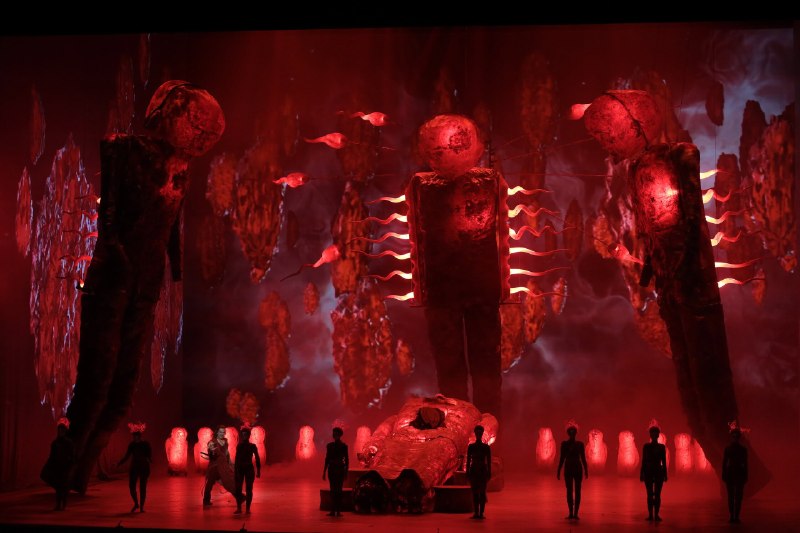
On 21 July 2026, the Mariinsky Theatre confirmed what Russian opera circles have been whispering about for weeks: from 23 to 26 July, all four parts of Richard Wagner's Ring of the Nibelung will be staged on the company's New Stage in St. Petersburg, in sequence, with a cast assembled from the top of the company's roster. The four-day marathon opens Das Rheingold on 23 July, runs Die Walküre the next evening, and closes with Siegfried on 25 July and Götterdämmerung on 26 July, according to the Telegram channel classicalmusicnews (18:16 UTC, 21 July 2026).
The choice matters for a reason that has nothing to do with the music alone. In a Russian season bookended by war, sanctions and a contested relationship with European institutions, the decision to programme the canonical German repertoire at full Ring-cycle scale is a quiet assertion of cultural continuity, and of a house unwilling to scale back simply because the international guest circuit has thinned.
A house that still programmes the long arc
The Mariinsky is closing its 243rd season. According to the same channel (08:44 UTC, 21 July 2026), the house has spent the closing weeks stacking concert programmes that show off its breadth: symphonic evenings, chamber formats, and recital slots designed to retain an audience that, in more ordinary summers, would partly decamp to Salzburg, Bayreuth or the BBC Proms. This year's Ring is the headline gesture in that effort, and the timing is not accidental. The cycle lands on the calendar just before the house's traditional summer pause, giving Russian listeners one last argument to stay in St. Petersburg rather than travel west.
The institutional logic is straightforward. A complete Ring is roughly sixteen hours of stage time, plus rehearsal weeks that consume the New Stage's summer calendar. Choosing to mount it now signals two things at once: confidence in the depth of the resident ensemble, and a calculation that prestige programming still travels, even when foreign tours are complicated. The Mariinsky's soloists, chorus and orchestra have performed individual Ring operas in recent seasons; presenting them as a cycle raises the stakes considerably, because a cycle exposes weaknesses that single-evening stagings can hide.
Who sings what remains the open question
The Telegram announcement frames the cast as a "star" ensemble drawn from the Mariinsky company, but stops short of naming individual singers for specific roles. That is unusual: Wagner casting is normally announced months in advance, with the heldentenor and Brünnhilde attachments treated as headline news in their own right. The silence is either a sign that contracts have not been finalised, or a deliberate holding pattern while the house confirms which of its international guest soloists can, in fact, travel to St. Petersburg in late July 2026 given the visa and routing environment.
What can be said from the available information is this: the Mariinsky has, in recent seasons, relied on a mix of company regulars and invited Wagnerians from the post-Soviet space and parts of East Asia to fill the heaviest roles. The house's own resources for heldentenors and dramatic sopranos are deeper than most Western companies of comparable size, partly because the Russian operatic training pipeline still produces Wagner voices at a scale that the German and American systems no longer match. Whether that pipeline alone can carry four consecutive evenings of Ring without external reinforcement is one of the few genuinely open questions about the run.
Wagner in St. Petersburg, in 2026
There is a subtext that the announcement does not address, and that most Russian outlets will not address either. Wagner in Russia has a complicated 20th-century history; the Mariinsky's own lineage, going back to the Imperial Theatres, includes performances that predate and postdate the politicisation of the repertoire under the Soviet and immediate post-Soviet periods. Staging a complete Ring in 2026 is not the same statement it would have been in 2014 or 2022, but it is also not nothing. For Western audiences who still associate Russian Wagner performance with ideological freight, and for Russian listeners who treat Wagner as simply part of the standard canon, the same four evenings on the New Stage will read very differently.
The Mariinsky's calculation seems to be that the music will be permitted to carry its own meaning. That is a bet that has paid off for the house before, including in the cold-war years when the company's tours to Europe and Japan were treated as cultural ambassadorship in everything but name. Whether the same reception greets the company now, in a season when Western booking has been uneven, is a question that will be answered less by Russian critics than by the international touring calendar of 2027 and 2028.
What to watch in the next ten days
The next concrete milestones are narrow and specific. By 22 July, the cast lists for each of the four evenings are likely to appear on the Mariinsky's own site; the New Stage's acoustics and sightlines, redesigned in the major 2000s renovation, will not change, but the staging concept will, and that is typically what gets posted first. By 26 July, the run will be over, and the audience response, in a city where Wagner cycles are no longer a once-a-decade event but still a serious cultural occasion, will be legible in local press within a week.
The bigger question is downstream. If the cycle succeeds with company forces largely intact, the Mariinsky will have a credible answer to anyone arguing that the post-2022 contraction of Russian cultural exchange has hollowed out its core repertoire. If it stumbles, the failure will be read, fairly or not, as evidence that the house is running on reputation rather than depth. The four evenings from 23 to 26 July will set that verdict, and not in the abstract.
Desk note: the wire coverage of this announcement comes from a single Telegram channel specialising in classical music; the underlying institutional fact is the Mariinsky's own programming decision, verifiable on the company's site, and we have flagged the open casting question as the principal unresolved item rather than smoothing it over.
Wire provenance
This editorial synthesis draws on the following public wire/social posts:
- https://t.me/classicalmusicnews/
- https://t.me/classicalmusicnews/
- https://en.wikipedia.org/wiki/Mariinsky_Theatre
- https://en.wikipedia.org/wiki/Der_Ring_des_Nibelungen